The dependence of UK universities on research income from overseas has “driven them into the arms of China”, marking the need for “tougher” research security measures, a former science minister has warned.
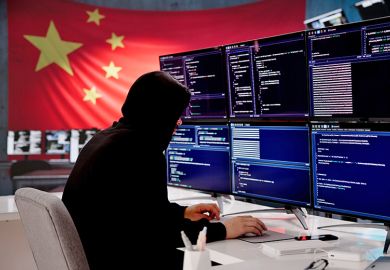
George Freeman, now Conservative MP for Mid Norfolk, raised such concerns after a nationwide alert by the national security agency MI5, issued on 30 September, warned that over 100 academics linked to UK institutions have unknowingly contributed to projects funded by a research institute “with very strong ties” to China’s intelligence service.
The alert said that the primary purpose of the China General Technology Research Institute (CGTRI) was “to fund research that improves the country’s technical capability for espionage”, and it wants universities to end all contact with it to prevent further benefit to the Chinese intelligence services.
In the hours following the alert, Sam Dunning, director of the charity UK-China Transparency Institute, took to his Substack to map a network of UK institutions that appear to be linked to the CGTRI.
Dunning wrote that the alert marked an “escalation” in the UK’s slowly increasing focus on research security, urging universities “to do better”.
The universities he identified include UCL, Queen Mary University of London, Birkbeck, University of London and the universities of Surrey, Warwick, Leicester, Hull, Southampton, Strathclyde, Lincoln, Sheffield, Cambridge, Manchester, Middlesex and Exeter.
Freeman told Times Higher Education that the warning is “unprecedented and very serious”, particularly given the national security services are dealing with “cyberattacks and new terror and infrastructure threats from Russia, Iran and other hostile actors”.
“I’m worried that the pace of the global race for science and technology sovereignty around the world has dramatically increased over the last few years and UK Research and Innovation, universities and Whitehall have been too slow to react,” said Freeman, who is also a member of the House of Commons’ Science and Innovation Committee.
However, Freeman sympathised with universities’ financial predicament: “The loan cap leaves them overly dependent on income from overseas students and overseas research, which has rather driven them into the arms of China, who are aggressively funding large-scale intellectual property and technology harvesting,” he said.
For Freeman, UKRI, government and universities need swiftly to “toughen up the [research security] framework to protect critical national security assets”.
The MI5 alert said that UK academics have been working on CGTRI-funded projects across a range of topics including AI, cybersecurity, covert communications systems and steganography (hidden messaging).
Dunning described the message to THE as a “kind of warning” to universities, saying “get your ducks in a row or there could be prosecutions”. The alert reminded academic institutions, staff and researchers of the potential criminal consequences of assisting a foreign intelligence service, as set out in the National Security Act 2023.
It also said that “many academic institutions and individuals will to date have engaged with CGTRI in good faith given the CGTRI’s obfuscated links to the Ministry of State Security”.
Dunning told THE: “They’ve been quite careful in saying that people might not have known. But anyone who speaks Chinese and is doing their due diligence on their research collaborators [should have known]. If it walks like a duck and quacks like a duck, it probably is a duck.”
Universities UK told THE there is lots of research security guidance already in place, which is actor-agnostic. But a spokesperson added that it is very unusual to get such a high level of specificity in public from intelligence services, and that this is a clear message that a specific entity must be avoided. The question remaining is how universities can assure themselves that a specific entity isn’t linked to other legitimate partners they work with, they said.
The episode comes as the sector awaits a promised research security strategy with dedicated funding.
Two-time author of major studies on research security Andrew James, professor of innovation management and policy at the University of Manchester, told THE that the strategy “is an opportunity to provide universities and academics with clearer, more practical direction on how to interpret research security risks and expectations in different collaboration contexts, not least regarding China”.
But he warned that “it would be premature to go down the route followed by Canada”, which lists high-risk organisational partners, because blacklists can “quickly become outdated”.
Meanwhile, James added that the planned Research Security Fund “is likely to provide resources to strengthen specialist capacity within universities”.
Meanwhile, Grace McConnell, chair of the Association of Research Managers and Administrators, is “increasingly concerned about the burden being placed on an already stretched university sector”, she told THE.
She explained that the MI5 alert comes “at a time when research manager and administrator roles are being reduced, combined and broadened in response to financial pressures.
“There is an urgent need for meaningful investment through the long-awaited Research Security Fund. If the UK is serious about protecting its research from foreign interference and other security threats, the sector must invest in dedicated research security and due diligence expertise and build sustainable professional capacity across the system,” she said.
Register to continue
Why register?
- Registration is free and only takes a moment
- Once registered, you can read 3 articles a month
- Sign up for our newsletter
Subscribe
Or subscribe for unlimited access to:
- Unlimited access to news, views, insights & reviews
- Digital editions
- Digital access to THE’s university and college rankings analysis
Already registered or a current subscriber?