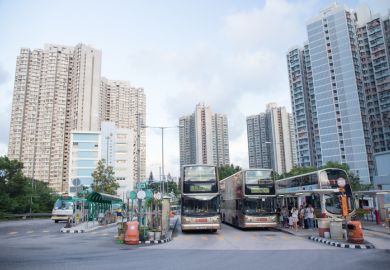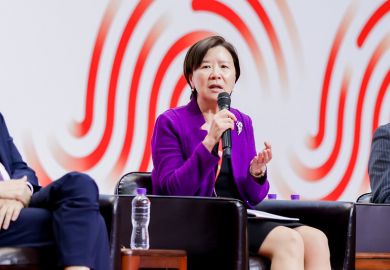
Hong Kong universities have welcomed freshly expedited plans to put higher education at the heart of the development of the crowded territory’s new Northern Metropolis, but say that government ambitions must be supported with funding to make the enterprise a true success.
Three university towns – San Tin, Hung Shui Kiu and Ta Kwu Ling – will span 1,000 hectares of the Northern Metropolis’ overall planning area, according to Hong Kong’s first Five-Year Plan (2026-30), unveiled last week by Hong Kong chief executive John Lee Ka-chiu.
Each town will focus on different fields. San Tin University Town will concentrate on the development of artificial intelligence, robotics, health sciences and medicine. Hung Shui Kiu University Town will provide a more application-oriented and vocational education model. And Ta Kwu Ling University Town will integrate arts, culture and ecotourism.
In his policy address, Lee said that the allocation of campuses in Hung Shui Kiu will begin this year, with institutions invited to submit proposals and expected to move in by 2027-28. Christine Choi Yuk-lin, the secretary for education, has said that “favourable consideration” will be given to institutions that do not require a government loan.
To date, 19 third-level institutions have expressed interest in establishing a presence in the Northern Metropolis.
The other main announcement in the five-year plan was a 30 per cent rise in the number of the PhD students funded by Hong Kong’s University Grants Committee, taking numbers from 7,200 up to 9,600 by the 2030-31 academic year.
The government will also increase the number of PhD fellowship awarded by 400 per year from the 2027-28 academic year and by 550 places in the 2029-30 academic year.
Ka Ho Mok, provost and vice-president (academic and research) of the Hang Seng University of Hong Kong, told Times Higher Education that the sector was “happy” to see the development blueprint become something more “concrete”.
However, Mok added, institutions were “concerned about funding support to make the university town successful”, specifically spotlighting the issue of housing and residential education.
“I think that this is a golden opportunity for Hong Kong,” he said. “But if we want to recruit more students globally…the issue is about accommodation. The sector would not only like to increase capacity for research but [also] for accommodation…My university is very keen to recruit high-quality students from all around the world. But the issue for us is: in what way we can create the space for supporting the learning and living together?”
In the wake of Lee’s address, all of Hong Kong’s universities have publicly reiterated their full support for the venture and outlined potential areas of research alignment – perhaps to boost their credentials ahead of a robust selection process.
But Gerard Postiglione, an emeritus professor at the University of Hong Kong, said the “lightning speed” development of the Northern Metropolis had potentially caught universities flat-footed.
“If you’re a university, you’ve heard a year ago about this place, and it’s just a piece of land. There’s not even a building on it; the infrastructure, the subways, the highways: [they are] not even there. Are you going to jump at it and say, ‘Hey, let’s put some money in? Let’s get it up there’?”
Hong Kong Baptist University, which has the smallest campus of Hong Kong’s eight publicly funded universities, is considering relocating its entire campus to the Northern Metropolis. The Hong Kong Academy for Performing Arts plans to build a second campus there. And the Hong Kong University of Science and Technology has received approval to open Hong Kong’s third medical school in San Tin University Town by 2028.
But, noting that the requirement for self-funding was “unusual” in Hong Kong, Postiglione suspected that other world-class Hong Kong universities in particular might be thinking much more critically about how the new development would prove “beneficial” to them.
Register to continue
Why register?
- Registration is free and only takes a moment
- Once registered, you can read 3 articles a month
- Sign up for our newsletter
Subscribe
Or subscribe for unlimited access to:
- Unlimited access to news, views, insights & reviews
- Digital editions
- Digital access to THE’s university and college rankings analysis
Already registered or a current subscriber?