England spent much of the 2010s trying to increase competition in higher education by making it easier for private providers to enter the market. Carl Lygo, founding vice-chancellor of BPP University, was among those who showed what that could look like.
Lygo helped to turn a professional training business into one of the country’s first for-profit universities. BPP was granted university status in 2013, three years after it became the first for-profit institution to secure degree-awarding powers. It has since grown to be one of the biggest private universities in the UK, with a student population of nearly 40,000.
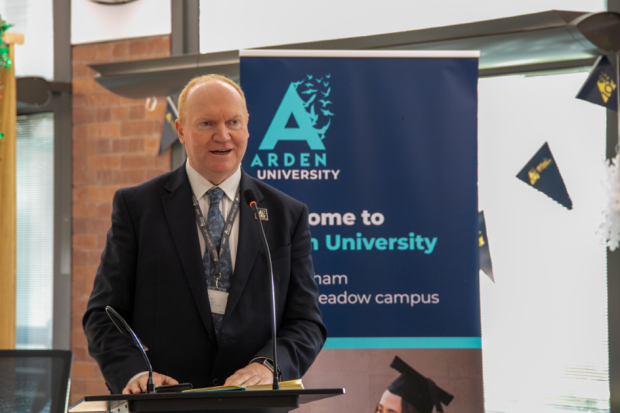
After two decades at BPP, Lygo went on to lead Arden University in 2019. But as he prepares to retire and step away from his position as a leading figure in UK private higher education, he is less enthusiastic about the prospects for anyone hoping to set up a for-profit university today.
“Would I do it now? If I was looking to set up a private provider, I think unless I’ve got a particular niche, I wouldn’t be trying to do it now,” he told Times Higher Education.
“I just don’t think it’s attractive. The regulation is tough. You need scale to be able to make it worth doing. You need students into the thousands, not hundreds. Otherwise, you’d need somebody with deep pockets to fund it.”
Establishing a private university in England can take up to seven years or more because new providers must meet strict requirements set out by the Office for Students before they can award their own recognised degrees and gain university status.
“I don’t think that the sector’s going to face massive numbers of private providers coming in. As we’ve seen, it’s a small number, usually specialist, quality providers,” Lygo said. “I had the benefit of ignorance when I did all of this.”
When Lygo joined BPP, the for-profit university sector barely existed in the UK. Having become frustrated with “overly academic” legal training, he wanted to turn BPP’s vocational law courses into degree programmes.
“I wanted to make BPP have a degree. I couldn’t get anyone to give us a degree, so I created my own university.” Lygo stressed that institutions looking to challenge established universities survive only if they offer something unique. “If you’re just aping what every other university does, there’s just no point. You’ve got to have something that’s really specialist.”
It’s an outlook that Lygo has brought to Arden. The university, which teaches more than 40,000 students across its six campuses in the UK and one in Berlin predominantly through online and hybrid learning, received indefinite degree-awarding powers in 2021.
But rapid expansion also attracted regulatory scrutiny. Arden received a “requires improvement” judgement for both student experience and student outcomes in the 2023 Teaching Excellence Framework. In 2024, the regulator found it at increased risk of a future breach of its student outcomes condition across five indicators and imposed an improvement notice.
Asked about the verdicts, Lygo said he felt that the university had been “unfairly judged” because the challenges faced by its students were not always fully reflected by the assessments.
“We serve a section of community that shouldn’t be judged by the standards of the 18- to 21-year-olds,” he said. “To apply the same mechanism to somebody who is…in their 40s, who is caring for five children and studying at the same time…I think was a bit tough.”
Lygo said Arden had responded with “significant investment in infrastructure”, staff development and new systems. “I’m not convinced that the Office for Students has achieved its objectives,” he said, “and that’s disappointing since I was on the board of the Office for Students when it first started.”
Private higher education has often been viewed with suspicion in the UK, with critics arguing that commercial incentives can undermine academic quality. “It’s an easy and lazy attack for critics to just say, ‘Oh, you’re bad because you’re for profit,’” Lygo said. “Is the profit motive in contradiction to quality? No, of course not.”
Register to continue
Why register?
- Registration is free and only takes a moment
- Once registered, you can read 3 articles a month
- Sign up for our newsletter
Subscribe
Or subscribe for unlimited access to:
- Unlimited access to news, views, insights & reviews
- Digital editions
- Digital access to THE’s university and college rankings analysis
Already registered or a current subscriber?