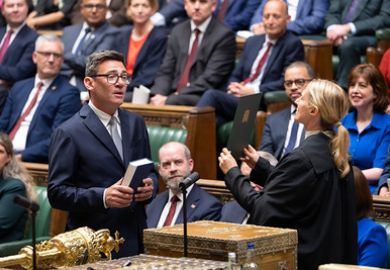
Responsibility for English higher education remains split across several government departments and ministers following the formation of Andy Burnham’s new administration, stoking fears that the sector may become a policy “blind spot”.
The new prime minister has shaken up Labour’s top team and the mechanics of Whitehall, appointing Lucy Powell as education secretary and disbanding the fledgling Department for Science, Innovation and Trade (DSIT). Science secretary Liz Kendall and science minister Patrick Vallance have both departed as part of the changes.
But there is some continuity for the higher education sector. Skills minister Jacqui Smith remains in post, with her portfolio split between the Department of Education (DfE) and the Department for Work and Pensions (DWP).
While many in the higher education sector have welcomed the decision to retain Smith, who is widely viewed as having a strong understanding of the challenges facing universities, there is some disappointment that the responsibility for higher education remains split across departments and ministers.
“Universities remain trapped in a policy blind spot,” said Diana Beech, director of the Finsbury Institute at City St George’s, University of London, as the sector is left without “a clear home”.
In the DfE, “universities will always struggle to compete for attention against schools and colleges,” she continued. “At a time when many institutions are facing acute financial pressures, the risk is that universities continue to lack the political focus their challenges demand and their economic contribution deserves.”
“If university leaders were hoping to climb up the priority list following the arrival of a new prime minister then the early signs will not be hugely comforting,” added education policy analyst Tom Richmond.
“The reappointment of not just Jacqui Smith but also Pat McFadden at DWP strongly suggests to me that tackling youth unemployment remains the number one objective for ministers in the post-16 space.”
He said he believed the decision not to appoint a specific universities minister “is very much in keeping with where this government is planning to focus its finite attention and resources”.
Meanwhile, as responsibility for research and science moved to the newly beefed up Department for Business, Innovation, Science and Trade, “we’ve still got this massive, uncomfortable boundary between the two main things universities do: teaching and learning on the one hand and research on the other,” said Nick Hillman, director of the Higher Education Policy Institute.
But others believe these splits may be positive for the sector, particularly as universities focus on proving their value to local regions and the national economy.
“The impact of our sector touches every government department as it touches every community and industry,” said Ken Sloan, vice-chancellor of Harper Adams University. He said providing cohesion between education, training and job providers was a positive development for the record number of out-of-work young people.
Smith’s position across two departments suggests the government is set to continue on the path forged by Keir Starmer’s administration, whereby policymakers attempted to create a more joined-up skills system, with further education and higher education working more closely together.
In the run-up to his appointment, Burnham has repeatedly emphasised the need to create parity between technical and academic education and to end the “dominance” of the university system.
“Smith’s reappointment signals more of the same on skills policy, with the government remaining wedded to a tertiary model that has yet to convince many across the higher education sector,” said Beech. “But a new secretary of state could yet force a rethink and a reassessment of what is working and what is not.”
Jess Lister, director of education at Public First, agreed that Smith represented a “continuity minister” rather than a “reforming minister”.
“They’ve not put someone new in to come and shake this up,” she said.
The appointment of Lucy Powell as education secretary has also been welcomed by universities. Known to be close to Burnham, many hope she will be influential over the new prime minister, although little is known about her views on higher education or how interested she will be in universities in comparison with schools.
Powell has previously spoken out about Plan 2 loans – an unresolved issue Burnham’s government may choose to tackle – calling them “unfair” and “egregious”.
As MP for Central Manchester since 2012, Powell has also worked with the city’s universities. As an undergraduate, she attended the University of Oxford for a year before transferring to King’s College London, having felt “like a fish out of water” at Oxford.
Lister said Powell had inherited a number of challenges in the schools sector, including an overhaul of education for children with special needs and ongoing reforms to the curriculum and assessment system, which are likely to be her priority.
Between this and the government’s focus on tackling youth unemployment at lower skill levels, “I think HE will continue to feel a bit unloved,” Lister said.
It remains unclear how science and research will be handled, with the responsible minister yet to be confirmed. Some have lamented the loss of science minister Vallance, but there are hopes that the changes may mean university-led research receives greater recognition under the new government.
“DSIT was too small a department to be taken really seriously, whereas the business department is a much bigger department and with a longer history, so I don’t think moving DSIT…is catastrophic [by] any means at all,” said Hillman.
“Patrick Vallance [was] more of an academic than a politician, but politics is a craft and I was never completely certain if he was advocating for the whole sector.”
Register to continue
Why register?
- Registration is free and only takes a moment
- Once registered, you can read 3 articles a month
- Sign up for our newsletter
Subscribe
Or subscribe for unlimited access to:
- Unlimited access to news, views, insights & reviews
- Digital editions
- Digital access to THE’s university and college rankings analysis
Already registered or a current subscriber?