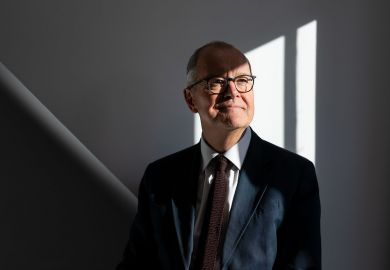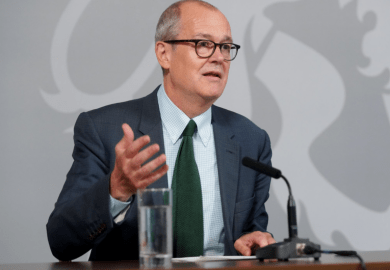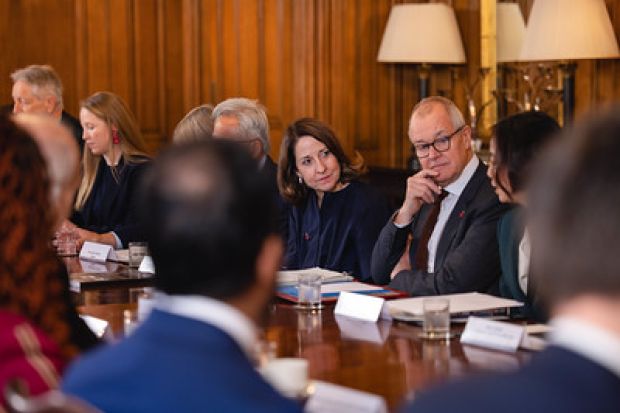
Patrick Vallance has resigned as science minister and Liz Kendall is leaving her role as secretary of state amid rumours that their department will be disbanded by the new UK prime minister Andy Burnham.
In a statement released on 20 July, Vallance said: “After nearly a decade in government, I am stepping down as a minister for personal reasons...I wish Andy Burnham and the new team in No 10 well and I will continue to advise and help them in a non-ministerial capacity.”
A former UCL medical school dean and head of research at GSK, Vallance was the government’s chief scientific adviser during the Covid pandemic before joining Keir Starmer’s Labour government in July 2024 as science minister as he joined the House of Lords as a peer.
His role was later enlarged in January 2025, taking on the responsibility for driving the Oxford to Cambridge economic growth corridor, a major initiative that was set to attract billions of pounds of government investment. In September 2025, Vallance also added nuclear energy to his ministerial portfolio.
His achievements in office include securing a record £86 billion budget for public research and development between 2026 and 2030, including £38.6 billion for UK Research and Innovation (UKRI) in the October 2025 Spending Review. He was also heavily involved in the government’s post-16 skills White Paper, which stressed the need for more collaboration between universities on research.
The news came as reports emerged that the Department for Science, Innovation and Technology (DSIT) is likely to be abolished as part of a governmental reorganisation. The stand-alone department, created in 2023, looks set to be subsumed into the Department for Business and Trade (DBT).
Science secretary Liz Kendall, who has led DSIT since September 2025, has also confirmed she has left the department.
In a statement posted on X, Kendall said: “I wish whoever takes on the science and technology portfolio the very best for the future. She or he is fortunate to be overseeing, what is to my mind, the most exciting and transformative brief in government.”
On her achievements in post, Kendall said: “As DSIT secretary I have been proud to stand up to Elon Musk and Grok, ban nudification apps and help make the online world safe for women and girls.”
“Throughout my career I have championed women’s equality which is why I established the Women in Tech taskforce and launched the Women in Research Charter: to give women a fair shot and make science and tech work for all,” she added.
In other changes, Peter Kyle, who served as secretary of state in DSIT before moving to DBT in the last reshuffle, is leaving the Cabinet altogether after being sacked from his current role by Burnham. Chancellor Rachel Reeves has also confirmed she will not be continuing in her role.
But it is the departure of Vallance that will likely have the biggest impact. While technically more junior to Cabinet ministers Kyle and Kendall at the Department for Science, Innovation and Technology (DSIT), he is widely regarded as the driving force behind UK science policy over the past two years. His “three buckets” model for research, in which funding flowed to “basic, curiosity-driven, investigator-led research”, “applied research” and “R&D-intensive companies”, is the inspiration for a major shake-up of UKRI being spearheaded by chief executive Ian Chapman, who took up the role last summer.
In a post on X, Vivienne Stern, chief executive of Universities UK, described Vallance as an “outstanding minister”. “We owe him a great deal for his service in the last two years, and before that as CSA [chief scientific adviser]. He has left us an important legacy which it is now up to us to make the most of.”
John Hardy, professor of neuroscience and group leader at the UK Dementia Research Institute at UCL, said: “It was reassuring to have someone with the ear of the PM who understood science and medicine. So often, as a community, it feels as if we are talking through interlocutors who do not understand the issues.”
Richard Torbett, chief executive of the Association of the British Pharmaceutical Industry, said Vallance had been a “tremendous science minister and a genuine champion for the UK’s life sciences sector”.
“He has been instrumental in beginning to turn around international sentiment towards the UK as a life sciences destination. On behalf of the industry, I want to thank him for his leadership and his willingness to engage directly and constructively with me and with our sector throughout his time in office. He leaves big shoes to fill,” he said.
Register to continue
Why register?
- Registration is free and only takes a moment
- Once registered, you can read 3 articles a month
- Sign up for our newsletter
Subscribe
Or subscribe for unlimited access to:
- Unlimited access to news, views, insights & reviews
- Digital editions
- Digital access to THE’s university and college rankings analysis
Already registered or a current subscriber?