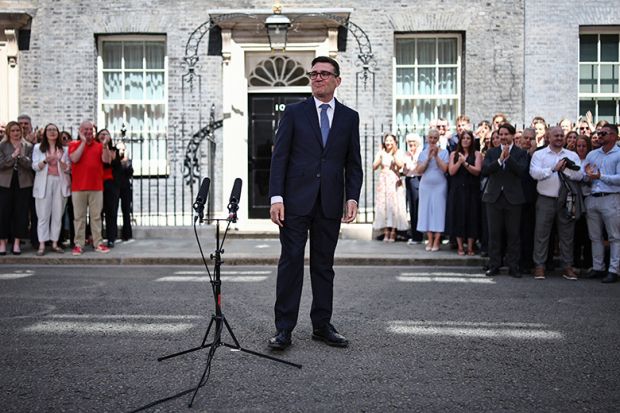
University leaders have expressed disappointment over reports that the Department for Science, Innovation and Technology (DSIT) is likely to be abolished as part of a governmental reorganisation as Andy Burnham becomes prime minister.
Media reports over the weekend suggest the department, which was officially established by Rishi Sunak in February 2023, will be subsumed into the Department for Business and Trade (DBT), which looks set to be led by chief whip Jonathan Reynolds.
At present, responsibility for universities is split between the Department for Education (DfE) and the DSIT, with the latter’s £13.9 billion budget in 2025-26 including some £8.8 billion for UK Research and Innovation (UKRI) and a further £2.7 billion for the UK’s contribution to European Union programmes.
The stand-alone science department was initially set up to drive the UK’s “science superpower” ambition, but its secretaries of state under Labour – Peter Kyle and then Liz Kendall – have increasingly focused on artificial intelligence and preventing social media harm, with science minister Patrick Vallance seen as driving science policy.
In a comment on LinkedIn, the University of Birmingham’s vice-chancellor Adam Tickell said he hoped the “rumours of DSIT’s demise are unfounded”, arguing that a return to DBT would mean “universities and the research system will be a small cog in a large DBT wheel”.
“Whilst not everyone has welcomed it, the emphasis from UK Research and Innovation and the Department for Science, Innovation and Technology on ensuring that we can demonstrate this, and for greater funding to support growth through start-ups, spin-outs, and tech transfer to companies large and small, is already bearing fruit,” said Tickell, referring to the record four-year £38 billion science spending settlement secured in the past Spending Review.
Vivienne Stern, chief executive of Universities UK, said she “hope[d] DSIT doesn’t disappear”.
“In DBT there would be immense pressure to move more of the budget towards today’s priorities,” said Stern, adding: “The fact of having a department focused on the interaction between research and innovation in the long as well as short term has been a good thing.”
“From the point of view of universities, I know that many will worry that they will become an afterthought, when they provide much of the underpinning infrastructure on which our outstanding research and innovation performance is based,” she added.
Matt Clifford, an adviser on AI to the outgoing prime minister Keir Starmer and his predecessor, Rishi Sunak, posted on X that “this would be a big mistake”.
“Right now is a critical moment for tech as an economic and national security issue. Tying up our most senior science and tech officials in a [reorganisation] wastes time and energy that’s desperately needed for the actual substance.”
That sentiment was echoed by other figures in the tech sector. In a joint letter posted on X, Julian David, chief executive of TechUK, and Dom Hallas, executive director of Startup Coalition, called DSIT’s mooted abolition “wrong change at the wrong time”.
“Breaking up the work of DSIT endeavours such as the world-leading AI Safety Institute, the Sovereign AI fund, GDS [Government Digital Service] and UKRI would slow momentum at a time when pace is essential for both the growth of the economy and our standing on the global stage.”
“It also sends a terrible signal to a sector that is growing at 10 per cent a year.”
Ian Hogarth, chair of AI Security Institute, which is funded by DSIT, agreed.
“Reorgs like this basically distract departments for a year. If you’re serious about growth as your top priority it’s not something you do,” he said on X.
“Doing it to DSIT is an odd idea given it’s one of the departments visibly delivering including creating ARIA, AISI, the AI Hardware Plan, SovAI etc. Unclear what the source who says DSIT is not ‘firing on all cylinders’ is comparing it to?”
Register to continue
Why register?
- Registration is free and only takes a moment
- Once registered, you can read 3 articles a month
- Sign up for our newsletter
Subscribe
Or subscribe for unlimited access to:
- Unlimited access to news, views, insights & reviews
- Digital editions
- Digital access to THE’s university and college rankings analysis
Already registered or a current subscriber?