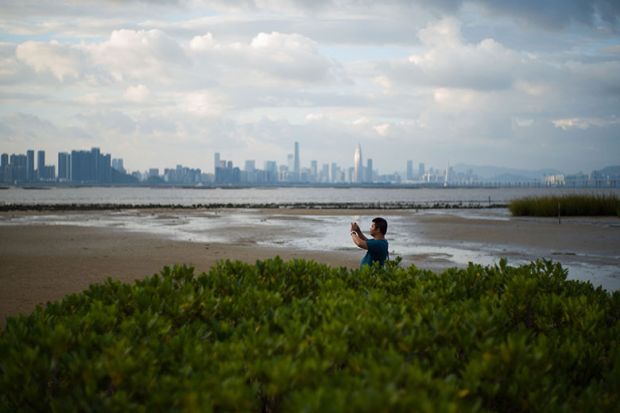
The Chinese University of Hong Kong, Shenzhen (CUHK-SZ) is not yet into its teens. But it already shows signs of outgrowing its 63-year-old parent.
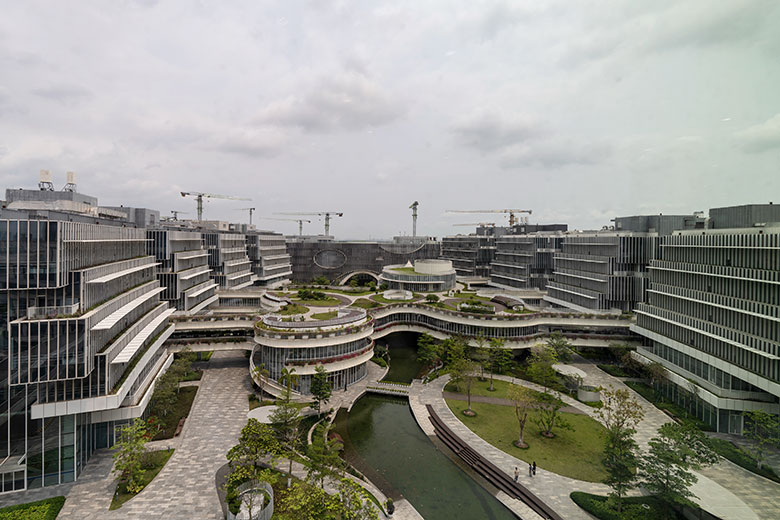
The campus in Shenzhen’s north-eastern Longgang district is every bit as extensive as CUHK’s original campus, 90-odd minutes south in Hong Kong. And it is every bit as green, if a little less steep. Nestled around a forested hill park are clusters of gleaming teaching and research centres, including three labs run by Nobel laureates.
The music school reportedly has 200 grand pianos. The architecturally crafted walls of the towering library are lined with books, or – at higher altitudes – convincing illustrations of books. The gardens are manicured and the grounds generous, guided by ancient principles of feng shui. Four tall residential buildings in the campus’ elevated north, each topped by a giant single letter from the parent university’s abbreviated title, proclaim the campus’ trans-border identity to the surrounding area.
A large bell tower was erected partly to obscure the view of a nearby Stalinist building. A 300-year-old pavilion, a philanthropist’s gift relocated from Anhui Province, lends majesty to Fairy Lake, a natural feature dominating the campus’ west. On the opposite shore, eight giant cranes are constructing CUHK-SZ’s School of Medicine.
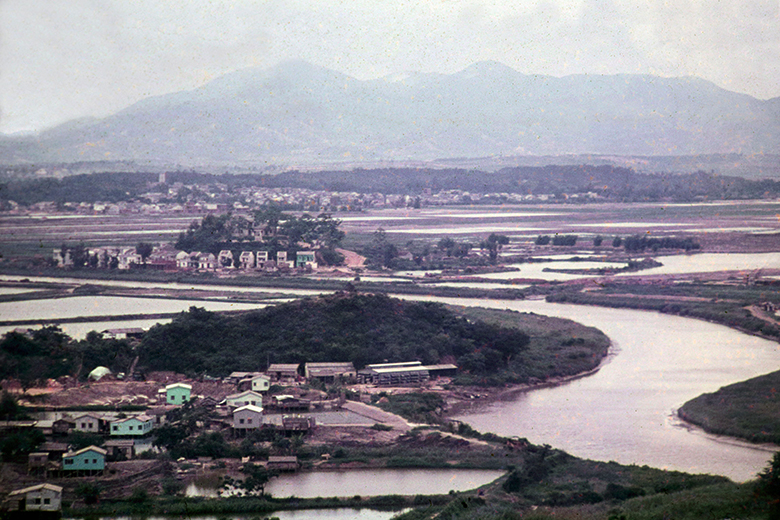
When the new facilities open in three years or so, administrators expect the campus’ enrolments to reach about 25,000 – more than its mother university in Hong Kong. That rapid expansion from its 2014 launch with perhaps 150 students in two refurbished industrial buildings is an eloquent illustration of what is known as “Shenzhen speed”. China’s tech capital of more than 18 million souls was a sprinkling of fishing and farming villages less than half a century ago.
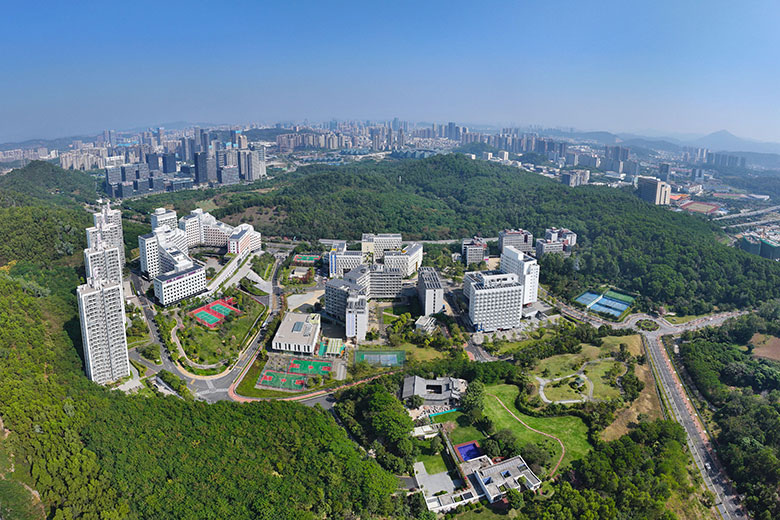
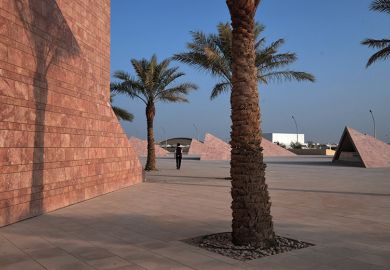
The CUHK campus in Longgang District, Shenzhen
It is no accident that a city like this sprang up on Hong Kong’s doorstep. When the authorities in Beijing designated Shenzhen China’s first special economic zone in 1980, they were keen to extract investment and knowledge from the thriving territory – then in British hands – on the other side of the Shenzhen River.
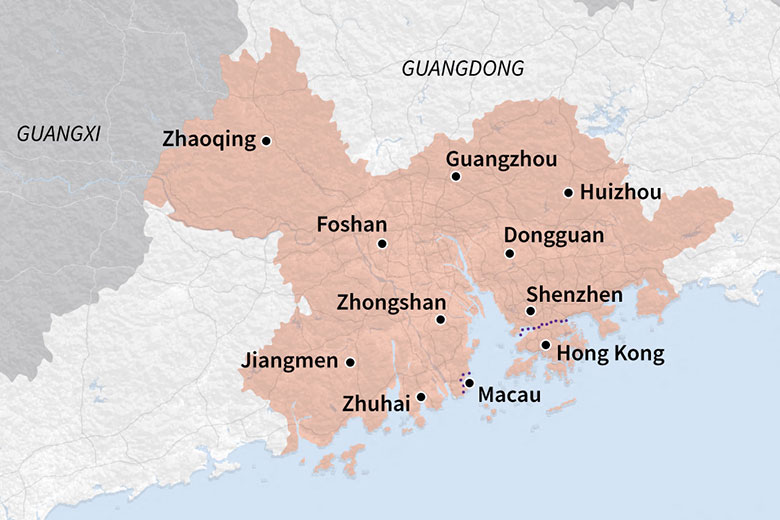
With higher education among Hong Kong’s recognised strengths, Shenzhen itself became a higher education hub. Universities and technology parks abound in the city, with the Southern University of Science and Technology (SUSTech) another eminent example of Shenzhen speed. Having only been founded in 2011, it has already reached joint 160th in Times Higher Education’s latest World University Rankings. But unlike the urban agglomerations around Beijing and Shanghai, Guangdong Province’s Greater Bay Area (GBA), to which Shenzhen belongs, barely has any universities ranked within major global league tables’ top 100, despite cramming a population bigger than Germany’s into a space smaller than Svalbard. And that is where Hong Kong – the city with more top-100 universities (five) than any other – comes in, having recently established several major branch campuses in the megalopolis of 11 cities clustered around the Pearl River Delta.
Since the Ministry of Education treats Hong Kong as a foreign territory, its universities need local partners to establish branch campuses. Hong Kong Baptist University (ranked in the 201-250 bracket in THE’s latest rankings) started the trend in 2005, launching a joint campus with Beijing Normal University in Zhuhai, near Macao. The Shenzhen outpost of CUHK (joint 41st) followed in 2014, in collaboration with Shenzhen University. Then Guangzhou University partnered with the Hong Kong University of Science and Technology (joint 58th) to open a campus (HKUST-GZ) in the city in late 2022. And, across the river, Dongguan University of Technology and City University of Hong Kong (73rd) received permission to establish a joint venture in 2024.
Municipal governments in the GBA are pouring capital into each campus as the region seeks educational cachet to match its economic firepower. Laurie Pearcey, adviser to the president at CUHK-SZ, said gross tertiary enrolment ratios were lower in Guangdong – China’s manufacturing powerhouse and largest provincial economy – than in other major centres.
Moreover, Guangdong lacks the concentration of top-ranked universities that can be found in Beijing, Shanghai, Jiangsu or Zhejiang. The key was to leverage the “uniquely internationally connected” special administrative regions on its doorstep, Pearcey added, with the province now home to the largest number of joint-venture campuses in the country.
Jimmy Fung, associate provost of teaching and learning at HKUST, said Chinese authorities were keen to “bring in the governance structure” of the autonomous region’s universities. “The Hong Kong system seems to work,” he said. “How come we have five universities in the top 100? It’s not by accident.”
Futao Huang, an international education expert at Hiroshima University, said the branch campuses furnished their host cities with “additional high-quality educational opportunities” combining “Chinese policy priorities” with elements of Hong Kong’s academic traditions – “globally oriented curricula” delivered in English by staff from around the world.
These developments “also help China reduce reliance on outward student mobility while enhancing domestic and regional attractiveness,” Huang said. As such, they “should not simply be understood as institutional expansion but rather as part of a broader restructuring of regional higher education ecosystems in East Asia. The Greater Bay Area is gradually becoming a new transnational higher education hub where…models of governance, talent cultivation, research collaboration and internationalisation are being reconfigured.”
The change is partly driven by demographics, as China’s population of 18- to 23-year-olds declines. Australian higher education expert Hamish Coates said that internationalisation, long an economic survival strategy in Western university systems, was increasingly becoming a demographic survival strategy in East Asia.
“They’re…searching for market, the same way we are,” said Coates, a professor of public policy affiliated with Tsinghua University and the Australian National University.
Indeed, Chinese authorities are now actively discouraging locals from heading overseas for higher education. Two publications reinforcing that message were reportedly released in April by the Chinese Service Center for Scholarly Exchange: an evaluation of the overseas study environment and an analysis of employment trends for returned overseas students. Media reports also refer to a book, Is Studying Abroad Still ‘Useful’?, by a Beijing international education specialist.
“There is a concerted effort under way to rein in the exodus of students abroad: hence the push on transnational education,” said Angela Lehmann, an Australian expert on Chinese higher education. “I think this is coming both from a response [from students and their families] to a trend – the return on investment is genuinely not as strong in the labour market any more – and a top-down effort to build internationalisation onshore in China.”
Coates said students in neighbouring countries have plenty of reasons to head to China, as well as to nearby international education hubs such as Singapore, Kuala Lumpur and Jakarta, rather than the West: “Security issues, conflict, disease, cost of travel and borders make it much safer to stick closer to home.” In addition, “the quality of [domestic] provision has come up in terms of scope and scale. It makes a lot of sense to think, ‘Can I get the same thing locally as I would have 10 years [ago when I] had to fly halfway around the world?’”
Huang agreed that “West-centred” internationalisation was giving way to a “more regionally diversified and strategically managed” model. While “elite students seeking symbolic capital, research prestige and global career opportunities” would still head to the US or UK, the scale and composition of mobility were “clearly changing”.
Tong Wang, a higher education practitioner who has written on cross-border higher education in the GBA, also sees branch campuses’ expansion as part of a broader diversification of international higher education. “Chinese students and families are becoming more selective and pragmatic in weighing educational quality, cost, location, career prospects, safety and long-term value,” he said. “This does not necessarily mean the end of outbound mobility but it does point to a more multidirectional and regionally embedded pattern of student choice.”
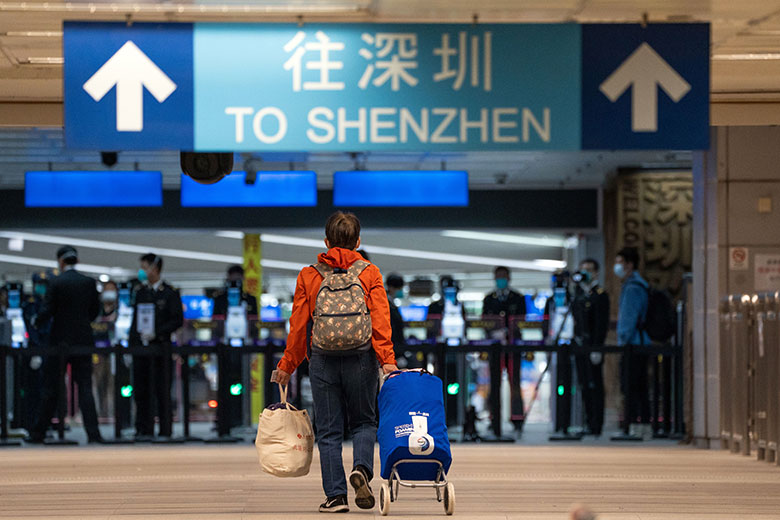
The mostly mainland Chinese students at CUHK-SZ pay annual fees of about $20,000 (£14,900), at least an order of magnitude more than they would spend at a nearby public university. But the same qualifications would cost a third more if earned in Hong Kong itself, and the living costs there would be inordinately higher.
Costs on the Shenzhen campus resemble those at China’s heavily subsidised public universities. Accommodation in pleasant four-bed dorms costs about £265 a year, with free access to a gym, pool and many recreation facilities. Meals on campus cost about £1.
The students also enjoy perks unavailable to their public university counterparts, including public celebrations of Christmas and Thanksgiving. They are not required to undertake military service, and they enjoy two years’ post-study work rights in Hong Kong.
Moreover, they have on their CVs what Pearcey described as “the most successful cross-border joint venture in the country”, as evidenced by CUHK-SZ’s table-topping position in the Shanghai Ranking of Chinese Cooperation Universities. He said the university had achieved Guangdong’s highest cut-off scores in the gaokao university admissions examination for seven consecutive years, “which is no easy feat for an institution that’s just 12 years young”.
High academic standards are also adhered to once students are admitted. The university’s grade point averages are moderated by the Hong Kong campus, Pearcey said, and the recruitment and promotion criteria of the two campuses align. Every new academic programme in Shenzhen is approved by CUHK’s senate, and the governing board is chaired by CUHK’s vice-chancellor.
“The academic standards of this campus are…identical with what you would see in Hong Kong,” Pearcey said. “Everything that we do needs to meet the rigorous standards that a place like CUHK is known for.”
The HKUST-GZ campus
HKUST-GZ’s governance model is different from the Chinese public university approach, where the president answers to the secretary of the university’s Communist Party committee. Branch campuses also have a degree of autonomy from the Ministry of Education, which controls many aspects of public universities’ operations.
And while other universities are subject to the ministry’s strict quotas on postgraduate enrolments, HKUST-GZ “can recruit as many PhD students as possible, as long as they have funding”, according to HKUST’s Fung. Likewise, the institution is not bound by rules giving the ministry control of degree names.
Pearcey says CUHK-SZ’s establishing documents depict it as “an experiment for reform” in China’s higher education system, and it “has always been about thinking differently in terms of the way its programmes are structured”. He cites the college system adopted from CUHK, where all students are assigned to residential colleges regardless of discipline or nationality.
“In Chinese universities…you have the internationals and the domestics quarantined from each other, [and] you’ve got chemistry students living with other chemistry students,” Pearcey said. But in one CUHK-SZ four-bed dorm, “you might have a chemistry student, a computer science major, an AI major and a music student of two or three different nationalities, including Chinese. That’s a really unique approach to…the student experience.”
The benefits of branch campuses on the mainland are not all one-way. For one thing, Hong Kong universities enjoy reputational benefits within China from their presence across the border. Pearcey oversaw corporate communications in a previous role at the parent university. And “for every time CUHK appeared in the mainland media, CUHK Shenzhen would appear 10 times,” he said.
They also benefit from the extra space – which has mostly run out in Hong Kong. Labs at HKUST-GZ mirror those in Hong Kong, allowing Hong Kong staff and research students to do their experimental work in Guangzhou if they cannot access the facilities in Hong Kong, Fung said. “They can spend one semester [or] one year up in Guangzhou.”
The Shenzhen campus also offers exchange opportunities for Hong Kong-based undergraduates. Fung said that although most would prefer to go to Europe, North America, Australia, Japan or Korea, Guangzhou offered worthwhile “GBA experience”; while Hongkongers often pop over the border for meals or weekend visits, “It’s very different to go [and] live there for six months.”
Its Shenzhen campus also gives HKUST access to “talented young researchers” and funding on a scale that is not available locally. Hong Kong academics are ordinarily ineligible for mainland Chinese research grants but can apply for them through affiliated appointments to institutions such as HKUST-GZ, Fung explained.
The mainland campuses cannot transfer funds across the border but Pearcey said Hong Kong universities had never thought about mainland branch campuses in financial terms or even as “pipelines” for more enrolments since, “over recent years, they have had no issue filling their quotas of taught postgraduate students coming out of the Chinese mainland”.
Rather the establishment of CUHK-SZ simply reflected a recognition that if CUHK “was going to contribute in a larger way to national talent development then it needed to do something on this side of the Shenzhen River”.
Establishing branch campuses potentially gives rise to “tensions” around issues such as governance, decision-making structures, curriculum design, language policies, faculty recruitment, mobility, academic freedom and “expectations regarding institutional missions”, according to Hiroshima’s Huang.
However, “most institutions appear to manage [the tensions] pragmatically, through negotiation, hybrid governance arrangements and selective adaptation”, he said.
And although “the long-term sustainability of these arrangements may depend on broader political and geopolitical developments, as well as how much institutional autonomy can continue to be maintained in practice”, the erosion of Hong Kong’s status as a separate social system from mainland China, for better or for worse, appears likely to lessen tensions as expectation on both sides of the border converge.
On academic freedom, for instance, a recent journal article by Bruce Macfarlane, dean of the Faculty of Education and Human Development at the Education University of Hong Kong, cites the introduction of “national security education” into Hong Kong university curricula, and a compulsory test about Hong Kong’s Basic Law and National Security Law for people wishing to qualify as teachers, as contributing to “a rising level of self-censorship in respect to what academics research and publish”.
For instance, “political science as an academic discipline has become an ‘endangered species’…with departments replaced by ones with a suitably tamer and more applied focus, removing any potential intellectual or theoretical challenge to politicians. University libraries have retired or restricted access to any book that might potentially give offence to Beijing.”
And Coates said that even before the National Security Law criminalised subversion in the wake of mass, student-led pro-democracy demonstrations during the 2010s, people “in Hong Kong, Shenzhen or Guangzhou” did not necessarily construe academic freedom “in the same way that people in London or Boston would. There [are] different cultural takes on what we do as communities, and they are again different in Jakarta and Surabaya.”
Pearcey agreed that tensions with China play out differently in Hong Kong, notwithstanding its Western academic traditions. “You can drive from CUHK in Hong Kong to CUHK Shenzhen in under an hour. Geographic proximity…and the fact that both exist within the broader sovereign borders of the People’s Republic of China makes that, by its very nature, quite different.”
Indeed, the fact that the geographic proximity between the Hong Kong universities and their mainland outposts “allows for more regular communication, staff and student mobility, academic exchange, quality assurance visits and governance coordination” means that the latter should be seen not so much as overseas branch campuses but as part of a “regionally embedded form of cross-border higher education”, according to Wang.
And although Hong Kong universities might still run risks when they establish branch campuses in mainland China, those risks are different from those faced by US or UK universities, she said. Rather than academic freedom, “the more important issues may be quality assurance, governance alignment, degree integrity, faculty recruitment, regional coordination, student outcomes and long-term institutional sustainability”.
But even sustainability might not be as fraught an issue as it can be for Western universities. For instance, Fung said financial issues posed little risk to HKUST’s Guangzhou venture because the two campuses are financially independent from each other. Hence, he said, the parent institution would only “pull out” if the Guangzhou campus stopped observing academic quality assurance arrangements – which he considered very unlikely.
“They have certain autonomy, but at the same time we need to oversee certain matters,” Fung said. “It’s a very delicate balance of working closely together.”
Register to continue
Why register?
- Registration is free and only takes a moment
- Once registered, you can read 3 articles a month
- Sign up for our newsletter
Subscribe
Or subscribe for unlimited access to:
- Unlimited access to news, views, insights & reviews
- Digital editions
- Digital access to THE’s university and college rankings analysis
Already registered or a current subscriber?