Now in his late eighties, A. G. Hopkins, emeritus Smuts professor of Commonwealth history at the University of Cambridge, has decided to end his writing career with a book uncompromisingly titled The Land Where Nothing Works: How Britain Lost the Plot (Princeton).
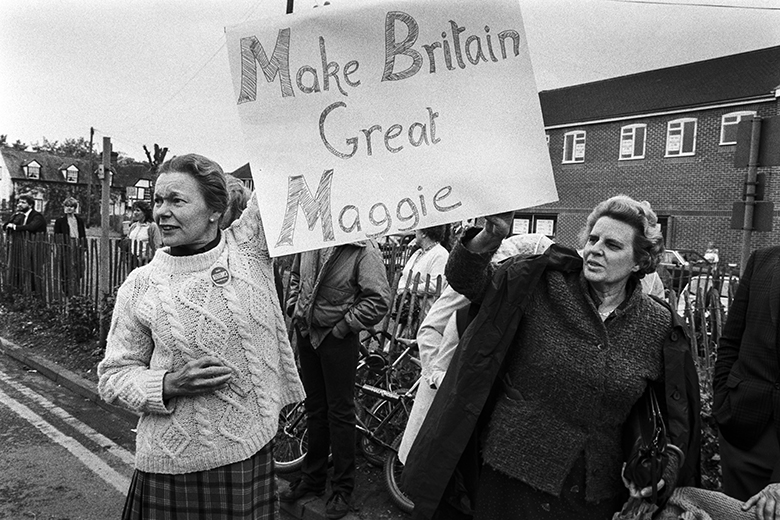
This sorry tale of potholed roads, overcrowded prisons and sewage pumped into the sea ranges widely across decades. Yet it makes very clear the main culprit for the “malaise that now infects every aspect of British life”: the political upheaval, loosely known as “Thatcherism”, which represented “a new form of moral economy based on individualism” and so “validated policies of deregulation and privatisation”.
Hopkins freely admits that his analysis involves “selecting relevant evidence” and “minimising features of the story that a comprehensive survey would rightly include”. Yet he nevertheless puts sufficient store in it to make a call, albeit rather vague, for “a transformative programme as radical as those initiated in 1945 [by the incoming Labour government] and 1979 [when Thatcher became prime minister], but adapted to present circumstances” – a call he hopes others can develop into something more concrete.
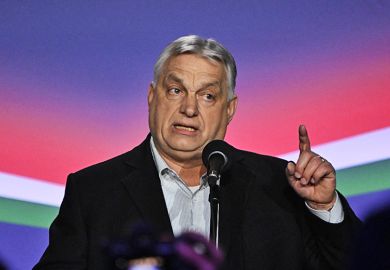
The idea that everything is broken, however, is fertile ground for the kind of “transformative programme” of which Hopkins would no doubt disapprove: right-wing populism. And one aspect of populism is a tendency to oversimplify the causes of problems – often identifying specific villains, such as immigrants or the “deep state”. So what happens when historians and other social scientists offer to explain “Trumpism”, right-wing populism and the possible threats to democracy they raise, while trying to avoid the dangers of overstressing one particular angle? Such accounts have particular urgency at a moment when Trump’s supposed model, Hungary’s Viktor Orbán, has just been swept from power after 16 years on the back of the highest turnout in any Hungarian general election.
Historians have a range of views about whether they, like pundits and politicians, should offer “lessons” or “warnings” from the past. Margaret MacMillan, former warden of St Antony’s College in Oxford, is the author of The Uses and Abuses of History as well as celebrated studies of the First World War and the peace treaty that followed. She sees it as precisely the job of academic historians to avoid easy oversimplification. They are or should be, she once told Times Higher Education, “pains in the neck. ‘That wasn’t really true’, ‘It wasn’t quite like that’ – we can be intensely irritating. And when people ask what was true, we say we don’t know!”
A very different line is taken by Timothy Snyder, professor of modern European history at the University of Toronto’s Munk School of Global Affairs and Public Policy and probably the most prominent American academic to leave the US since Trump was re-elected (although he denies that it was as a direct result).
Although he has produced major works of pure history such as Bloodlands: Europe between Hitler and Stalin, he clearly believes that historians can and should intervene in current affairs, at least when occasion demands it. Even back in 2017, he wrote in On Tyranny: Twenty Lessons from the Twentieth Century (Bodley Head) that when Trump “surmounted barrier after barrier and accumulated victory after victory”, pundits “assured us that at the next stage he would be stopped by one fine American institution or another”. But there was “one group of observers who took a different position: east Europeans and those who study eastern Europe. To them, much about the president’s campaign was familiar, and the final outcome was no surprise.”
A selection of recent and soon-to-be-published books take different positions on whether and how history or historical parallels can explain populism’s resurgence.
Take Katja Hoyer’s new book Weimar: Life on the Edge of Catastrophe (shortly to be published by Allen Lane). A cover quote from former British Museum director Neil MacGregor describes it as “the autopsy of a liberal democracy...a book about a hundred years ago – without question a book for now”. This, and perhaps the subtitle, might suggest that it offers direct insight into where we are today. But what is the author’s attitude to drawing such parallels?
Writing such a book is “a difficult balancing act”, said Hoyer, who is a visiting research fellow at King’s College London. On the one hand, she is “acutely aware of my audience. I know what times they live in and what is likely to remind them of people or patterns they observe in the here and now. Ultimately, I’m not just a historian; I’m also a person who lives in the present and is shaped by current-day events. In that way, neither I nor my audience will leave the present behind when we delve into the past.”
Nonetheless, while “the German interwar period is often referenced for ‘lessons from the past’,” Hoyer’s main aim is to “make readers a different offer: let me take you into that world, to one specific place and the people that lived there, and you, the reader, can observe things for yourself and draw your own conclusions for the present”.
Several other authors, however, are far less cautious about telling us what has gone wrong – and, in some cases, what we need to do now. Perhaps the most trenchant analysis is provided by Mordechai Kurz’s Private Power and Democracy’s Decline: How to Make Capitalism Support Democracy (coming shortly from MIT Press).
At the start of the book, the Joan Kenney professor of economics emeritus at Stanford University told Times Higher Education, “I frame the question as being the relationship between free-market capitalism and democracy. I’m looking for a unified approach to the problem.”
The current states of our economy and democracy, he believes, result from “the combined influence of three forces”: namely, “neoliberal policies”, “digital technology” and “a culture of meritocracy”. The last of these has “meant that millions whose livelihoods [have been] lost were ignored, creating a large group of angry people who see themselves as innocent victims of economic progress that made some very wealthy at their expense”.
While Kurz does not doubt that “someone has written about each component of my argument”, he also believes that “the combination of these forces into a unified theory is entirely original”.
The book itself is written in a similarly forceful style, declaring that he “did not find the explanations provided [in earlier books on ‘the decline of democracy’] compelling” and that “If the forces of technology and the free-market policy cause the decline of democracy, the classical idea that democracy and capitalism are mutually reinforcing – two sides of the same coin – cannot be true.”
The practical implications are also unequivocal, although not developed in detail. If we hope for “democracy to regain its legitimacy, the [US] must establish long-term policies that reduce today’s private economic and political power and share more equitably the gains from economic progress”.
Lorenza Antonucci, associate professor in sociology at the University of Cambridge, also believes her latest book has broken new explanatory ground, this time by setting out the links between insecurity and politics. Although earlier writers had often speculated about the link, she has produced “the first and most comprehensive study” of their relationship, “with a focus on populism, but not only [that]”.
Insecurity Politics: How Unstable Lives Lead to Populist Support (Princeton) uses in-depth research conducted over 10 years and across nine countries to develop its central claims that “socioeconomic insecurity has steadily increased in Europe” and that “this increase has created the basis for support for populism”.
Most earlier scholars have focused on “indicators which measure quantifiable aspects of people’s lives, such as income and wealth” or put the stress on “job tenure insecurity”, writes Antonucci. This ignored the fact that insecurity can arise as much from factors such as “higher workloads, increasing work pressure, and declining autonomy” as from the direct fear of unemployment. Her research team therefore developed ways of examining “the present everyday realities of insecurity that individuals face in both their work and their financial lives”. This is something affecting increasing proportions of the population, including much of “the declining middle class”, which explains why populist voting is not associated with “extreme socioeconomic disadvantage”.
By using broader indicators of financial and work-based insecurity, Antonucci told Times Higher Education, she has been able to demonstrate that “insecurity has increased and reached a tipping point where more than 50 per cent [of the European population] has some forms of insecurity. This is important in political terms.”
As for solutions, her book suggests that progressive parties often rely too much on “macroeconomic interventions” and promoting “economic stability”, which are unlikely to generate much support from people who experience insecurity at a much more “micro” level. It might be better to “refer more directly to the conditions they are trying to address” through such measures.
Such parties also need to try to forge “new coalitions across classes”, she suggests. It is not enough to develop policies that “fix a minority of precarious citizens” on the erroneous assumption that “the rest will be automatically protected from insecurity through job participation”.
While there may be similarities, at least at a very broad level, between the explanatory factors highlighted by Kurz and Antonucci, other equally ambitious books seem to come from a different world.

One is co-authored by Larry Bartels, Shayne chair of public policy and social science at Vanderbilt University, and Katherine Cramer, Virginia Sapiro professor of political science at the University of Wisconsin-Madison. The political system in the US, they claim in their recent book, The Politics of Social Change: From the Sixties to the Present Through the Eyes of a Generation (Chicago), “seems to be fraying at the seams if not unraveling”. They offer a bold but very different account of how we got here.
In 1965, they explain, a political scientist called M. Kent Jennings surveyed 1,669 senior pupils in 97 different high schools across the US about their backgrounds, lives and attitudes. He and his team also carried out over 2,400 supplementary interviews with parents, school principals and social studies teachers. Many of the pupils were interviewed again in 1973, 1982 and 1997.
Jennings’ Political Socialization Study ranks as “the longest-running tracking of individual Americans’ political opinions and behavior ever conducted”, according to The Politics of Social Change, and has been extensively used by earlier researchers. But the two professors decided to take it further and reinterview 33 of the people, now in their seventies. Their new book, therefore, sets out to “understand the evolution of American politics over the past sixty years through the attitudes and experiences of those high school seniors from 1965”.
One of its key claims is that “the social-class backgrounds and cultural worldviews of the Jennings respondents in 1965, when they were high school seniors, predict their positions on contentious contemporary issues like gay marriage and immigration that did not appear on the political agenda until decades later”. Even at the time, in other words, their divergent views “foreshadow the political divisions we see in contemporary America”.
It is clear that the extended Political Socialization Study offers a rich body of evidence, but can it really bear the explanatory weight that the authors put on it? They acknowledge that it was a coincidence that Jennings’ first interviews were carried out just a few weeks before the historic civil rights march in Selma, Alabama. They only mention in passing factors such as “climate change, deindustrialization, the rise of China and radical Islam”, which have clearly had a deep impact on American politics. And crucial developments such as the appearance of social media get even less attention. The material assembled in the book certainly offers some powerful insights, but can it really tell the story of “the evolution of American politics over the past sixty years”?
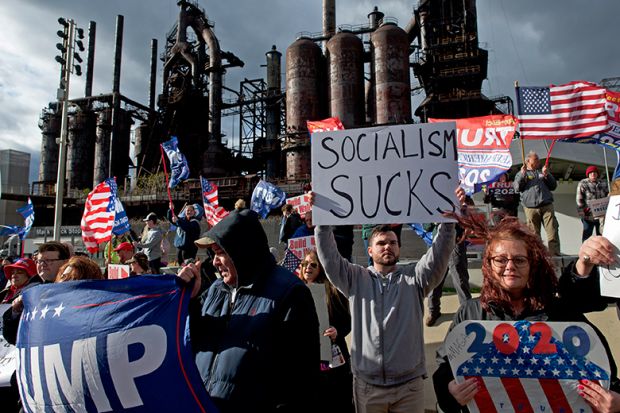
Asked to comment on this, Bartels and Cramer responded: “We believe that the 60s were indeed a significant turning point in American society and politics, independent of the fortunate timing of the Jennings study...When Donald Trump’s supporters say that they want to Make America Great Again, much of what they mean is that they want to repeal those social changes, to return to a traditional (idealized) American way of life that looks more like the 1950s than like any decade since.” Nostalgia for a mythical decade that no one under 75 has any meaningful experience of may indeed be crucial to Trump’s success, but it is not a factor that the other authors considered here pay any attention to.
Another perspective on (some) voters’ attitudes can be found in Rural Pain, Republican Gain: How the Republican Party Is Killing Rural America and Why Democrats Are Blamed, by Michael Shepherd, an assistant professor in the School of Public Health, Health Management and Policy Department at the University of Michigan.
This book, to be published by University of Chicago Press in August, also has an ambitious goal: to explore the startling paradox that rural American voters have come to “feel so negatively about the government health assistance and social welfare programs that they depend on and vote for Republican politicians who promise to take away these benefits”.
His argument is that since the issue of healthcare is often seen as “owned” by the Democrats, “the party of the government”, clever messaging from Republican elites has succeeded in obscuring the responsibility for declining levels of healthcare caused by Republican policies such as the closures of rural hospitals.
Hence, Shepherd says, the book provides detailed evidence for the claim that “it is possible for parties and politicians to engage in policymaking that is harmful for their own voters without paying much of an electoral penalty – and perhaps benefit from doing so”.
An analysis which puts such stress on the perverse, almost masochistic attitudes of some American voters clearly leads in very different directions – and suggests very different policy responses – from one emphasising the longer-term structural factors identified by Kurz and Antonucci. But it is noticeable that even the latter two scholars have widely divergent views on current events.
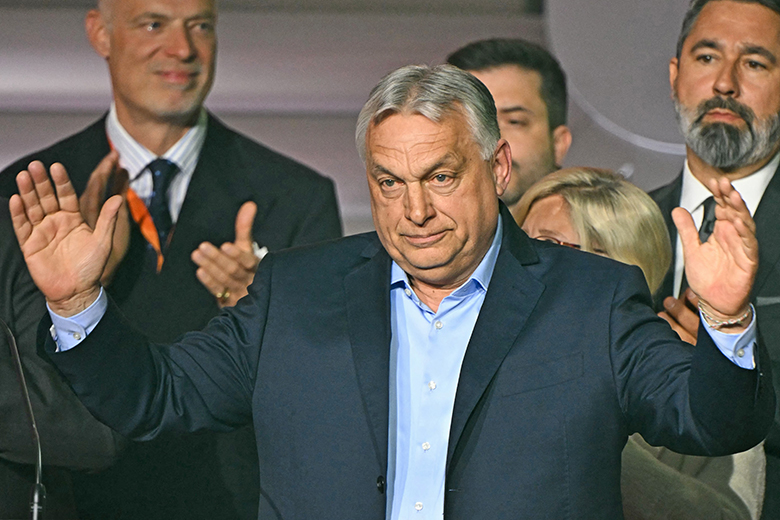
Speaking on the day following the Hungarian election, Kurz attributed Orbán’s unexpected landslide defeat to “the vast corruption of his regime” and “the demonstrated economic failure of this model of ‘illiberal democracy’”. Combined with “the growing signs of Trump’s confusion”, he went on, the “very significant” election result suggests to him that “the democratic forces are now in the ascendant and the end of Trumpism in America is not far”.
For Antonucci, on the other hand, the election result proves no such thing. Although there is no reason to think that Hungarians are feeling less insecure now than they were on the five occasions they elected Orbán, “the connection between insecurity and holding a populist outlook is still valid in Eastern Europe”. The salient point about Hungary is that “populism is both in power and in opposition”: Orbán’s opponent, Péter Magyar, is a former member of his Fidesz party and “the agenda of his current party, albeit more traditionally liberal in some respects, has a lot of populist right elements” in its policies and rhetoric, Antonucci points out. It would, therefore, be a mistake to interpret the election result as a straightforward move away from the populist right, she believes.
It seems safe to assume that all these books offer important insights, but they are too incompatible in their emphases for any single one to be completely right. Readers may still be left scratching their heads about the direction of history’s plot – and whether Hungary, the US, the UK or anywhere else is losing it.
Register to continue
Why register?
- Registration is free and only takes a moment
- Once registered, you can read 3 articles a month
- Sign up for our newsletter
Subscribe
Or subscribe for unlimited access to:
- Unlimited access to news, views, insights & reviews
- Digital editions
- Digital access to THE’s university and college rankings analysis
Already registered or a current subscriber?