For more than two decades, Twila Moon has worked closely with Greenlandic scientists while studying the Arctic ice sheet. But over the past few months, those relationships have come under strain in a geopolitical environment unlike anything she has seen in her career.
“There have been instances of partners stepping back from collaborative spaces,” says Moon, a scientist at the National Snow and Ice Data Center at the University of Colorado Boulder. “There is much more caution now and an awareness that work could be stopped suddenly if tensions rise further or approval processes change.”
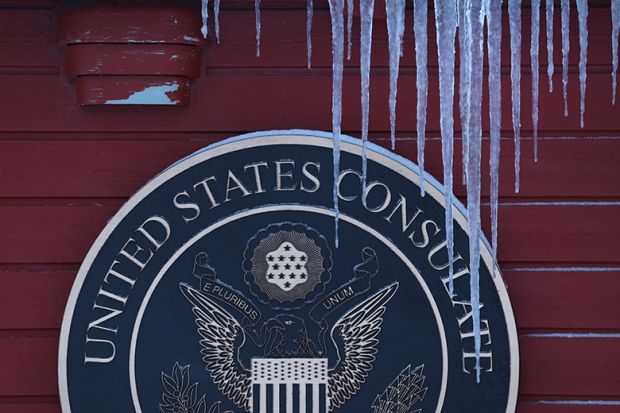
Relations between the US and Greenland – a self-governing territory of Denmark – have been under pressure since US president Donald Trump revived proposals for Washington to take control of the island. While he has since ruled out the use of military force in acquiring the territory, scientists say trust has already been damaged.
Moon, who signed a letter along with 200 scientists opposing Trump’s efforts, said some scientific products that were created between US and Greenlandic organisations were no longer being shared in Greenland particularly if they had a National Science Foundation logo or a US flag.
Moon said that in one case a Greenland-based researcher stepped back from an advisory role on a US-funded project, believing they had been told not to continue working with her. None of her projects have been cancelled so far.
“I worry especially about early-career scientists,” she said. “People who want to build relationships in Greenland now may not have the same opportunities that my generation had.”
Times Higher Education contacted several scientists in Greenland for comment.
Other US academics have reported similar disruptions. Paul Bierman, a geoscientist at the University of Vermont and author of When the Ice is Gone, said the political fallout had damaged the US’ reputation abroad. “It’s a depressing moment for scientists who work internationally and specifically on the Arctic,” he said.
Bierman said half a dozen emails he had sent to Danish scientists had gone unanswered, which he saw as a sign of mistrust. “Clearly there’s deep anger on the Danish side, which there should be. We have no business threatening another country’s territory,” he added.
He knows of US and European scientists who have decided not to attend meetings if they involve travelling to each other’s countries. “I can’t see how our relationship with the Danes and the Greenlanders will ever be the same again,” he said. “The damage is done.”
Bierman said because of US funding cuts and the heightened tensions over Greenland, he has had to pivot his research priorities. “I’m not writing more grants on climate change or Greenland, I’m focusing on other directions,” he said.
The concerns come at a critical moment for climate change research. Greenland’s ice sheet contains enough ice to raise global sea levels by about seven metres, scientists estimate.
Ice cores extracted there preserve detailed records of Earth’s atmosphere going back more than 100,000 years, Martin Siegert, a glaciologist and deputy vice-chancellor at the University of Exeter, explained.
“Greenland is not a scientific niche. It’s an area of research the entire world needs because of climate change,” he said, adding that much of that work depended on international collaboration.
He said that at the moment, collaboration on the ice sheet remained largely intact. But he feared that the US administration could make it harder for scientists to obtain permits to carry out research in Greenland if it were to gain more power over the territory. Permits currently are issued by the government of Greenland.
“The idea that Greenland could be locked out from the rest of the world because of some geopolitical reason would be detrimental to the science that could be conducted there, and as a consequence we will be less able to understand our climate future,” Siegert said.
Register to continue
Why register?
- Registration is free and only takes a moment
- Once registered, you can read 3 articles a month
- Sign up for our newsletter
Subscribe
Or subscribe for unlimited access to:
- Unlimited access to news, views, insights & reviews
- Digital editions
- Digital access to THE’s university and college rankings analysis
Already registered or a current subscriber?