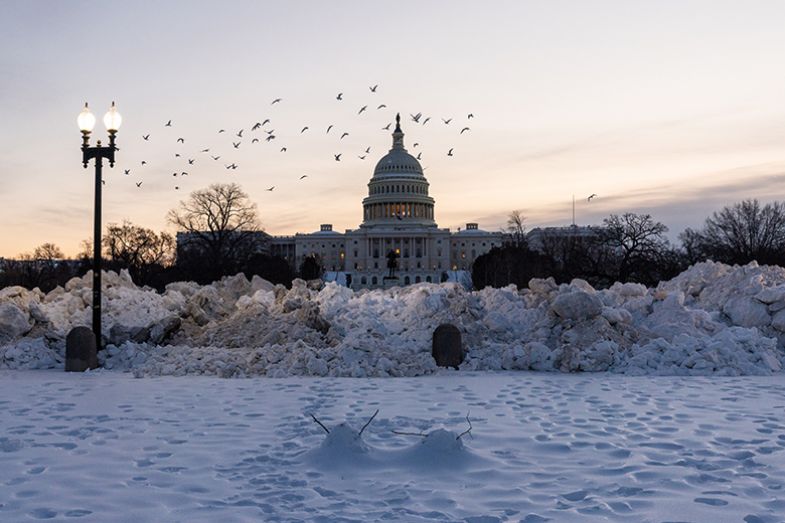
The past couple of weeks have seen a powerful bipartisan victory for US higher education and its vital research enterprise. In an increasingly rare bipartisan effort, Congress approved funding bills that will preserve the budget of federal science agencies such as the National Science Foundation and the National Institutes of Health more or less at current levels – in sharp contrast to the White House’s budget request, which would have slashed the NSF budget by more than 50 per cent and the NIH’s by nearly 40 per cent.
This was a clear and unambiguous statement, united across party lines: Americans believe that science matters and is worthy of public investment. And the legislation is far from the only indicator of that sentiment.
Of course, the challenges of the past 12 months have been stunning in their scope and impact. The administration is transforming higher education in numerous ways, including threatening academic freedom and institutional autonomy, imposing caps on federal loan programmes, restricting international student admissions, and shrinking the Department of Education. I acknowledge the turbulent impact of all this – with more promised for 2026.
Yet last year also saw many positive higher education trends that it would be easy to overlook in the current climate but that are significant and deserve to be celebrated.
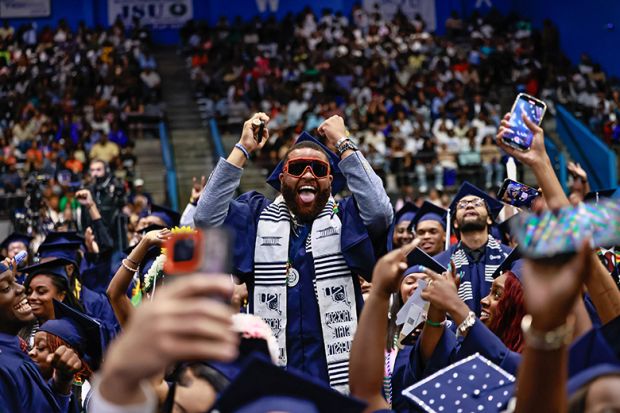
There’s good news about enrolment, for instance. Despite concerns about the return on investment and the rising costs of college, the National Student Clearinghouse reports that fall 2025 postsecondary enrolment climbed 2 per cent from last year, approaching pre-pandemic historical highs.
All sectors of undergraduate enrolment saw growth, including a notable 4 per cent increase for community colleges. This was due both to an increase in the number of 18-year-olds and substantial rises in adult students over the age of 25.
Also encouraging is the fact that more Pell-eligible students entered college in 2025. The primary reason may be due to a simplified and workable FAFSA form that arrived ahead of its deadline – unlike in 2024. The National College Attainment Network reported a 17.5 per cent surge in student aid applications in 2025.
Also significant on the access front is December’s news that MacKenzie Scott’s philanthropic investments in higher education now exceed $1 billion – including over $750 million for historically black colleges and universities. Her dedication to the transformative power of higher education, especially for chronically underserved students, should inspire us all.
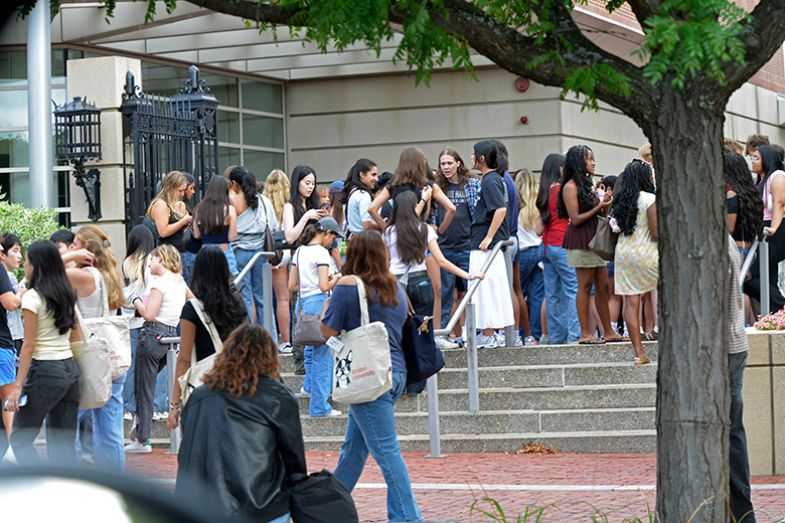
Reflecting the enrolment increase, college applicants also are up, according to the Common Application, perhaps by as much as 5 per cent. That drove a 10 per cent increase in the number of applications submitted to US institutions in 2025. Early data indicate that this surge includes greater numbers of low-income and other under-represented students.
These trends will cheer enrolment leaders, who labour under widespread concern that the number of high school graduates in the coming years will decline significantly. It also signals something about the resilience of US higher education. There has been relentless coverage of survey data showing disappointing public support for the value of postsecondary credentials (more about that in a minute), but the fact that undiminished numbers of men and women of all ages are still committing resources and time to earning them is a far more important touchstone of the nation’s support for our colleges and universities.
The National Student Clearinghouse also reported in 2025 that the six-year college completion rate held steady for the fourth year in a row, at 61.1 per cent. You might counter that stasis is hardly a win. But surely it must be seen as one given the pandemic and the increasingly vexing cost-benefit calculus (especially for middle-class students) – not to mention the persistent questioning of the value of postsecondary education. People who completed a college credential should be seen as bold investors in their futures.
Enthusiasm for higher education is also evident in the increasing numbers of high-school students who complete dual-enrolment courses. Although figures for 2025 enrolment are not yet available, the past two years registered the increasing popularity of this opportunity to take regular two- and four-year college courses while still in high school. Established programmes such as advanced placement are also seeing their popularity endure.
We know, from research reported in 2025, that students benefit from this experience. They are more likely to apply to college, and they perform better than their peers when they get there, leading to better completion rates. After six years, 71 per cent of students with dual-enrolment credit earned a college credential, compared with only 57 per cent of those without.
One reason for the boost in enrolment and steady completion rates may be that college tuition and fee levels continue a steady downward slope. The College Board reports that the average net tuition and fees paid by first-time full-time in-state students enrolled in public four-year institutions peaked in 2012-13 at $4,450 (in 2025 dollars) and declined to an estimated $2,300 in 2025-26. Actual costs paid at private institutions have also declined, from $19,810 (in 2025 dollars) in 2006-7 to an estimated $16,910 in 2025-26.
The decline in net tuition and fee levels is the result of substantial and ongoing state support for higher education. Despite all the political noise, the State Higher Education Executive Officers Association estimates a 4.3 per cent overall increase in state support for higher education for 2025 (before a forecasted 2.1 per cent rate of inflation). If this estimate proves accurate, it will be the fourth consecutive year of state spending that topped $100 billion. A total of 41 states increased their funding or kept it level from the previous year, suggesting that, on the ground, support for higher education remains strong.
Indeed, perhaps the most surprising piece of good news in higher education last year was July’s Gallup survey, which found that the number of Americans who have “a great deal” or “quite a lot” of confidence in postsecondary education rose to 42 per cent, from a historic low of 36 per cent the previous year. In addition, the number of Americans having the least degree of confidence in higher education dropped from 32 to 23 per cent.
The glass-half-empty reader will correctly argue that a one-year bump in a nationwide survey does not represent a trend. And it is true that Americans’ confidence level remains much lower than when Gallup began administering this survey in 2015, when 57 per cent of Americans registered significant confidence. However, there is other evidence of public support. In December, the American Association of Public Colleges and Universities released the results of a survey showing that 70 per cent of employers have either “a great deal” or “quite a lot” of confidence in higher education. In addition, 85 per cent of employers said that colleges and universities are doing a good job preparing students for the workforce, and 73 per cent believe a college degree is worth the financial investment.
Although the jury is still out about the benefits that will accrue from the newly approved Workforce Pell programme, funding for short-term, industry-aligned job training deepens higher education’s linkage with the workforce needs of business and industry. A key proviso for the eligibility of non-credit programmes is that they should articulate into credit-bearing pathways; eventually, this could lead both to new job opportunities, as well as to additional educational pathways for students.
The creation of the Workforce Pell reflects postsecondary education’s growing interest in offering other kinds of skill-based training beyond the traditional bachelor’s degree. Interest in apprenticeships is already surging, for instance. And states and higher education institutions are devising initiatives to provide more students with experiential learning opportunities that provide explicit skills in the marketplace. Academic traditionalists quibble that such skills may be outdated in a few years, but it is clear that to remain competitive internationally, the US must train a workforce with relevant credentials well beyond the high school diploma.
Significant among those credentials, of course, is facility in the use and possibilities of artificial intelligence. Universities, ranging from Rice to Penn to the University of Wisconsin-Madison, are creating exciting new degree programmes in AI. More widely, a remarkable shift in pedagogy was initiated in 2025 in response to AI. To be sure, there is plenty of uncertainty about how this technology will play out on our campuses, but, across states and institutional types, professors are seeking to more deeply engage and collaborate with students in their writing and critical thinking process, while also engaging in thoughtful discussions about the ethical usage of AI.
Thoughtful studies are showing that judicious use of adaptive digital technologies can enhance student learning, and AI-powered digital assistants are now being widely deployed in service to the specific needs of higher education students. Early studies demonstrate that these technologies are able to provide the kind of 24/7 personalised attention that can increase student engagement and success throughout their academic journey, from enrolment to graduation.
Such attention could also help to improve student mental health – although that is already on an upward trajectory. The 2024-2025 Healthy Minds Study shows that the proportion of students showing severe depression symptoms and suicidal ideation have both fallen year-on-year since 2022 – from 23 and 15 per cent to 18 and 11 per cent, respectively. Of course, far too many young people still suffer, but these data suggest that colleges’ efforts to meet the mental health needs of their students are making an impact.
The key to success in US higher education is to never lose sight of the needs of the students we serve, no matter how difficult the wider social, political and technological environment. The goal remains what it always was: to educate and develop the people that represent our future. And the idea that those people no longer recognise the value of our endeavour turns out to be greatly exaggerated.
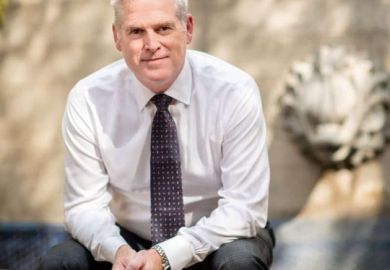
Eileen L. Strempel is a higher education consultant and the former inaugural dean of the Herb Alpert School of Music and professor of education at the University of California, Los Angeles.
Register to continue
Why register?
- Registration is free and only takes a moment
- Once registered, you can read 3 articles a month
- Sign up for our newsletter
Subscribe
Or subscribe for unlimited access to:
- Unlimited access to news, views, insights & reviews
- Digital editions
- Digital access to THE’s university and college rankings analysis
Already registered or a current subscriber?