The US action in Venezuela and threats over Greenland in the first few weeks of 2026 were vivid examples of the shifting geopolitics we are seeing one year into Donald Trump’s second presidency – and a stark reminder of the need to take America’s new National Security Strategy very seriously.
The strategy, published last November, has been hugely criticised for its attack on Europe and its institutions. Allegedly, the EU is contributing to “civilizational erasure”, undermining Europeans’ political liberties, censoring free speech and suppressing political opposition. Shockingly, the strategy takes clear political sides with populism, attacking migration – which has always been part of the European experience – as alienating Europe from itself. And, to top it all, the strategy intends to actively cultivate “resistance” to what it opposes in Europe, including the EU.
It is also striking how pivotal research, innovation and technology are to the Trump administration’s conception of US global interests. In practice, we have already seen the administration attack research in some areas, including climate science, gender and reproductive health. Yet the strategy is rooted in the power that derives from the US’ status as “the world’s most scientifically and technologically advanced and innovative country”. The strategy emphasises the importance of “investing in emerging technologies and basic science”, to ensure the US’ “continued prosperity, competitive advantage, and military dominance for future generations”.
A revealing passage on how to contain China emphasises the importance of the US investing in research in key strategic domains, including undersea, space, AI, quantum, autonomous systems, nuclear and energy more broadly. But the document is also clear that the US will assert its interests in countries it deals with that it considers secret proxies of China. What this means in practice is unclear, but the survey sent out a year ago to research collaborators with the US on their links to China and their DEI strategies alerts us to what might be on the administration’s mind.
What little good the strategy has to say about Europe is summarised in two sentences. One directly praises Europe as the “home of cutting-edge scientific research and world-leading cultural institutions”. And the other notes its “robust” economic sectors nourished by cutting-edge research, notably manufacturing, energy and technology.
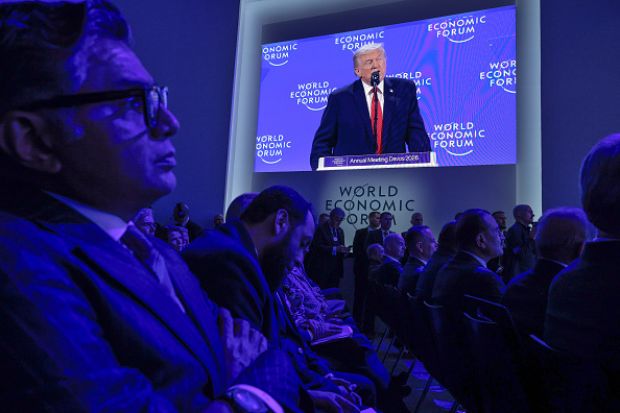
In a direct response to the US strategy during the recent World Economic Forum in Davos, European Commission president Ursula von der Leyen reasserted the need for Europe’s “independence”. In particular, she emphasised Europe’s commitment to strong global trade partnerships and investment in critical technologies and defence.
Meanwhile, Canadian prime minister Mark Carney also called for an assertive response to the new “era of intensifying great-power rivalry”, proposing a new, flexible response from mid-sized powers such as Canada. Both leaders agreed that the future lay in a new world order of “genuine cooperation” different from the postwar arrangements we are leaving behind. This has profound implications for universities.
First of all, economic competitiveness and geopolitical positioning are closely intertwined and are dependent on ambitious spending for R&I – not only through the next framework programme, FP10, but also at the national level. Political leaders need to face the fact and act on it – not neglecting to invest in higher education, which is a crucial part of the R&I ecosystem.
Second, Carney’s notion of a better kind of collaboration needs to be built on greater equity and trust among partners. Universities are central to building cross-border alliances, but if we want to collaborate better, more sustainably, now is the time to tackle the inequities – research agendas and prestigious publishing venues dominated by the Global North – that have underwritten our commitment to open collaborations for too long.
Third, the EU must ensure coherence across its funding programmes. The new Global Europe programme, intended to support the EU’s external partnerships, needs to align with the research and education focus of the EU Global Gateway – the strategy established by von der Leyen in 2021 to support its partnerships with lower- and middle-income countries. This should translate into at least €6bn (£5.2bn) spending for higher education collaboration through Erasmus+, and an even more ambitious provision for research.
Fourth, we in Europe need to boost resilience in the systems we use, from our operating services to where we store our data. Our global opportunity lies in our capacity to create systems that work across borders. We should build on our advantages to develop understandings (and protocols) with international partners.
And, finally, association to FP10 could become much more than agreements for research collaboration: it could put the EU at the heart of a global R&I “coalition that works”, to paraphrase Carney. This would make Horizon Europe the starting point for wider collaboration with third countries worldwide. And this, in turn, could be a basis of agreeing to shared global research priorities, common protocols around IP rules, interoperability and research security in particularly sensitive research areas. This would not aim at establishing exclusivity and hegemony, but at being an open offer of collaboration for a new geopolitical environment.
This would require the EU to become much more agile in how it agrees association for FP10, especially with countries that have already associated to the current Horizon Europe programme. And it would require the EU to take on board the ideas and experiences of its global partners where appropriate.
In an increasingly fragmented world, the role of universities should be precisely to build bridges and present counterweights to strategies whose values are inimical to the values and internationally collaborative instincts of academia. Von der Leyen and Carney challenged us to develop new kinds of collaborations that are – as the latter put it – “bigger, better, stronger, more robust”.
This requires a new way of seeing, trusting and acting. In R&I, Europe is uniquely positioned to lead the way, together with its partners. The sector, and policymakers, should waste no time.
Jan Palmowski is secretary general of the Guild of European Research-Intensive Universities.
Register to continue
Why register?
- Registration is free and only takes a moment
- Once registered, you can read 3 articles a month
- Sign up for our newsletter
Subscribe
Or subscribe for unlimited access to:
- Unlimited access to news, views, insights & reviews
- Digital editions
- Digital access to THE’s university and college rankings analysis
Already registered or a current subscriber?