When Karl Deisseroth, Peter Hegemann and Georg Nagel were named recipients of this year’s Nobel Prize in physiology or medicine, critics argued that it neglected the contribution of several other neuroscientists.
Nobels, only ever awarded to between one and three scholars, are a stark example of how “science is heavily anchored in individual achievement and contribution”, as Ottoline Leyser put it, when more often than not it is a collective endeavour.
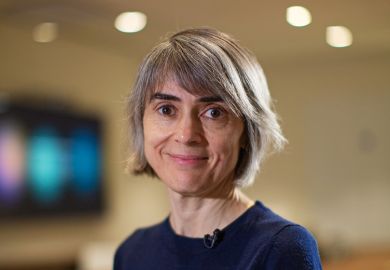
Leyser, who was chief executive of UK Research and Innovation from 2020 to 2025, told Times Higher Education that there is a desire to move on from this, claiming “people are concerned about the notion of shifting away into a more team-based assessment system, which recognises that different people are bringing different things”.
Since leaving UKRI, Leyser, Regius professor of botany at the University of Cambridge, has started a blog series called the Science Project that she hopes will shift some of how we think about science, including towards increased recognition of its team-based nature, in this time of “massive disruptive change”.
In one post, she writes that “the concept of the lone genius is embedded in the way we do science, the way we talk about science, and the way we present science”. She explained to THE: “It’s very much in our identities that we are individually Einstein-like figures. And I think that causes a lot of difficulties for people because…I know I’m not an Einstein.”
Leyser said, of shedding these identities, “we have to because I think all of us would do better if we knew that we were part of a collective endeavour, bringing our unique expertise and skills to that”.
“That does need to be recognised in the way we think about funding decisions, promotion, recruitment, and appointment,” she said.
Matthew Flinders, professor of politics and public policy at the University of Birmingham, agreed with Leyser “that there is an issue around the heroic, lone scholar”.
Flinders suggested that there’s a “misalignment” between the “increasing recognition that the most advanced science is done by a team base” and the continued “focus on an individual or a very small group of individuals” in the wider rewards system.
“The issue is seen in an iceberg, we have the scientific superstar, who is visible above the waterline but nobody can see the fact that he, and it is usually a him, is standing on the shoulders of a vast body of people” underneath, he said.
Flinders added that there is lots of evidence that “particularly women are much more willing to dedicate their time to activities which are often invisible or not recognised, despite the fact that they are absolutely vital to the scientific endeavour.” These activities include mentorship, pastoral support and listening to early career researchers who “are going through the trials and tribulations of an academic career, which is getting harder”, he said.
On how the dial could be moved further, “we need to somehow close that gap between the reality of team science and the recognition and reward structure…just because you’re the principal investigator on a grant does not mean that you will be the only leader.” Flinders suggested that this could be achieved through funders providing more team-based grants and gave the example of the Political Studies Association, which has an annual award for the best scientific team.
He added that changes need to be made “quicker and faster” because, if not, “we are just locking in and reinforcing structurally embedded inequalities”.
However, astrophysicist Martin Rees, a member of the House of Lords, told THE that in some cases individual prizes are warranted. “This year’s physics prize celebrated the amazing Ice-Cube Neutrino Observatory,” he said, which has been “a long-term team effort, although few would gainsay the singling out of Francis Halzen, the ‘prime mover’ and inspiration”.
Although he also said, in other cases, “the Nobel Committee’s refusal to make an award to more than three people has led to manifest injustices”. One example he gave was the 2017 Nobel for physics that recognised a discovery, Ligo’s detection of gravitational waves. It was “reported in a 1,000-author paper – but just three of these authors were rewarded”, he said.
Register to continue
Why register?
- Registration is free and only takes a moment
- Once registered, you can read 3 articles a month
- Sign up for our newsletter
Subscribe
Or subscribe for unlimited access to:
- Unlimited access to news, views, insights & reviews
- Digital editions
- Digital access to THE’s university and college rankings analysis
Already registered or a current subscriber?