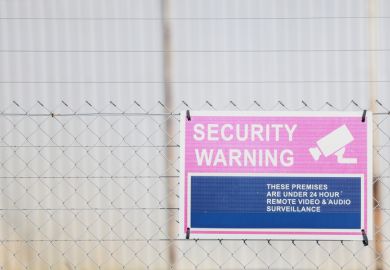
Vague warning letters from Canberra have muddied the already turbid waters around universities’ dealings with foreign doctoral students, reducing offerings for people from countries subject to Australian sanctions.
Several universities have stopped considering PhD applications from Iran, citing government advice over sanctions and research security. It comes after the Education Department wrote to vice-chancellors in March, highlighting the need to “comply with the Australian sanctions regime” and make policies “fit for purpose” in “the current strategic environment”.
The advice relates to dealings with Iran, Russia, North Korea and – in subsequent correspondence with two vice-chancellors – Belarus. “I am seeking confirmation that there is no current collaboration between researchers at your university with entities in these countries,” says the letter from the department’s deputy secretary, Jasmina Joldić.
“This applies not only to institutional arrangements but also to collaboration undertaken by individual researchers, as well as allowing foreign researchers access to facilities and specialised equipment. This approach to risk assessment is required across all your research arrangements, from your largest to smallest partnerships.
“The government’s approach is clear: Australia’s public universities should remain globally connected and collaborative, while also being firmly anchored in the national interest.”
Times Higher Education asked whether universities were expected to stop enrolling PhD students from Iran, long a significant source of research students in STEM fields. The department said its advice applied to “formal institutional partnerships as well as informal researcher-to-researcher collaboration”.
Asked for further clarification, including whether universities should cancel existing PhD enrolments – and the legal ramifications of doing so – the department said universities were expected to “ensure all international engagement aligns with Australia’s national interest and complies with Australian law”.
Sources have expressed frustration at the lack of clarity. “It’s very hard for us to know how to respond if we’re being asked to effectively read their minds,” one said. “If the government wants to outlaw something, they should just do it. We’ll all comply.”
Deakin University said it had decided not to proceed with enrolments of research degree candidates “from certain sanctioned countries” following advice from government. “We will continue to monitor government advice, the regulatory environment and our particular risk obligations and review our position should circumstances change,” a spokesman said.
Swinburne University has also paused assessment of Iranian PhD applications while it reviews its processes. “Swinburne follows relevant Australian government guidance and legal requirements relating to sanctions and research security,” a spokesman said. “We regularly assess and update our procedures in light of an evolving and complex regulatory landscape.”
Universities considering PhD applications from overseas already take account of an array of factors including the students’ academic suitability, their financial situations, their likely contributions to local skill needs, the security risks associated with their research and – increasingly – visa obstacles.
Griffith University is not considering PhD applications from Iran until October, partly over fears that the Middle East conflict could lead students to claim asylum, with negative impacts on the university’s immigration risk rating.
Queensland University of Technology vice-chancellor Margaret Sheil said she was concerned that PhD students from sanctioned countries could have their careers undermined by constraints on their ability to publish their research findings. Moreover, some students who did not pass their PhDs were required to repay their government scholarships, forcing administrators to consider whether it was “ethical” to accept them – particularly given the “very substantial” fees charged for visas they may not receive.
“It’s not just about whether they’ll get a visa. Are we going to be able to work with them productively? Do they have support? Are they in an area where we need skills? Can they work in an area where the security arrangements can be put in place?”
Sheil, a former CEO of the Australian Research Council (ARC), said the Iranian populace was “very well educated”, with particular strengths in mathematics. “We’ve been benefiting from their contributions to our universities for a long time.”
An energy researcher in the northern Iranian city of Babol, whose PhD scholarship with Adelaide University lapsed after he had waited 10 months for an Australian visa, said many of his countryfolk – mostly science and health researchers – faced similar predicaments.
“A significant number of Iranian student visa applications have been referred to security checks, often without a clear time frame for a final decision,” he told THE by email. “Several Australian universities are currently reluctant to consider applications from Iranian students because of the prolonged visa processing times and uncertainty.”
The Department of Home Affairs is continuing to grant visas to doctoral candidates in Iran, irrespective of the Education Department’s views. In June, the latest month for which data are available, Home Affairs granted visas to 30 Iranian PhD students and their family members, and accepted applications from another 76.
A Home Affairs spokesman said the Education Department’s advice regarding research collaboration was “separate” from the student visa framework. “The role of the Department of Home Affairs is to assess student visa applications in accordance with Australia’s migration legislation,” he said. “The department is legally required to accept and assess student visa applications that meet the eligibility requirements.”
Migration expert Abul Rizvi said the education and immigration departments were often at loggerheads over visa policy.
Universities’ activities are increasingly being stymied by security concerns. Last week, foreign affairs minister Penny Wong ruled out two university agreements with overseas institutions – including a joint research project into pain relief therapy – marking the first time the 2020 Foreign Relations Act has been used to veto international partnerships.
In May, Clare told parliament that he had directed the ARC Board to deny funding for 13 projects. The ARC refused to release information about the quashed research “for national interest reasons”.
Register to continue
Why register?
- Registration is free and only takes a moment
- Once registered, you can read 3 articles a month
- Sign up for our newsletter
Subscribe
Or subscribe for unlimited access to:
- Unlimited access to news, views, insights & reviews
- Digital editions
- Digital access to THE’s university and college rankings analysis
Already registered or a current subscriber?