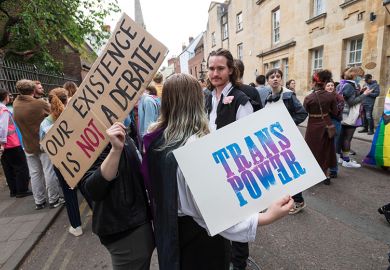
The Office for Students (OfS) has denied taking an “absolutist” position on free speech and academic freedom issues, claiming the record fine handed out to the University of Sussex was about “safeguarding those fundamental values in higher education”.
On the final scheduled day of proceedings in Sussex’s judicial review of the regulator’s decision to sanction it over alleged breaches of its free speech duties, lawyers for the OfS called for all six of the institution’s claims to be dismissed.
The university was fined £585,000 as part of an investigation into its handling of gender-critical academic Kathleen Stock’s exit from the university in 2021.
Sussex claims that the OfS does not have the power to fine it because a trans and non-binary policy statement that has been at the centre of the case was not part of the “governing documents” of the university.
But the regulator’s lawyers argue that it “had jurisdiction to consider all relevant matters; it conducted a careful and detailed investigation, correctly interpreting the relevant regulatory conditions”.
According to documents, Sussex staff members “privately expressed a degree of ‘nervousness’” after the statement was published in 2018. Stock, a philosophy professor, raised her concerns with the HR department in March 2019 – two and a half years before she gave in to students’ demands to step down.
In a witness statement from November 2023, Stock criticised an “institutional atmosphere” which was prescriptive about gender identity and said that to question whether transwomen are women or transmen are men would be seen as transphobic.
“Although I did not stop expressing some gender-critical views (very cautiously) in my teaching, I was never assured that I would not face disciplinary action as a result of contravening the policy,” she said.
Stock said the policy had a “chilling effect” on her and others. She was concerned that even some lawful topics would be “too contentious and controversial”, while she taught other areas “extremely nervously as a result”.
This included discussing trans-identified sex offenders in prison, the proportion of trans-identified children who had mental health issues, and certain sexual interests connected to transwomen.
The academic was concerned that the policy left her “open to vexatious complaints when teaching and expressing” views about gender, and “contributed to an overall atmosphere in which harassment against her and others critical of gender-identity ideology is seen as acceptable”.
But the OfS claimed that this was misconceived and would have an “implausible effect” in restricting the OfS’ ability to regulate universities and accused Sussex of “shifting sands” in its argument.
In another of its grounds for appeal, Sussex contends that the OfS adopted “an absolutist position” that any restriction of speech that is not contrary to criminal or civil law was incompatible with the requirement for its policies to “uphold” freedom of speech principles.
But Monica Carss-Frisk KC denied there was anything resembling an absolutist position, adding: “You have the OfS properly and legitimately looking not only at whether the speech would be in the law, but whether there are adequate safeguards and concluded that there weren’t. The decision is ultimately about their approach, not whether their decision was justified.”
The OfS also denied arguments made by Sussex that Stock had a close “personal connection” to OfS director for free speech and academic freedom Arif Ahmed as seen by “warm and friendly email exchanges”.
Lawyers for the OfS said their relationship was “one of limited professional acquaintance”, to be expected given both are philosophy academics, and that they have had no contact since Ahmed joined the regulator.
Register to continue
Why register?
- Registration is free and only takes a moment
- Once registered, you can read 3 articles a month
- Sign up for our newsletter
Subscribe
Or subscribe for unlimited access to:
- Unlimited access to news, views, insights & reviews
- Digital editions
- Digital access to THE’s university and college rankings analysis
Already registered or a current subscriber?