Spain’s next government should maintain close ties with the European Union to avoid falling behind Brussels’ research agenda and tackle the proliferation of “low-quality” private universities in the country, the rector of the University of Barcelona has said ahead of the general election.
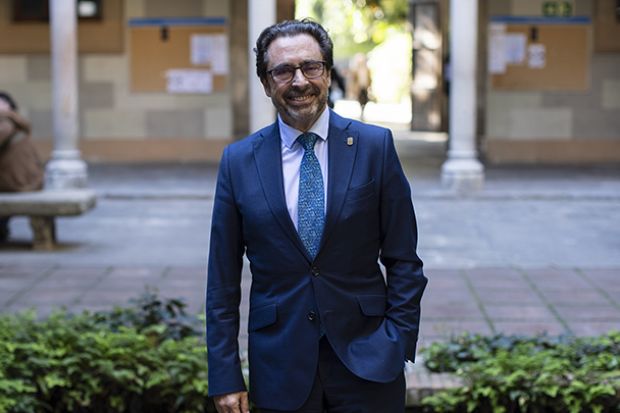
Joan Guàrdia said the biggest risk facing Spanish universities after the 29 November election was that a new government, of whatever stripe, might not prioritise alignment with European research policy.
“The most risky situation now is that the new government in Spain will not [stay] closely in touch with European policies,” he told Times Higher Education. “As rector, I want the new government of Spain to be close to European priorities to reinforce research, universities and the public system.”
Spain could get a change in government after more than eight years under prime minister Pedro Sánchez. Opinion polls put the conservative People’s Party (PP), led by Alberto Núñez Feijóo, ahead of Sánchez’s Socialist Party (PSOE). The far-right Vox, led by Santiago Abascal, could play an important role in forming a parliamentary majority.
“The public system requires a very important budget and investment in research and innovation, especially to adjust the Spanish system to the European Commission’s priorities,” Guàrdia said.
“Spain is excessively rigid when it comes to the application of the law and administrative procedures to the management of universities,” he said, adding that more flexibility was needed.
Guàrdia also urged the next government to engage closely with European discussions about dual-use research, which covers technologies with both civilian and military applications. The commission has proposed allowing such research to receive support under the next Horizon Europe programme.
“We need a very specific interpretation of dual-use research. The differences between the north of Europe and the south are enormous, including different interpretations of dual-use research. The new Spanish government must keep pace with the discussions happening at the commission in order to adapt the concept of dual-use to the Spanish scenario,” he said.
Closer to home, Guàrdia warned that the rapid expansion of private universities was threatening academic standards. He accused some regional governments of approving “low-quality” institutions.
“The problem is that some autonomous communities are [approving] universities that do not have the minimum quality to represent the concept of a real university,” he said. “The increase in private universities without quality is a very dangerous scenario for the research and university system.”
Spain has seen rapid growth in private higher education over the past decade. In September, the prime minister said enrolments in private universities had risen by 128 per cent in the past 10 years. There are 49 private universities, nearly as many as the 50 public universities across the country.
Guàrdia stressed that he was not opposed to private universities in principle, but he did want them held to high standards.
Register to continue
Why register?
- Registration is free and only takes a moment
- Once registered, you can read 3 articles a month
- Sign up for our newsletter
Subscribe
Or subscribe for unlimited access to:
- Unlimited access to news, views, insights & reviews
- Digital editions
- Digital access to THE’s university and college rankings analysis
Already registered or a current subscriber?