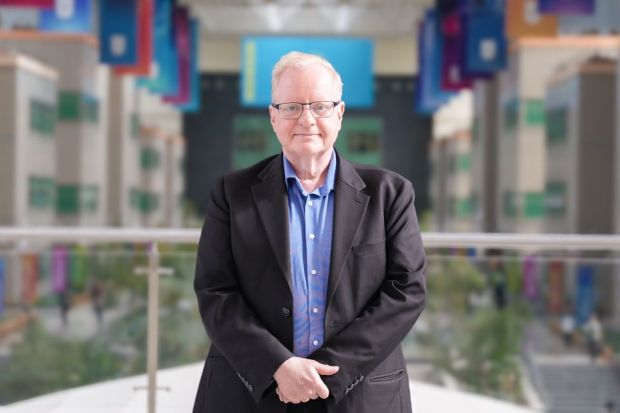
Any innovation stemming from research at traditional universities currently happens by accident, according to a senior leader who has switched Western sectors for Kazakhstan in an attempt to build a new way of doing things.
Icelander Bjorn Birgisson, vice provost for research and innovation at Nazarbayev University, told Times Higher Education that “disjoint” and “conservatism” are baked into the university system, including in grant writing proposals and panel reviews, which means innovation often occurs by coincidence rather than it being the intention.
“I would argue if you look at the traditional research outputs, the focus is not on innovation…it’s an accident.
“When a professor writes a proposal, they tend to think quite traditionally...because that is actually how the panels often review them as well.”
Birgisson was brought on board at Nazarbayev at the beginning of 2026 to untangle some of these tensions. He joined Kazakhstan’s flagship research institution after a five-year stint at Texas A&M University, where he served as the inaugural director of the Center for Infrastructure Renewal.
“I had kind of reached the ceiling in terms of what I could accomplish,” Birgisson said. “I got to a point where I just wanted the next challenge. The challenge at Nazarbayev University was exactly what I was looking for – taking a university that was created quite recently...to the next level.”
Birgisson had built several relationships with other Asian universities, including in China and South Korea during his time at Texas A&M, and the move to Kazakhstan therefore felt like a “natural switch”.
“I feel very comfortable in Asian cultures,” he added. “I understand the Asian mentality.”
The civil engineering professor has also served in senior roles at European institutions including KTH Royal Institute of Technology in Sweden and Aston University in Birmingham.
Like many in the sector, Birgisson said there is a “crisis” in higher education and he recognised that research institutions battle expensive operating costs and a lack of government backing. But unlike some of his colleagues, he stressed these problems are much “deeper” than funding.
According to the vice provost, the “crisis” is related to the widening gap between what researchers believe is a “great academic contribution” compared with the expectations of governments and citizens who want to see scholarship deliver “impact, value, and innovation”.
The idea that basic science alone will “eventually benefit society” or “lead to new innovation, new discoveries” is no longer enough, Birgisson said.
He argued the mission of modern research universities has strayed too far from the blueprint outlined in Vannevar Bush’s 1945 report, Science, the Endless Frontier, which made an argument for sustained funding by tying basic research to national priorities including economic competitiveness, national security and social welfare.
“Out of that came a much bigger focus on research because the universities now had clear pot of money to go to support them and that worked well,” said Birgisson.
But now research universities are “for the individuals” because “they’re paying for it, they [have] become customers”.
Some of the steps that Nazarbayev has taken to promote innovation at all levels include training faculty to write proposals with a focus on potential innovation pathways, and rolling out a new innovation PhD programme.
Each PhD project should address a gap in the market or contribute to the creation of a new product or policy, said Birgisson.
“A lot of times a professor will think that their idea is the best in the world, and this is needed by society. It’s not necessarily the case.”
Nazarbayev University Science & Technology Park, an innovation hub connecting academic research with entrepreneurship, guides students throughout the PhD process alongside their academic supervisors.
The Central Asian destination – long known as “a flyover land” – has already come a long way.
But Birgisson’s hope is that the 15-year-old institution will help transform the country into a “Central Asian powerhouse in higher education”.
With 70 out of the top 100 most-cited scholars in Kazakhstan affiliated with Nazarbayev, the vice provost’s focus will be continuing to invest in Kazakh academics, drawing a comparison with how successfully Singapore has invested in research-intensive universities to drive economic growth.
“Our goal is to be a 100 per cent Kazakh university in the next 10-15 years,” he said. “What I mean by that is the great majority of faculty should be Kazakh. That’s what we’re doing, we’re systemically hiring more and more Kazakhs.
“We send our students to...top universities around the world. When they return, they want a good job, and we’re trying to help them and actually hire them and bring them up. And bring Kazakhstan up at the same time.”
Register to continue
Why register?
- Registration is free and only takes a moment
- Once registered, you can read 3 articles a month
- Sign up for our newsletter
Subscribe
Or subscribe for unlimited access to:
- Unlimited access to news, views, insights & reviews
- Digital editions
- Digital access to THE’s university and college rankings analysis
Already registered or a current subscriber?