Concerns have been raised after it emerged that decisions made about which physics projects to cut in the UK departed from scientific advice for “strategic reasons”.
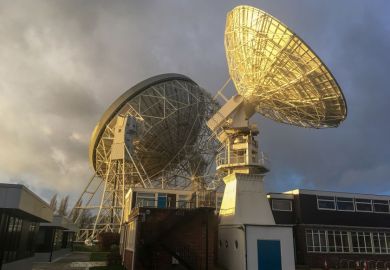
In July, UK Research and Innovation (UKRI) revealed a 10 per cent cut to particle physics, astronomy and nuclear physics (PPAN) projects funded by the Science and Technology Facilities Council (STFC), including the £2.8 million e-MERLIN stream supporting the Jodrell Bank telescope.
The measures, informed by a prioritisation exercise conducted by a PPAN Science Board advisory body, are part of UKRI’s efforts to cut the STFC’s spending by nearly £700 million by 2029-30 because of rising costs.
In March, former science minister Patrick Vallance told the House of Lords Science and Technology Committee that, in the cases of individual projects, “the experts will decide where the money goes, as it has always been”.
But recently published minutes of an STFC advisory council meeting held on 16 July state: “Where possible, Science Board PPAN recommendations for the 10 per cent scenario had been followed, but some changes were required for strategic reasons.”
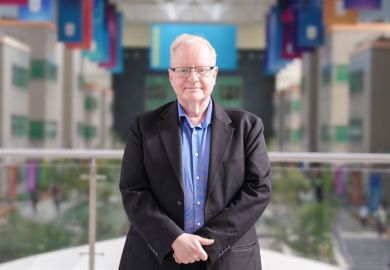
George Efstathiou, emeritus professor of astrophysics at the University of Cambridge, said there has been “disquiet about the changes that [were] made”.
Efstathiou, who was previously a member of a PPAN Science Board, said it is believed that that advisers had been strongly supportive of the Large Hadron Collider beauty (LHCb) project, an upgrade to the experiment at Cern on which the UK was leading.
Funding for this £49.4 million upgrade was initially withdrawn by UKRI under its Infrastructure Fund. It was then denied funding for a second time in the PPAN prioritisation exercise.
As minister, Vallance had promised that “the decisions on individual projects…will completely follow the Haldane principle”, which states that funding will be decided by experts rather than politicians.
Speaking to Times Higher Education about the July minutes, Jon Butterworth, professor of physics at UCL, said: “I strongly suspect this both goes against the Haldane principle and contradicts the statements about curiosity-led research being protected. But, of course, the lack of transparency means this can only be a suspicion.”
Hiranya Peiris, professor of astrophysics at Cambridge, noted that the minutes did not say “which recommendations were changed, what the strategic reasons were, or who required them”.
Like Butterworth, she urged the STFC to publish the results of its prioritisation exercise “so the community can see where they differ and why”. The pair are both former members of the STFC council.
THE understands that the Science Board’s PPAN report is expected to be published within weeks, but physicists say that they have already been waiting for months.
John Womersley, former chief executive of the STFC, said that “as always, whether this is appropriate depends on what was done and why – it is actually quite typical to vary a bit from the precise recommendations of advisory panels, sometimes for very benign reasons”.
“However, at a time like now, when every decision of STFC is being scrutinised for evidence of potential interference, I would think it would be wise to avoid doing this unless it was well justified and explained clearly,” Womersley added.
A UKRI spokesperson stressed that the organisation has been clear since July that not all of the PPAN Science Board’s recommendations were implemented, as it is only one of many advisory bodies. They also said no decisions had been changed after the UKRI executive committee approved the prioritisation process outcomes.
They added: “STFC is investing £794 million in world-leading particle physics, astronomy and nuclear physics research from 2026 to 2030.
“We have, however, had to take appropriate action to place STFC on a more sustainable financial footing, protect critical national capability and ensure investment remains focused on areas where it can deliver the greatest long-term impact. UKRI is providing additional investment of £135 million to support this transition.
“To inform its decision-making, STFC considered the expert advice it received from its advisory bodies, including Science Board Particle Physics Astronomy and Nuclear Physics (PPAN). Final decisions were made by STFC and UKRI after considering that advice alongside a range of factors beyond the remit of Science Boards.”
Register to continue
Why register?
- Registration is free and only takes a moment
- Once registered, you can read 3 articles a month
- Sign up for our newsletter
Subscribe
Or subscribe for unlimited access to:
- Unlimited access to news, views, insights & reviews
- Digital editions
- Digital access to THE’s university and college rankings analysis
Already registered or a current subscriber?