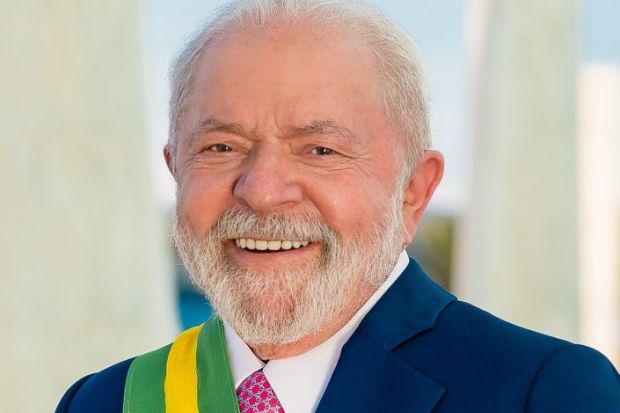
Many in Brazil’s higher education sector are breathing a sigh of relief with the historic re-election of left-wing incumbent Luiz Inácio Lula da Silva (Lula) – although he might have little room to offer much more financial support to the sector.
Lula, who has just won his fourth non-consecutive term as president in Latin America’s largest economy, becomes the first leader since the end of Brazil’s military regime in 1985 to be elected after losing the first round of voting.
He beat the right-wing, Donald Trump-favoured challenger Flávio Bolsonaro, who was running in the shadow of his father, former army captain Jair Bolsonaro, taking 51.79 per cent of votes in the election’s second round on 25 October.
Brazil’s União Nacional dos Estudantes (National Union of Students) and Abruem (Association of Rectors of State and Municipal Universities) had both backed Lula’s campaign.
Meanwhile, a group of Brazilian scientists had organised a letter encouraging support for the left-wing leader, which garnered more than 8,000 signatures.
The public universities sector had been looking on at the election with trepidation, amid fears Flávio Bolsonaro might try to emulate his father’s deep cuts to research.
Jair Bolsonaro served one term as president from 2019 to 2022. His leadership oversaw the defunding of the country’s public universities and an anti-science rhetoric that forced many high-profile academics to leave Brazil.
Last year the disgraced president was jailed for 27 years and three months after plotting a coup to take back power following the 2022 election, which Lula narrowly won.
But with a wider swing to the right taking place across Latin America in recent months, there was some expectation Flávio Bolsonaro had a serious chance of taking the seat of power – particularly as he won the first-round vote earlier in October.
Although Bolsonaro initially rejected Lula’s victory, his backers, the Liberal Party, have now accepted the result.
Lula has described his win as belonging to the “Brazilian people”, and said it arose in part “from the educators who believe in the transformative power of education and from every Brazilian who never stopped believing in a fairer country”.
The president, who boosted affirmative action policies in university admissions in 2023, is expected to protect and possibly expand these interventions – which are aimed at supporting those from lower socio-economic backgrounds and particularly black and indigenous people into education.
Reacting to Lula’s win, Brazil’s NUS said students had “re-elected the greatest political leader” in the country’s history, adding that it hoped to see him instigate more funding for science and student support.
Rectors’ association Abruem said it welcomed Lula’s “consistent and predictable” public funding for education, and called for education, science and innovation to take centre stage in his vision for national development.
Diego Sánchez-Ancochea, professor of the political economy of development at the University of Oxford, told Times Higher Education that the result was “great news” for people “interested in freedom of speech and academic freedom”.
In contrast, the legacy of Flávio Bolsonaro’s father was one of “attack” on universities and a “questionable” relationship with academic freedom.
But Sánchez-Ancochea suggested the result was nevertheless evidence of a “totally divided country”.
“The vote is much more anti [Bolsonaro] than in favour [of Lula],” he said. “Lula had done a relatively poor first-round campaign where he had not shown enough enthusiasm.”
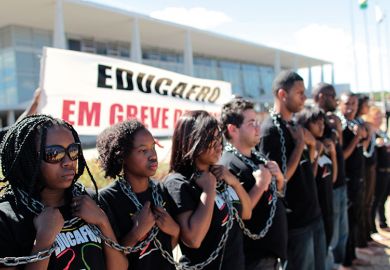
Lula’s previous term saw strikes by university workers over pay as the leader struggled to find the funds to increase wages.
His decision-making, meanwhile, is likely to be “totally constrained” this time, with Sánchez-Ancochea noting that the Brazilian Congress remains right-leaning, dominated by Bolsonaro allies and fewer centrists and pro-Lula politicians.
The “complex fiscal position” the country is in, with high public debt, will make it difficult to “advance any progressive agenda”, Sánchez-Ancochea predicted.
Roberto Medronho, a public health expert and rector of the Federal University of Rio de Janeiro, recently called for a coordinated national strategy for scientific progress and research funding. But Lula could lack wiggle room.
“[Overall] this is great news, but complicated, and of course in terms of the university sector, it becomes complicated because I’m sure they would like to increase spending,” Sánchez-Ancochea said.
“Research and development is important for the future [of Brazil] but it will be very much constrained by the fiscal position.”
Register to continue
Why register?
- Registration is free and only takes a moment
- Once registered, you can read 3 articles a month
- Sign up for our newsletter
Subscribe
Or subscribe for unlimited access to:
- Unlimited access to news, views, insights & reviews
- Digital editions
- Digital access to THE’s university and college rankings analysis
Already registered or a current subscriber?