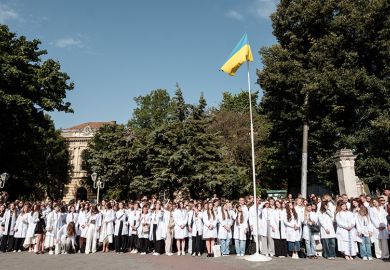
The timing of the World Bank’s attempts to improve Ukrainian higher education, announced just ahead of Russia’s full-scale invasion, was both perfect and disastrous. Over the past four years, Ukrainian universities have needed international support like never before. But, at the same time, the wartime conditions have only made an already extremely difficult task into an impossible one.
The “Ukraine Improving Higher Education for Results Project”, announced in 2021 and launched in 2022, is now entering its final chapter with the CampeX (Campuses of Excellence) project. The bank aims to support universities in establishing centres of excellence in areas of strategic importance to Ukraine, and to strengthen their capacity for research and innovation. The aspiration is that such centres will serve as platforms for developing talent and generating new knowledge and practical solutions for the country’s recovery and modernisation, while also strengthening international ties.
CampeX was announced by Ukraine’s Ministry of Education and Science last December, but the 12 participants – an increase on the 10 initially planned – were only announced in September. That was just three months before the World Bank project was due to be completed, at the end of the year. Accordingly, the project has been extended for another six months, to June 2027. Yet in its nine months of deliberation, the ministry only succeeded in coming up with a list of the usual suspects.
Almost half of the selected universities are located in the less populated west of the country. Only two are in the east – V.N. Karazin Kharkiv National University and Dnipro University of Technology – and one is in the north, Sumy State University. The rest are in Kyiv. The only surprise is that the National University of Kyiv-Mohyla Academy is not included, even though it is usually favoured by both the Ukrainian bureaucracy and the West.
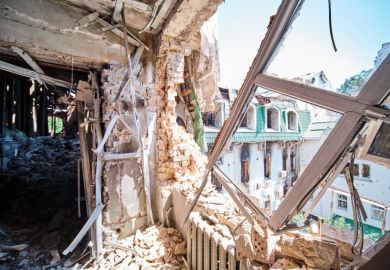
The ministry’s bias against the east and the north may be explained by security considerations, as Kharkiv, Dnipro and Sumy get a disproportionately large share of bombings. The problem with the project and the selection is not confined to this geographical bias, however.
Another problem is the narrow selection criteria. Only state universities were invited to apply, and there was an inflexible list of criteria, such as appearing in world rankings and participating in Horizon 2020. But what about private universities? Not all of them are utterly corrupt. There may be exceptions, such as the Ukrainian Catholic University in Lviv and Kyiv School of Economics, both under strong and explicit Western influence.
The bigger problem is that the excellence CampeX is supposed to promote remains completely out of reach. The minister said the project will “support universities that are ready to think not in terms of separate buildings, but as integrated campuses, with a strong educational and research ecosystem. It is important to us that these investments work in the long term, strengthening the quality of education, developing modern infrastructure and creating an environment for students and researchers that makes them want to stay in Ukraine and build its future.”
But even the Ukrainian universities that have evaded the Russian bombs have no campuses: their buildings and facilities scattered around cities and even into other towns. And since the CampeX initiative does not anticipate construction of new buildings, there will be no campuses. The World Bank itself stated in its main research document for the project that Ukraine’s construction sector is known for numerous irregularities – which is just a polite term for corruption – and, thus, there will be no such activities funded by the project beyond repair and refurbishment of existing academic facilities. This is despite the fact that over $37 million remains in the project budget.
The size of that figure is especially surprising, since the World Bank spent about half of the project budget of $200 million at the very start, as emergency relief for academic and social stipends to college students. And it underlines that the World Bank’s part in the whole initiative is also somewhat murky. The bank has published myriad procurement reports, with large tables and itemised costs, but other project documents and reports are full of opaque bureaucratic language that leaves the real content of the fulfilled tasks aside.
There are other question marks around the fact that the project itself was amended three times, in 2022, 2024 and 2026, which is unusual. And its progress is marked in the World Bank documents merely as satisfactory. Even that subjective self-estimate is probably generous; an objective external evaluation of the project is badly needed. Either way, the project extension could give the impression that the World Bank is anxious to just dump the remainder of the money and to save face by declaring the project completed.
Ultimately, failure was inevitable from the start. Even if the Russians hadn’t invaded in early 2022, these incremental steps were never going to solve any of Ukrainian higher education’s deeply entrenched problems.
The bankers can declare their mission accomplished, and the 12 campuses of “excellence” will gratefully receive their money. But the situation in Ukrainian higher education remains way below satisfactory, with Russian strikes inflicting damage from the outside and endemic corruption eating the system away from within.
Ararat Osipian is founding fellow of the New University in Exile Consortium at the New School, New York. He was a fellow of the Petrach Program on Ukraine at the George Washington University and Sustaining Ukrainian Scholarship fellow at New Europe College Institute for Advanced Study.
Register to continue
Why register?
- Registration is free and only takes a moment
- Once registered, you can read 3 articles a month
- Sign up for our newsletter
Subscribe
Or subscribe for unlimited access to:
- Unlimited access to news, views, insights & reviews
- Digital editions
- Digital access to THE’s university and college rankings analysis
Already registered or a current subscriber?