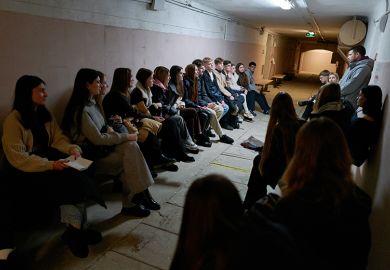
When Dmytro Serebrianskyi returned to Ukraine’s State Tax University in the city of Irpin after it was freed from Russian forces, he barely recognised the place where he had spent years of his career.
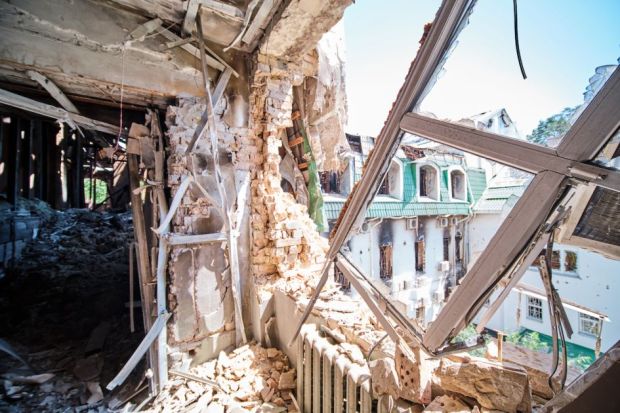
“Those spaces and rooms I had been using for my work and my education, such as my master’s and PhD, were completely damaged and burned out,” he said.
Serebrianskyi was appointed the university’s rector in December 2022, months after Russian forces swept through Irpin, a city just 20 kilometres northwest of Kyiv, in the first few weeks of the full-scale invasion.
By the time Ukrainian forces recaptured Irpin, about half of the university, which is Ukraine's only institution dedicated to training public servants in taxation and public finance and has about 5,000 students, had been damaged or destroyed. Its main administrative building, dormitories and sports complex were gutted. Images show shattered windows and debris-strewn corridors.
Four years on, temporary repairs have allowed students to attend classes. But the university is undergoing a massive rebuilding effort, one of Ukraine’s most ambitious higher education reconstruction projects to date.
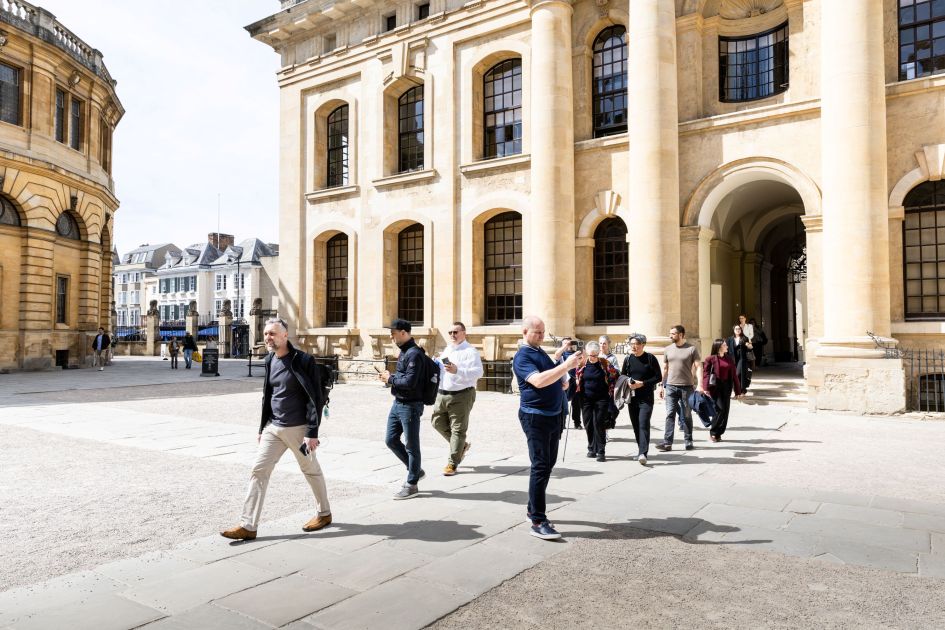
This scheme brought the rector, along with other university staff and students, to the UK this month to tour some of the country’s top academic institutions – the universities of Oxford and Cambridge and the London School of Economics. These campuses offered an insight into historic adaptation and sustainable campus design as part of a trip organised by non-profit Build Forward Ukraine, which also ran an international architectural competition to redesign the university’s main building.
“We don’t know any other European university that has had a similar experience to us recently,” Serebrianskyi said.
“We’re hoping to create something that serves as a template for others in this situation. As a university head, I have peer-to-peer collaboration with other universities in Ukraine and they’re watching what we’re doing very closely and how things develop.”
The winner of the competition, selected by a global jury, was Stantec, a design and consulting firm.
For Stantec’s principal and design director Dathe Wong, who has overseen several campus redesigns, the brief demanded more than just rebuilding a facade. “One of the destroyed buildings was the iconic front door of the university. One of our key ambitions was to rethink how an iconic entrance would look,” he said.
The renderings show a modern building with open courtyards, floor-to-ceiling windows and informal study spaces.
But the design decisions you cannot see in the images are what set it apart. The basement will house a bomb shelter, disguised as a fitness centre and theatre, with deployable walls that can seal the space within minutes.
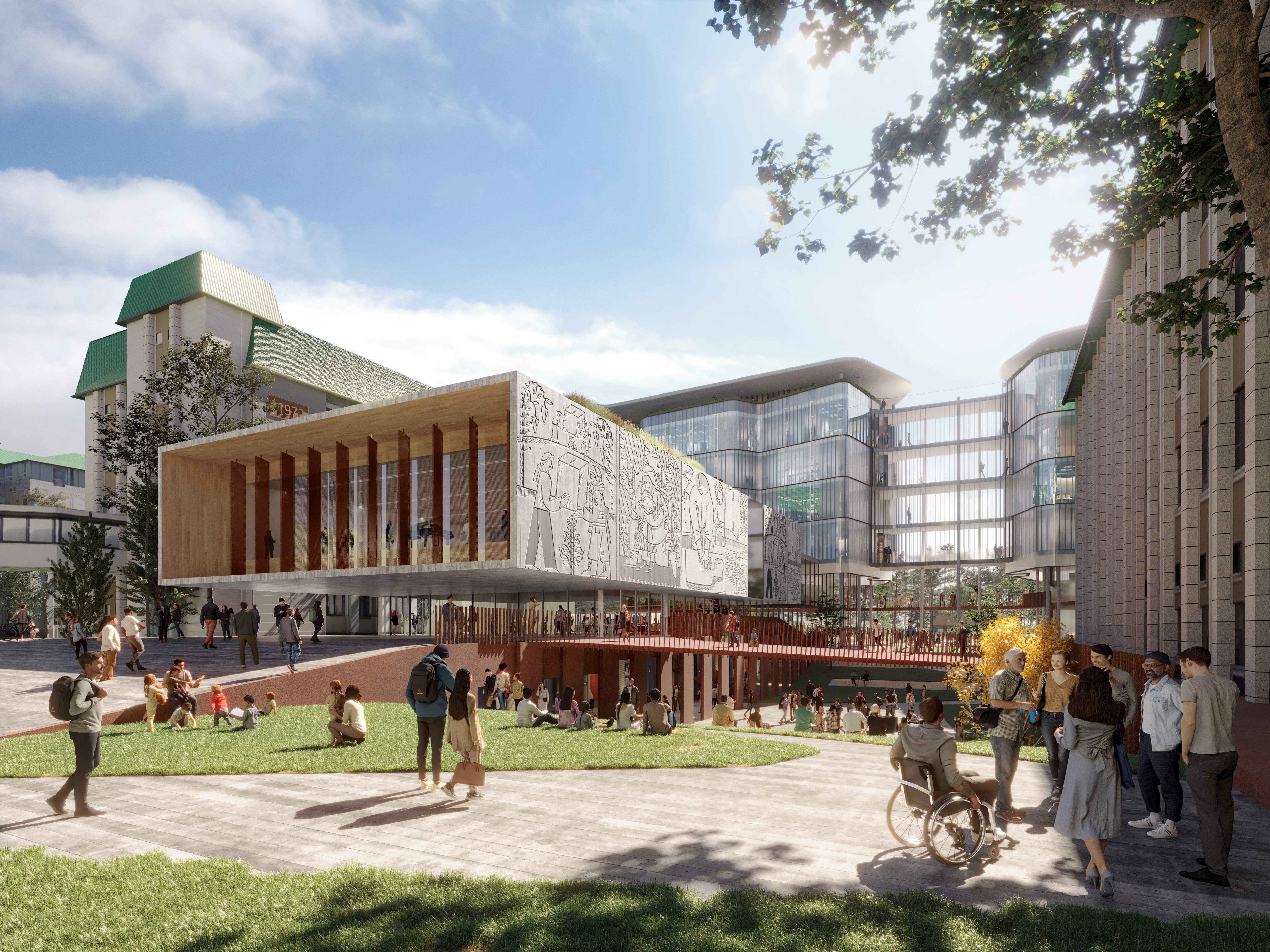
Every pathway and entrance is designed with wheelchair access in mind. The team anticipates a significant number of returning veterans, Wong explained. The building is designed for energy independence to keep functioning when the grid goes down.
“Trauma-informed design and well-being is very much part of this. We’re looking at places that are communal but also spaces where students can have some quiet,” he said.
But the process has not been without its tensions. “Ukrainians move quickly, because it’s a nation at war. We move slowly because we want to get it right – this building will be here for at least 100 years so we have to take the time to articulate the values and vision,” said Margie O’Driscoll, chief executive of Build Forward Ukraine, adding that the group was not getting the same level of support under the Trump administration in the US, compared with the previous Biden government.
Board member Andrii Lakshtanov was more direct. “The friction comes because Ukrainians needed it yesterday. The campus is destroyed, there is no space to educate people that you need on a daily basis. But it is a constructive friction.”
The itinerary for the delegation’s tour in London was collated by Christina Cattelan, senior associate at Stantec, who selected buildings that could offer direct lessons for the project.
Campus resource: Trauma-informed care within academic settings
At Cambridge, the focus was on how historic institutions have added modern buildings without losing their sense of place and how a new structure can acknowledge the past while including something new.
“The architectural design for universities is very important because they want to attract the best minds to come to the institutions and this point is very salient in this context, where a war-torn country is facing brain drain,” she explained.
“Students are choosing to leave and potentially not return. So they could have a generational gap in education. The design of this building is an opportunity to be a magnet for people to feel ‘I really want to come here to learn’. Brain drain is a real concern.”
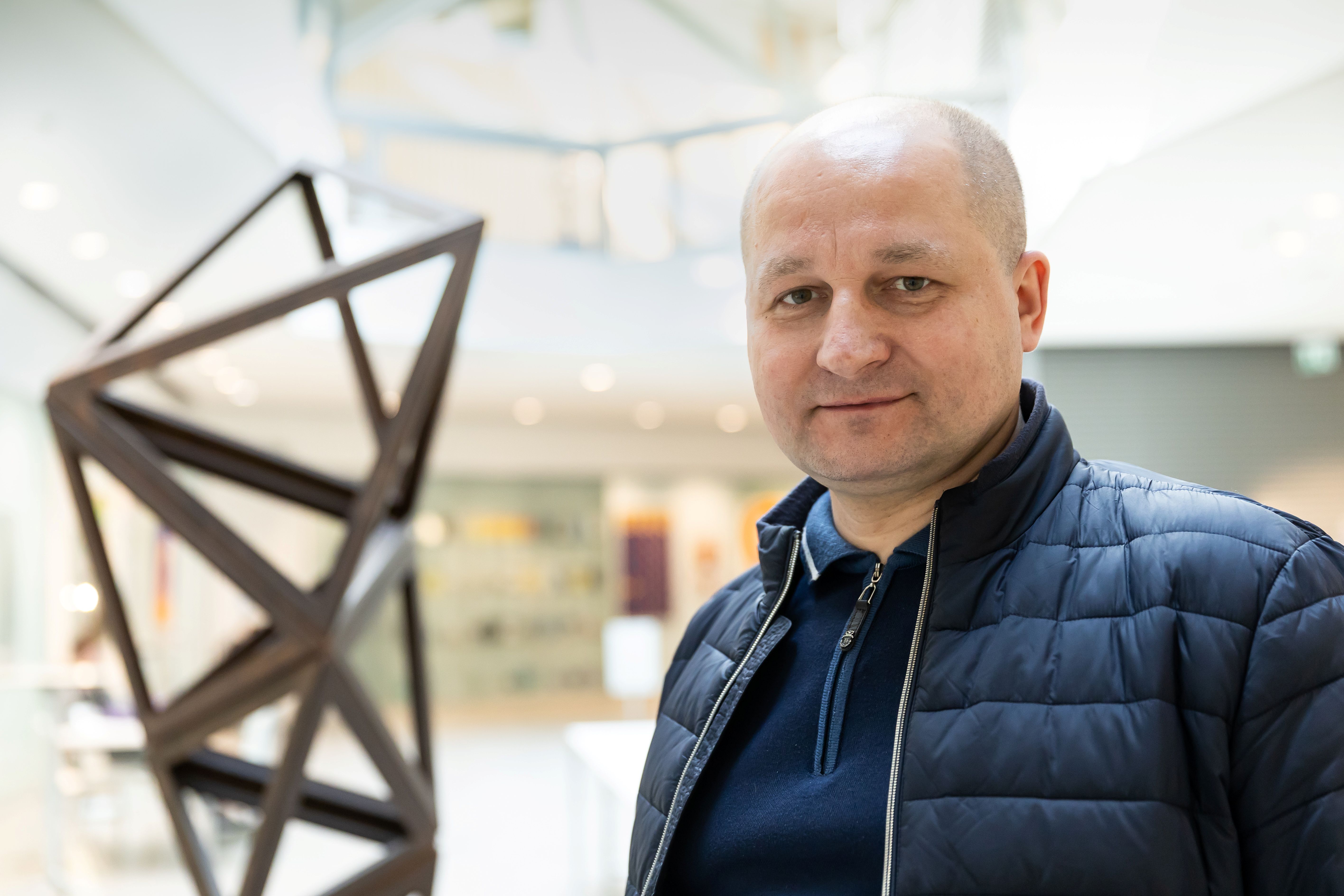
For rector Serebrianskyi, the chance to rebuild the university is more than simply about the buildings themselves.
“This trip has been very useful and intense for us in terms of understanding how the educational process is carried out in Europe,” he said. “Our mission is not just to rebuild the university but transform it to European standards. This tour showed us the direction to aim for and what we’d like to achieve in this development journey.”
Third-year law student Khadidzha Alekberova, who joined the delegation, offered the clearest case for why the project matters. After nights of rocket and drone attacks, she said, students need somewhere safe to go. “If we have a modern and new building, a new campus, we can go there and just do our work,” she said.
The project is currently in the fundraising phase. Construction has not yet begun.
Register to continue
Why register?
- Registration is free and only takes a moment
- Once registered, you can read 3 articles a month
- Sign up for our newsletter
Subscribe
Or subscribe for unlimited access to:
- Unlimited access to news, views, insights & reviews
- Digital editions
- Digital access to THE’s university and college rankings analysis
Already registered or a current subscriber?