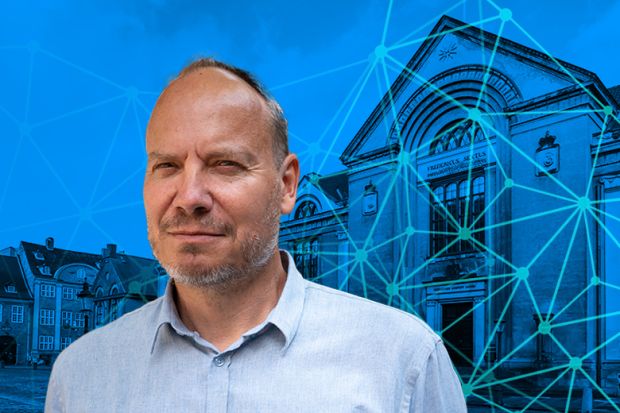
When Denmark’s largest university decided it needed someone to steer it through the once-in-a-lifetime changes brought by artificial intelligence, it did not follow the path taken by many other universities and appoint a computer scientist.
The University of Copenhagen instead turned to Morten Axel Pedersen, who studied anthropology – the study of what makes us human – through to PhD level at the University of Cambridge. He previously helped to establish the Copenhagen Centre for Social Data Science and served as its leader.
Pedersen, who took on the newly created role of deputy prorector of AI in September, said anthropology has played a major role in how he understands new technologies. He stressed that universities need to not only grapple with AI’s future potential but also to try to understand how people are actually using it in their day-to-day lives – something he sees as an anthropological question.
“Anthropologists don’t necessarily take people’s explanations at face value. If you ask people why they are doing something, they might come up with an answer to please you. There might not be an intention to lie but they may simply have not thought deeply about why they are doing something. This insight is very important when it comes to AI in an organisation,” he said.
“AI is being used for a lot of different things by both students and researchers and administrative staff, but as leaders, we have no idea how exactly they are using it, because it takes place in the shadows.”
Copenhagen is now trying to bring some of that activity into the open. The university said it has invested DKr110 million (£13 million) to help adapt the university to what it calls a “new reality” in education, research and working life. The project includes an AI office and cross-university task force, AI labs, its own generative AI assistant and an “AI traffic light” designed to tell staff what kinds of data can safely be used with different systems.
One of the most ambitious parts of Pedersen’s plan is to revisit every single course offered by the university over the next year and consider whether AI should be incorporated into it.
“I don’t think that what I’m going to do is to embrace AI. I want to essentially act on the world the way it is,” he said. “There might be some [courses] where AI is a fundamental part of them. There may be some courses where AI should not be part of the course at all. There may be some courses where AI should even be a requirement.”
Pedersen stressed that while his team will come up with a “framework” to guide AI use, it is up to the individual disciplines to determine to what extent AI should be used in courses. A chemist and an anthropologist will have very different ideas about which skills should be automated and which students still need to master on their own, he added.
He describes the impending framework as a “scaffold”, a temporary structure to help disciplines work out their own relationship with the technology, before AI becomes part of the ordinary workings of the university.
“My goal is to create this scaffold to make it possible for faculties to do this all-important job. I don’t want to sound grandiose, but how often in the history of universities have they ever faced a situation like this? There have been pandemics, global wars and the industrial revolution. [AI] is somehow on that scale,” he added.
His own role is deliberately temporary. When the three years of his contract are over, Pedersen said he hopes there will be clearer guidelines covering AI use in education and research.
“This role is not meant to last forever. The hope is that in three years, the scaffold will be dismantled, and the building is standing on its own,” he said. “I do believe AI is not something that only belongs in a university’s IT department…it touches everything. It’s not just a technical thing and it’s not helpful to think about it as such. It is up to each and every professional community in this university to figure out what AI means for them,” he said.
Register to continue
Why register?
- Registration is free and only takes a moment
- Once registered, you can read 3 articles a month
- Sign up for our newsletter
Subscribe
Or subscribe for unlimited access to:
- Unlimited access to news, views, insights & reviews
- Digital editions
- Digital access to THE’s university and college rankings analysis
Already registered or a current subscriber?