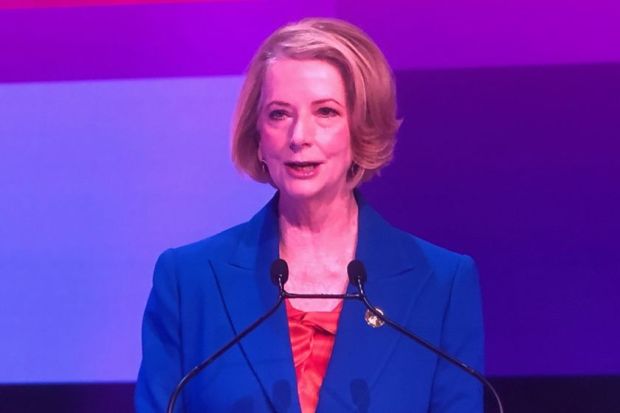
Universities must relinquish some authority to reclaim trust in a “cynical world” where two in five people want to “burn it all down”, according to former Australian prime minister Julia Gillard.
The one-time education minister said an erosion of faith in universities was part of a broader collapse of trust in institutions of all kinds, as people fretted about geopolitical rivalry, global warming and the threat of technological annihilation.
Gillard said a world that had been “happily kidding itself” about the ascendency of liberal democracy, and popular acceptance of institutions like the International Monetary Fund and the European Union, had given way to a “splintering” world beset by “fear and uncertainty” with a “Cold War dynamic around artificial intelligence” just around the corner.
Educational institutions had been caught up in a broader backlash against a perceived progressive “elite”, reflected in survey findings that two in five Britons would not trust politicians to mind their bags, and that young men around the world were statistically less likely than their grandfathers to support gender equality. Much of this backlash came from people’s sense of being “frustrated by powerlessness”, Gillard said.
“Devolved decision making is one way to address that powerlessness,” she told the Australian International Education Conference. “In the political world, I am increasingly convinced we need to build more community trust through more devolved decision making and more direct democracy experiments, enabling people to participate and see a clear through-line from their views to the outcomes.”
This approach could help address the mortal threat from AI, which was torpedoing trust both of and within universities – with lecturers suspecting students of using bots to produce assignments, and students suspecting academics of using bots to mark assignments.
Gillard said techniques to ensure academic integrity – such as closed book exams, oral assessments and direct monitoring of the production of assessment work – were “needed”, in ways which did not “revive traditional biases” or harm students’ mental health. “That’s all an extraordinarily tall order,” she acknowledged.
“[To] add to the difficulty, how do we ensure the environment doesn’t scream lack of trust, [where] the cultural baseline assumption in education is the belief that all students will cheat if we don’t stop them?”
The answer could lie in “co-creation”, she said. “Involving students in a direct and thoughtful way…would build trust. Given [that] they are the digital natives, it would also generate answers that those further up the hierarchy are unlikely to see.”
Gillard said an “attitude of relentless cheerfulness” among educators would not help young people confronting the “grim realities” of contemporary life. “But education can be deliberately structured to teach constructive hope, to develop the cognitive pathway between analysing an immense challenge like climate change or growing inequality, and creating practical, hands-on answers – whether that be creating an urban garden, designing local economic models or coding open-source tools.
“What would it look like if hope and trust were the watchwords as we built the future of education for international and domestic students? That would be a real delineator, I think.”
She said the international education sector faced a difficult task in “extracting” itself from a “toxic” debate about immigration. “I think the only way of working through it is with the authenticity of local stories and community engagement,” she told the conference.
Publishing statistics and analyses would not help, because “either no one cares or no one believes it. You really…need to be telling the story of overseas students at your institution, in your community. Where they came from, what they’ve done, how they’ve contributed. We’ve got to break it right down into that kind of storytelling to have any hope of getting a better community view about overseas students.
“The only thing that seems to turn around community opinion now is authenticity, directness, localism. It’s a lot more work and it’s a lot harder, but that’s the work that has to be done.”
Gillard said international educators faced a “painful” period for the next two or three years, but “I think we will come out of this cycle. We will get to a more rational debate about the role of international education in Australia.
“Yes, there’s market share and reputation questions. Many of the source countries’…education systems are developing leaps and bounds. But I continue to believe that an experience in Australia, or through an Australian institution, will be viewed as a desirable and premium experience for many a long decade to come.”
Register to continue
Why register?
- Registration is free and only takes a moment
- Once registered, you can read 3 articles a month
- Sign up for our newsletter
Subscribe
Or subscribe for unlimited access to:
- Unlimited access to news, views, insights & reviews
- Digital editions
- Digital access to THE’s university and college rankings analysis
Already registered or a current subscriber?