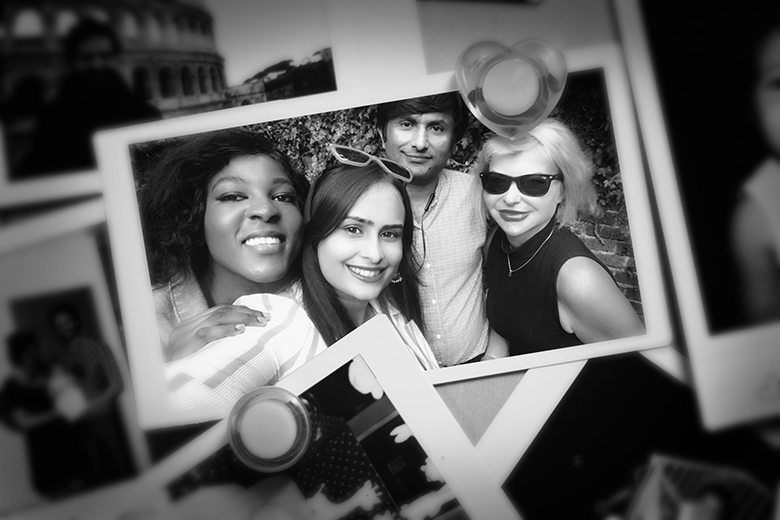
My loo in west London, like so many in other people’s houses, doubles as an informal photo gallery. There is my son at nursery, my son graduating from the University of Edinburgh, my own PhD ceremony at Birkbeck, University of London, as well as assorted images of weddings, family and friends. And there is one photo I display with particular pride: four people in my garden, squinting into the sun and laughing. Three of them are my former doctoral students, now fully fledged academics: Charmaine Dambuza, Priyanka Singh and Babar Hussain. The fourth is me.
The picture was taken a few years ago, perhaps a year before they finished. I have been thinking about this a great deal recently, prompted by current stories about discrimination and prejudice, as well as recurring concerns about plagiarism in doctoral work. These concerns raise a question nobody seems keen to ask: where, exactly, were the supervisors and examiners? A doctorate does not materialise by itself. Supervisors read it, examiners examine it, institutions award it. Supervision is intellectual, ethical and pastoral labour, and when universities stop valuing it, both standards and vulnerable students pay.
I have been on the receiving end of academic offences myself. My own work has been plagiarised more than once. Mostly I let it go. Once it was so blatant that I did complain to the publisher. Plagiarism is a terrible thing, not only as a breach of academic honesty but also because another human being’s work, often produced through blood and tears, has been stolen. It is never excusable, in exactly the way that bullying, hounding or witch-hunting of any kind, in the mainstream or social media, can never be justified.
A little more about me, because it is relevant. Before academia I was BBC-trained, ran my own company and made award-winning documentaries for a living. I then did a PhD under some quite famous professors: a transdisciplinary work spanning psychoanalysis and film. My director of studies, the notable psychology professor Stephen Frosh, was tough and rigorous. He read every line I wrote and came down hard on any slackness. That was my training, and I am forever grateful for it.
I finished in three years flat with no corrections. My first monograph was published a few months after graduation and went into a second edition a couple of years ago. My ambition, absurd as it sounds now, was to go into higher education to change the world. So I took a job at a modest UK university and spent almost nine years there before becoming a full professor and head of school at another.
I say this not to boast but to explain why I know what a doctorate should look like and why I mind so much when the process is treated carelessly. A PhD, taken seriously, is a brutal ride. Supervising one well means entering another person’s thinking and staying there for years. It has been the greatest joy of my academic life.
I should also confess to a personal sensitivity. I am Polish, obviously, with a name like Agnieszka Piotrowska. But I am also British, with nowhere else I could call home but London. Post-Brexit, that was a curious place to occupy. I was regularly reminded that I did not quite fit, that I was too brazen or too productive. “Stay in your lane” I was told more times than I care to remember. It is not fashionable to talk about discrimination when you are white, blonde and blue-eyed, and I do not equate what I went through with the racialised prejudice my students faced. But I experienced it, consistently, alongside moments of real generosity, and it made me unusually alert to the mechanics of exclusion, to every flicker of it directed at my students.
The three in my photo came from Zimbabwe, India and Pakistan. Counting my roles as second supervisor, I have 12 doctoral completions to my name, and these three were outstanding by any measure. Yet they were also, without exception, subjected to prejudice, some of it petty and some of it consequential, in institutions that had DEI objectives printed in every strategy document.
The subtle signs of discrimination included some resistance to their even being admitted to doctoral study at all, on the grounds that they allegedly lacked the capacity for research. This was emphatically not true and we fought it together and won, supported by some colleagues. Later, in the early post-Covid days, I was in a meeting where there were apparently too many bodies in the room – upon which a senior academic turned to the only Black person present and asked her to leave. I left the meeting too and complained in writing, which was deeply unpopular. It was, at best, unconscious bias in its purest form: tragic and laughable at once.
All three of my students were homesick at times. All three carried pressures well beyond the usual academic ones. Their subjects were very different, but cinema, gender and postcoloniality seen through psychoanalysis were the common threads, and I knew the territory. I was obsessed with helping them find their own voices, sometimes through auto-ethnography set against rigorous theoretical and reflective analysis. But I was equally obsessed with something less glamorous: checking, and checking again, that nothing in their work could ever be read as academic misconduct.
I did this because I knew what was coming. Somebody, somewhere, would question their abilities because of the colour of their skin.
The only defence was to make the work unassailable: in referencing and citation, obviously, but above all in the quality of the thinking. So for their final vivas I invited as examiners the best specialists in the country and internationally: Diana Jeater (University of Liverpool), Rajinder Dudrah (Birmingham City), Amanullah De Sondy (University College Cork) and Ashvin Immanuel Devasundaram (Queen Mary University of London). The role of examiners is crucial, and it is another thing that goes unmentioned in the recent scandals.
My students were well prepared, both for their vivas and for the job interviews that followed. The vivas were tough, rigorous, even frightening, but the candidates did well. There were corrections, which they carried out rigorously, but there was also praise for their originality. When all three secured academic posts soon afterwards, in a brutally competitive market, a few eyebrows were indeed raised about supposed DEI hiring. But we could ignore them, and we did. Their work stood on its own merits.
Which brings me to a contradiction at the heart of the system. Universities rightly demand rigour of their doctoral candidates: every citation must be checked, every claim defended in a viva. They do not always apply comparable expectations of scholarship to those who lead them. It is not unusual, particularly in non-Russell Group universities, to find senior academic managers holding professorial titles without a doctorate or a meaningful industry or publication record – and remaining in post while redundancies sweep through the sector. Basic metrics of qualification and experience should apply at every level, and rather obviously to those who lead departments, schools and whole institutions. If a candidate must be unassailable, so should the people who sit in judgement over her.
Meanwhile, supervisors, under constant threat of losing their jobs and judged primarily on their own research output, have every incentive not to spend the enormous hours that doctoral students actually need, including on pastoral care.
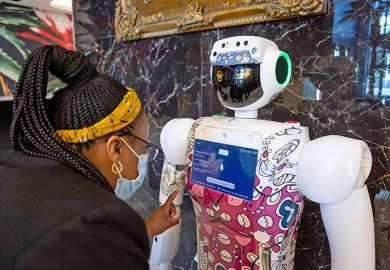
Some of that gap is now being filled by machines. At UNSW Sydney, Jill Bennett and Gail Kenning have been deploying experimental AI avatars to support international students, particularly their well-being, as they showed at a recent conference in London. Where the university cannot offer enough support, the avatar does; it will even speak to a homesick student in her own language. Digital tools can also help supervisors with text matching and citation checking before it is too late. But no tool replaces a supervisor who actually knows the work and can tell when something is wrong. And that we are farming out the most human parts of the job to machines at all is, of course, its own kind of desperation.
While I am proud that those three students in the photo now enjoy their own academic careers, mine is now only part-time. The petty envies and prejudices hurt me as well and I was resilient and creative enough to move on. Coming from industry, I had plenty of ideas for projects. But I remain linked to the sector and I treat that freedom as a gift. Not everybody is so lucky.
I also know that I was privileged to have been able to guide my students and to watch them succeed. I am grateful for what I learned from them, too. And their photo stays in the loo, among the family, because that is where they belong. They were never just a line on someone’s workload spreadsheet.
Agnieszka Piotrowska is an international keynote speaker on AI intimacy, as well as an award-winning film-maker, psychologist and academic. She supervises PhD students at Oxford Brookes University and the University of Staffordshire and is the author of AI Intimacy and Psychoanalysis (Routledge). She is a senior fellow of the Higher Education Academy.
Register to continue
Why register?
- Registration is free and only takes a moment
- Once registered, you can read 3 articles a month
- Sign up for our newsletter
Subscribe
Or subscribe for unlimited access to:
- Unlimited access to news, views, insights & reviews
- Digital editions
- Digital access to THE’s university and college rankings analysis
Already registered or a current subscriber?