The “steady erosion” of research ties between China and the US is damaging to both countries’ interests, experts have said, after 30 top research universities in the US were ordered to audit their foreign partnerships.
This week the US Department of War gave universities just two weeks to review ties with institutions that feature on a list, known as Section 1286, that identifies institutions deemed a “concern to national security”.
The department said the action “is designed to protect American taxpayer-funded research investments from unauthorised technology transfer, intellectual property theft and adversarial exploitation”.
There are 130 academic and research institutions on the list that are currently deemed national security threats, 88 of which are situated in mainland China.
The Department of War has said that the 130 institutions named “have been confirmed to engage in activities that increase the likelihood of U.S. government-funded research and development efforts being misappropriated”.
US universities have been warned by the department that any research collaborations with an institution on the Section 1286 List could “negatively impact their eligibility” for future federal funding.
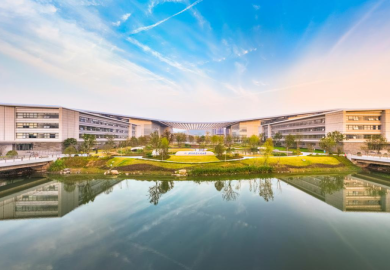
Two of China’s leading universities, Fudan University and Shanghai Jiao Tong University, have most recently been placed on the national security list. Fudan University and Shanghai Jiao Tong University are members of China’s C9 League, an affiliation of elite public universities likened to China’s equivalent of the Ivy League.
The Chinese embassy in Washington said in a statement that it opposed “the overstretching of the concept of national security and the politicisation or instrumentalisation of normal scientific, educational and academic exchanges”.
Some scholars have also suggested that blacklisting Chinese universities could weaken US research capabilities and outputs.
Philip Altbach, emeritus professor at the Center for International Higher Education at Boston College, told Times Higher Education that the “best” policy was to maintain – and verify – research ties with China.
“As Chinese improve and produce more quality research, collaboration and links are ever more important,” he said.
Altbach argued that “the steady erosion of higher education and research ties between China and the US, largely but not exclusively initiated by the Americans, is damaging to both countries”.
He added that the intervention was especially damaging to the US “at a time when US government support for research and higher education is declining and universities are under pressure from the Trump administration”.
The Department of War also added Shandong University to the list of “foreign institutions engaging in problematic activities” at the end of July.
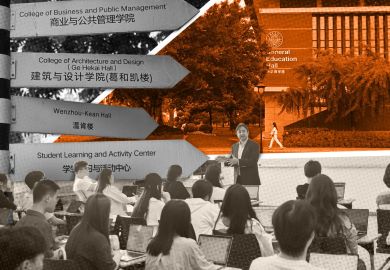
The same institution has also been caught up in a crackdown in Australia, where the country’s foreign minister has axed the Shandong University (SDU) and Australian National University (ANU) Joint Science College on the grounds of national security concerns. The SDU-ANU Joint Science College collaboration was first approved in 2018 and officially launched in 2022 with an inaugural cohort of 61 students.
The joint venture college has a capacity for 1,200 students, but official figures pertaining to the number of Chinese students affected by the closure have not been released.
It is still unclear whether Chinese students currently enrolled in the programme will be permitted to finish their degrees. Assistant minister for international education Julian Hill has said that the Australian government is “working through those issues with the institution”.
Hamish Coates, honorary professor at ANU and tenured professor at Tsinghua University, told Times Higher Education that: “Universities have always operated in national contexts. For a few ‘global’ decades it seemed the world had fewer borders and more frontiers.
“These days many countries are pivoting from ‘markets’ back to ‘mission’, refocusing on the needs of the national communities which they are constituted to serve.”
Register to continue
Why register?
- Registration is free and only takes a moment
- Once registered, you can read 3 articles a month
- Sign up for our newsletter
Subscribe
Or subscribe for unlimited access to:
- Unlimited access to news, views, insights & reviews
- Digital editions
- Digital access to THE’s university and college rankings analysis
Already registered or a current subscriber?