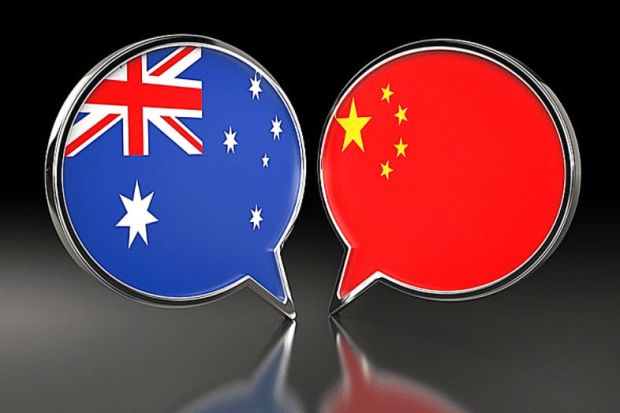
The near decade-old campaign to frame Australian university research collaboration with China as a national security threat is experiencing a renewed burst.
Fears around research security are not made up. In 2023, the Australian Security Intelligence Organisation disclosed a plot by China’s intelligence services to “infiltrate a prestigious Australian institution”.
Still, this does not change the broader reality: greater threats to Australia’s national security are posed by inflated views of the country’s scientific and technological standing and by exaggerating the risks of collaboration with China relative to the costs of curbing it.
Featured prominently in recent reporting and commentary is an authorless report by US “AI-led intelligence company” Strider Technologies. It claims to show how research partnerships with Australian universities are being used by China “to access sensitive dual-use research, recruit talent, and advance the technological capabilities of the PLA [People’s Liberation Army]”.
It shows nothing of the sort. Rather than demonstrating technology transfer or espionage, the report simply identifies academic publications co-authored by researchers affiliated with Australian institutions and those working at what it calls “PLA-affiliated research institutions”.
Unspecified publications are claimed to advance China’s expertise in “covert communication” and “target-tracking techniques for unmanned underwater vehicles”. But the logic is hard to sustain: after illicitly acquiring sensitive technology, a Chinese intelligence asset supposedly publishes it in English for a global audience – while crediting their Australian victim.
An overwhelming majority of the supposedly problematic collaborations are not with entities directly tied to the PLA or the Chinese Communist Party’s Central Military Commission, such as the National University of Defense Technology. Instead, they involve institutions such as the Harbin Institute of Technology and the Beijing Institute of Technology.
Yes, these are part of China’s “Seven Sons of National Defence” university grouping, overseen by the Ministry of Industry and Information Technology, and so warrant scrutiny. But they are also large, comprehensive public universities, producing fundamental STEM research at least as good as that generated by the best Australian institutions – which themselves are deepening ties with Australia’s defence enterprise.
The broader data tell a different story. Clarivate’s Incites database indicates that researchers affiliated with Chinese institutions have appeared on 55 per cent of the world’s top 10 per cent most-cited STEM publications since 2020 – more than triple the US share (17 per cent) and 11 times Australia’s (5 per cent).
Of Australia’s share of these top-tier publications, collaborations with China-affiliated researchers appear on 52 per cent – three times more frequently than collaborations with US researchers.
This is not evidence of a vast Chinese espionage effort. It reflects Australian researchers seeking to collaborate with the world’s leading scientific communities.
By contrast, Australia-affiliated researchers appear on just 4 per cent of China’s top-tier output. Restricting collaboration would therefore do little to slow China’s technological progress, but it would directly weaken Australia’s access to the global STEM frontier – undermining, rather than strengthening, national security.
It is also important to note that Australia’s STEM success owes much to Chinese-background researchers at Australian institutions. In 2025, of the 300-odd recipients of the prestigious Clarivate Highly Cited Researcher awards affiliated with Australian institutions, one-quarter were of Chinese background.
Since 2020, 13 researchers of Chinese background have also been inducted as Fellows of the Australian Academy of Science. Many of the most senior and productive among them are Australian citizens or permanent residents who have called the country home for decades.
In our in-depth interviews with them, they contend that what is unfolding is not a sensible accounting for risk, but rather over-securitisation. And that process is taking a personal toll. In media coverage, some have been targeted with slurs of disloyalty for their work with colleagues in China, despite having broken no laws or regulations.
The fearmongering is also constraining research capacity and career incentives. We – researchers at the University of Technology Sydney’s Australia-China Relations Institute – spoke recently with a senior researcher of Chinese background at a New South Wales university with promising ideas for breakthroughs in materials engineering; he lamented that assembling a capable team was becoming nearly impossible because local students are mostly unwilling to undertake a PhD in his research field, while well-qualified PhD candidates from China struggle to obtain visas.
Moreover, for every grant application he submits to the Australian Research Council (ARC) involving collaboration with China, he must specify how he will manage the risk of foreign interference. Yet despite extensive due diligence, his university has warned him that such collaboration may still jeopardise his chances of securing funding.
“I feel torn between the excitement of potential breakthroughs and a growing sense of futility,” he said. “Why bother? It’s just a job.”
Another expert in metallic materials, also based in New South Wales, warned that by limiting collaboration, Australia risks falling behind by cutting itself off from the world’s most advanced STEM ecosystem.
“Australia is fairly competitive in basic research, but we often don’t have the capacity to translate ideas into applications,” he said. “Chinese universities have both the teams and the resources. What might take us five years can be done there in one. In many fields, China now leads Australia by years.”
This assessment was echoed across our interviews. One Adelaide-based marine scientist put it bluntly: “If Australia and China collaborate, Australia has more to gain than China [does]. Chinese scientists work with us not out of necessity but because it enhances their professional standing.”
Many Chinese-Australian researchers expressed confusion at Australia’s apparent alignment with US policy settings. As one Queensland-based energy scientist put it: “The US and China are competitors, and the US wants to contain China. That logic makes sense for them. But Australia is not the US, and China is already well ahead of us, so what do we gain by not working with them?”
We have also been told that some elite researchers – including several ARC-funded Laureate Professors – have left for positions in mainland China, Hong Kong and Europe.
National security is not strengthened by making Australia smaller, less connected and less attractive to scientific talent. The greater danger is not that Australia collaborates too much with China but that it retreats from global science – and convinces itself that it can thrive while doing so.
James Laurenceson and Wanning Sun are, respectively, director and deputy director of the Australia-China Relations Institute at the University of Technology Sydney.
Register to continue
Why register?
- Registration is free and only takes a moment
- Once registered, you can read 3 articles a month
- Sign up for our newsletter
Subscribe
Or subscribe for unlimited access to:
- Unlimited access to news, views, insights & reviews
- Digital editions
- Digital access to THE’s university and college rankings analysis
Already registered or a current subscriber?