When ChatGPT was first launched in late 2022, many universities rushed to ban its use on the grounds that the artificial intelligence posed an existential threat to learning and the integrity of assessment.
One report found that as many as a third of Russell Group universities banned AI use by students in 2023. Yet that usage has just kept on rising. Today, as many as 95 per cent of students say they use AI in their studies – up from 66 per cent as recently as 2024.
Within those figures, the proportion of students directly including AI-generated text in assessed work has risen to 12 per cent, up from 3 per cent in 2024.
Nevertheless, universities have gradually softened their positions in recent years, increasingly allowing large language models to be used for revision, research and exploring ideas. Some, like the universities of Manchester and Oxford, have even established partnerships with AI companies, granting students access to the latest tools, reasoning that since AI will become ubiquitous in the workplace, knowing how to use it is now a vital graduate skill.
But what about the use of AI in assessed work? Is that also just a reflection of modern reality? Or does it obscure students’ inherent abilities, which is what employers really want to know about?
Writing in Times Higher Education in 2023, Andrew West, associate professor in the School of Accountancy at Queensland University of Technology, suggested that allowing students to use AI in assessed work is like allowing people to do their driving test in a self-driving car. By contrast, the following year, Dorottya Sallai, chair of the London School of Economics’ AI working group, argued that “the reality of GenAI’s widespread use and near undetectability cannot be ignored or fought against, but instead of viewing GenAI only as a threat, we can and should embrace it as an opportunity to reform some of our outdated approaches” – including in assessment.
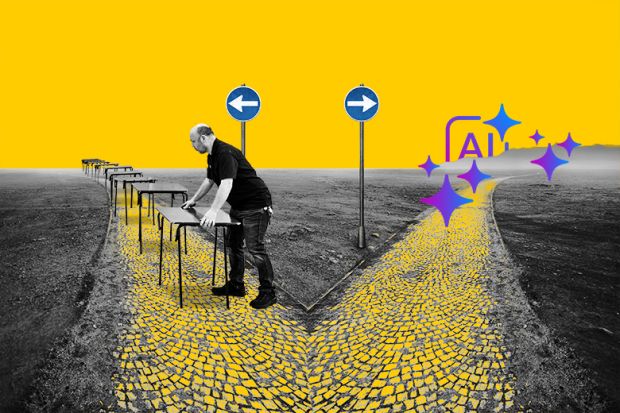
Another two years on, however, approaches remain diverse and in flux. Based on THE’s investigations, the most common approach across UK universities appears to be a “traffic-light” system. “Red” assessments disallow AI use completely, amber ones allow some use and green permit or even encourage it. Such an approach is taken at the universities of the Arts London, Bristol, Chichester, Leeds and Nottingham, among many others.
Interestingly, while the LSE also uses a traffic-light approach, a spokesperson said it has also seen an increase in what are assumed to be inherently AI-proof assessment methods, such as in-class assessments and in-person, invigilated examinations, “as well as oral assessment and a greater focus on process-based assessment”: the idea that students should be critiqued on their ability to critically interact with AI to improve their work. Some staff across different LSE departments have been integrating AI into formative and summative assessments, and the university has been “piloting edit-tracking technology”, the spokesperson added.
Meanwhile, the University of Bath has announced that from the 2026-27 academic year, it is abandoning its traffic-light system for a “simpler, principles-based ‘Two-Lane’ approach” developed by the Association of Pacific Rim Universities (APRU). This will see it move to either “open” or “closed” assessments.
In “open” assessments – including coursework and remote open-book exams – “use of GenAI is optional (or in some cases integral)”. This is “ideal for assessing areas where GenAI would be expected to be used effectively in industry”. However, “closed” exams will be time-limited, invigilated and in-person exams.
Cardiff University also confirmed it is looking to implement the two-lane approach. While it doesn’t “anticipate a large-scale” return to paper-based exams, “it is anticipated that adjustments could include greater emphasis on in-person, supervised assessment formats where appropriate, as well as a redesign of take-home tasks”, a spokesperson said.
Decisions on specific AI use in assessment at Cardiff are taken at the school and module level, while “institutional parameters” are set centrally: a common policy across institutions.
Cardiff is also one of several universities, alongside Durham and Edinburgh Napier, whose institutional parameters include a requirement for students to fill out “declaration” statements alongside their assessments stating how they have used AI and agreeing that they have not knowingly broken academic integrity rules.
A recent report by the Higher Education Policy Institute (Hepi) set out to analyse UK universities’ AI policies to establish whether their phrasing was “education-dominant” (including such terms as critical thinking, literacy, agency and assessment design) or “detection-dominant” (incorporating words such as plagiarism, misconduct, penalty, Turnitin and zero tolerance). Of the UK’s 163 universities, 96 (59 per cent) had publicly accessible AI policies. The report found that 83 of those 96 used education-dominant language. Nine fell in between, while only four were classified as detection-dominant.
However, the report says, there is a “systematic gap between what policies say and what they do”, and that they “use the language of education while operating as compliance instruments. They promise critical thinking but deliver audit trails. They name support yet deliver surveillance.”
The University of Southampton, for example, promises to produce “critically digitally literate” graduates, but then produces a “binary list of acceptable and unacceptable uses”, with the latter resulting in “disciplinary action that may result in penalties on your marks”.
The report also suggested that the institutional location of AI policies has an effect. A policy placed in a university’s misconduct framework “inherits that framework’s assumptions about students”, while policies located within teaching and learning pages – like those at University of Stirling and Canterbury Christ Church University – “were more likely to be genuinely educational”.
The report author, Sam Illingworth, a professor of critical AI literacy at Edinburgh Napier University, told THE he believed that universities should approach policies from a position of “trust” – not least because “there’s yet to be any evidence that demonstrates that students are cheating more with AI tools than they used to.”
Cheating “has always been an issue” he said, citing essay mills. He conceded that “AI democratises cheating, in a way”, given that the basic versions are free to use. But the “kneejerk reaction” against its use is on a scale not seen in relation to other threats to academic integrity – because it triggers “harder questions that need to be asked, like ‘what is the purpose of assessment?’, which universities are uncomfortable addressing”.
But Daniel Sokol, a former academic and a lawyer who has represented “hundreds” of students accused of using AI, said that although he recognised his sample is biased, “my clients often say that nearly everyone they know is using AI. As an employer, and with the exception of a few subjects such as medicine, I have far less confidence than before about the reliability of a degree as a measure of knowledge or competence.”
He also suggested that the detection rate for unauthorised AI use is probably very low. “Universities have become more sophisticated in identifying AI use, but students are one step ahead,” he said. “Even if an institution can track a student’s keystrokes, you can get AI software that simulates someone writing an essay, letter by letter, with occasional deletions and typos. It is usually [only] the AI-naive students who get caught.”
Sokol also worries about “poor standards of investigation and decision-making” in academic misconduct cases. “The decision-makers in these cases are, on the whole, insufficiently trained to make these important decisions. They do not grasp the rules of natural justice and struggle to weigh evidence, to make findings of fact, and to give adequate reasons for their decisions. Consequently, there are innocent students who are found guilty and guilty students who get away with it.”
Still, Adam Waddingham, company secretary of the UK’s Office of the Independent Adjudicator (OIA), which handles complaints from students about universities’ internal procedures, said that the watchdog had so far seen a “relatively low” number of complaints from students about academic misconduct procedures around perceived AI use – although he admitted that this could increase in the coming years.
The small number of complaints received by the OIA have revealed that “AI is rarely the real issue”, Waddingham added, and generally turn on “a lack of clarity over what is permitted”, with students “genuinely believing” they acted within their universities’ AI policy.
Insistences that AI should not be used “inappropriately” are especially hard for students to adhere to, he said, and universities need to ensure that policies are written “for students, not AI specialists” and provide “clear examples” of their application.
In Sokol’s view, “the temptation to use AI is now so great that, when setting assessments, there should be an assumption that, where the opportunity presents itself, students will use it” – and that meant, in his view, that there should be a return to in-person exams, in which it is “much harder” to cheat than in at-home assessments. Failing this, he said, it may be “fairer and simpler” to abandon traffic-light systems and allow students to use AI in all assessments.
That approach has been taken by the University of Surrey. Earlier this year, the institution announced it had redesigned its entire curriculum and assessment policy to embed artificial intelligence into every course.
The transformation, effective from September 2026, will see it move towards assessing students’ “process” over their “outputs”, or critically evaluating the outputs of AI as part of assessment. For example, third-year civil engineering students could be asked to use AI to help them design a building, before then verifying every AI output by hand calculations and modelling. Meanwhile, in English literature, students will continue to submit essays, but they may also be asked to submit drafts or revision memos to prove their authorship.
Annika Bautz, pro vice-chancellor for education, said the university previously used a traffic-light system, but she believes this is “prohibitive and punitive and just outdated” and is “starting now to be rolled back by quite a few universities”. Such approaches “pretend that there are situations where AI doesn’t exist, and I think that’s just not appropriate to the 21st century any more”.
Equally, returning to in-person exams is an “artificial way of dealing with the problem” that “won’t prepare your students for the world of work”. In that sense, assessment policies cannot be isolated from considerations of the wider curriculum: “If it’s a stand-alone policy it’s not going to work…It needs to be embedded.”
Yet THE spoke to numerous academics who are returning to in-person and invigilated exams nonetheless.
One is Andy Hamilton, a professor of philosophy at Durham University. As he described in an article earlier this month for The Spectator, he has stood down from his role as chair of Durham’s board of examiners for philosophy because of the “crisis” surrounding student AI use.
“You have had to have marked essays in the last few months to appreciate the problem because it’s become dramatically worse,” he told THE. He explained that he had been on research leave during the winter assessment period, meaning that up until April, he had not marked any assessments since June last year.
“I realised that I couldn’t tell any more which ones had used AI improperly and which ones had used it properly,” he said.
In his Spectator article, he laid some of the blame at the door of universities for failing to revert to the mixture of in-person assessments and coursework that had been used to assess students, before the former were “understandably” replaced by at-home exams during the pandemic. Initially this was satisfactory, he said, as universities’ use of the plagiarism checker Turnitin made it “hard to cheat”. But with AI it is now all too easy, he believes.
“[People say it’s] too difficult to provide sit-down exams, but it’s not that difficult because it was only five years ago that we had them,” he told THE. Yet they have not been reintroduced because universities “are not agile”, tend to “defend the status quo” and “have invested a great deal in investigating how to deal with AI [cheating] and detecting it”.
Michael Draper, professor in legal education at the University of Swansea and director of the university’s academic regulations and student cases board, is slightly more forgiving of universities’ reluctance to row back.
He suspects that vice-chancellors “discovered they saved quite a lot of time and resources in not having in-person exams”, relieving themselves of the bureaucracy of organising timetables and hiring invigilators – and, “let’s face it, universities are not well placed financially at the moment.”
Alongside Philip Newton, a professor of medicine at Swansea and a fellow expert in academic integrity, Draper discovered last year, via a series of freedom of information requests, that 78 per cent of UK universities were still using online exams.
Of those, 65 per cent did not use any proctoring service, while 25 per cent used supervision or monitoring for only some of their exams. Just 10 per cent used a remote invigilation system for all their online exams. That meant that an average of 246 examinations per university went unsupervised. And of the institutions that ran unsupervised online invigilation exams, 65 per cent provided a policy or guidance regarding their security or integrity, but only 28 per cent of those referred explicitly to generative AI usage.
In addition, 70 per cent of institutions said they had no plans to phase out online exams. And while 19 per cent intended to scale back their use, only 3 per cent (two institutions) planned to eliminate their use completely.
But Draper told THE that his department will now be returning to in-person exams for some assessments next year, as “we had noticed that student use of AI had got progressively worse this academic year” – although there will be no return to the “memory test”-style exams common before the pandemic; students will be permitted to take some notes into the exam.
Ultimately, Draper believes that more universities will inevitably return to having at least some in-person exams to protect integrity; in his view, “at least” 50 per cent of assessments should be supervised.
Interestingly, one of the ways that increased AI usage has been manifested is lower marks. “We actually found that we’re awarding fewer high-class marks,” Draper said, adding that grades were “getting bunched” in the high 2:2, low 2:1 range, “because students aren’t able to actually use AI efficiently or effectively in relation to assessment”.
Nor, it seems, does a return to in-person exams necessarily entail a fall in student scores.
The law school at Birkbeck, University of London, reintroduced invigilated exams this academic year, after academics became “unwilling to wade through piles and piles of essays that clearly, for the most part, had not been written by students”, according to Stewart Motha, a professor in the school. “We ended up with a very large number of academic misconduct allegations, which is really quite serious.”
Students were consulted and then informed of the changes. Despite being permitted to take handwritten notes into the exams, many were nervous. Yet more than 45 per cent of Motha’s students received a first-class grading, which he described as “a staggering outcome. When we had take-home essays in the same module the previous year (2024-25), the proportion of firsts was 13 per cent.
“One of course needs to be cautious about heralding firsts as the measure of success,” he conceded. But that increase in grading came alongside an increase in attendance, engagement and cooperation between students.
“They were on a completely different learning journey than if they had just been waiting for me to release the essay questions [with the intention of] using AI to produce an essay,” he said. “It was a completely different atmosphere of teaching and learning throughout the term. It was a return to the university as a site for learning how to learn complex material and make good judgements and arguments.”
Motha rejects the term “analogue” to describe his new approach, pointing out that his students still have access to virtual learning suites and are encouraged to engage with emerging tech as part of their courses. But he and his colleagues are “recognising that when it comes to assessment in particular, the integrity of the process is really quite fundamental”.
Approaches to the use of AI in assessment, then, are “just so different”, as Edinburgh Napier’s Illingworth put it. But he doesn’t believe that the question of where and where not to allow AI use “needs to be as complex as people are making it”. For him, one of the sector’s many professional bodies could and should draw up a more informed model policy, which could then be “adapted and adopted” by individual institutions.
Motha’s mind is already made up, however. The pedagogical benefits of returning to in-person exams are so great that, for the first time in years, he is “excited” to see what his students produce in the current round of exams. And so are they.
“When I speak to them about how they’re planning their revision, I feel like I’m back in an authentic process,” he said. “There’s real authenticity to what they will produce themselves and what we produce together as a degree outcome. I think this is the really precious thing that we are at risk of losing…There’s a genuine excitement that the students have now. [But] how could asking a machine to write your essay be exciting?”
Register to continue
Why register?
- Registration is free and only takes a moment
- Once registered, you can read 3 articles a month
- Sign up for our newsletter
Subscribe
Or subscribe for unlimited access to:
- Unlimited access to news, views, insights & reviews
- Digital editions
- Digital access to THE’s university and college rankings analysis
Already registered or a current subscriber?