Universities UK’s recent announcement of an ambition to double private investment in university spin-outs to £10 billion a year by 2035 was presented as a sector-wide opportunity to create jobs and boost economic growth.
At the launch event, University of Oxford vice-chancellor Irene Tracey, who in 2023 co-chaired a review of university spin-outs, said that “creating more high-growth companies that stay in the UK providing well-paid jobs relies on universities in every part of the country working closely with investors, the government and regional partners. If we get this right, we will make the UK an attractive place to invest and a world-leading innovation ecosystem built on our creative spirit.”
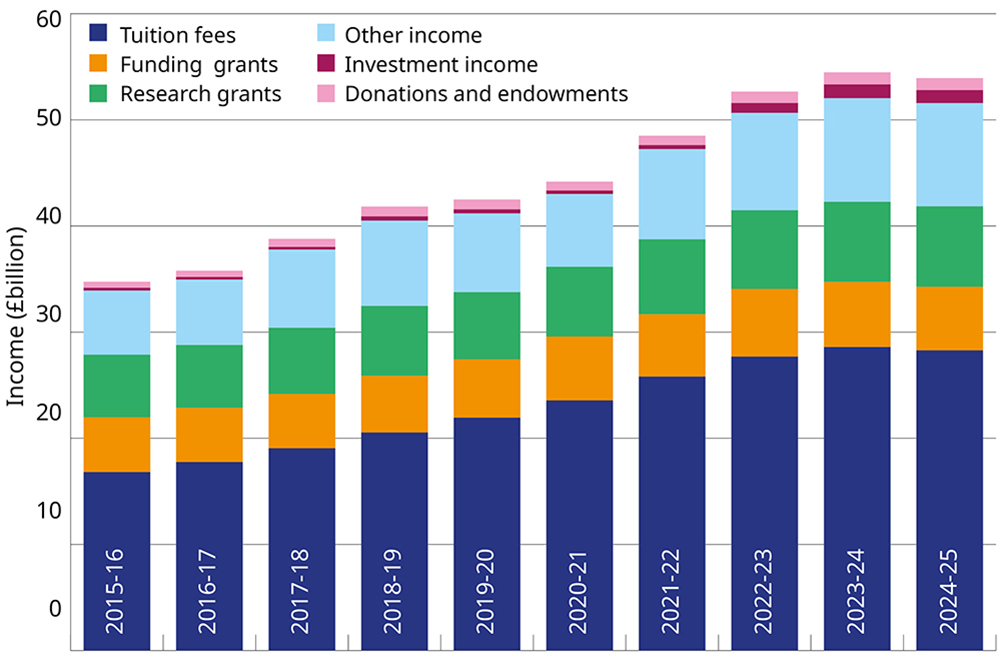
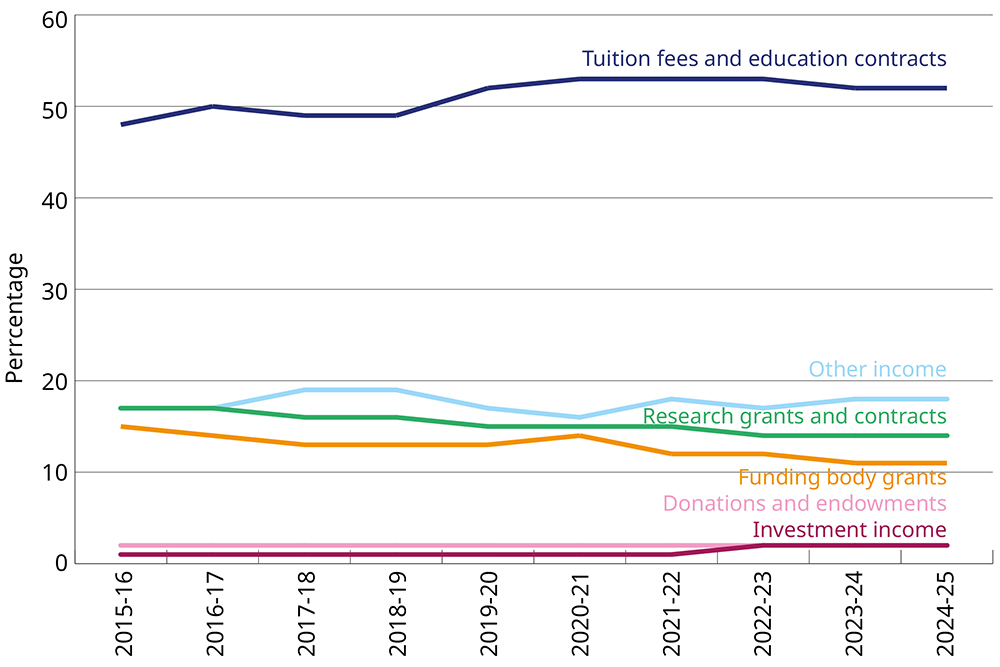
There are several reasons why achieving this ambition would be a boon to the UK’s cash-strapped universities. First, it would cement the case for continued and increased public investment in the university research that leads to spin-outs. Over the past decade, UK universities’ research income grew by 29 per cent, but it fell as a share of total income, accounting for three percentage points less (14 per cent) in 2024-25 than it had in 2015-16.
Other vice-chancellors may also like the prospect of direct income from equity stakes in spin-outs. In 2024-25, Oxford derived more than £7 million from this source. But, for institutions without Oxford’s research depth or technology transfer infrastructure, the figure is a ceiling, not a benchmark.
The concentration of spin-outs at large research-intensives is a microcosm of the concentration of earned income as a whole – the discretionary funding streams that have powered a decade of income growth that only began to stall in 2024-25, the most recent year for which data is available.
Since 2010, more than 2,000 spin-outs have emerged in the UK, with a combined value of £49 billion, generating 27,000 jobs, 70 per cent of which have been created since 2020. The combined enterprise value of these spin-outs has nearly tripled, signalling strong momentum in the UK’s innovation ecosystem.
But the distribution of this activity tells a different story. Of the 2,187 currently active spin-outs recorded across 95 providers, 225 are Oxford companies (10.3 per cent of the total) and even more – 271, or 12.4 per cent – derived from University of Cambridge research. Add UCL, Imperial and Manchester and that accounts for 38 per cent of all active university spin-outs nationally, while the Russell Group collectively hold just over 70 per cent of the register.
The exceptions are instructive. The University of Dundee has produced a unicorn. The Royal College of Art has generated 31 spin-outs. Strathclyde University, a mid-sized technical university, counts 13 venture capital-backed companies. None sits in the Russell Group. All suggest that with the right conditions, including institutional focus, regional partnerships and sectoral alignment, the spin-out opportunity is not exclusively a research-intensive privilege.

For most institutions, however, those conditions remain out of reach. Hence, the institutions most exposed to the current funding crisis – those without research depth, commercial pipelines or endowment income – are precisely the ones least positioned to attract the private capital from institutional investors, sovereign wealth and pension funds, as the plan requires.
If the full £10 billion materialised by 2035, it would be a significant gain for the sector’s wealthiest institutions. For the bottom 110 providers, collectively earning less than any single Russell Group university, it might offer little.
That vast disparity of wealth and opportunity is UK higher education’s key structural weakness. And all the growth of the past decade came despite that weakness, rather than because of it.
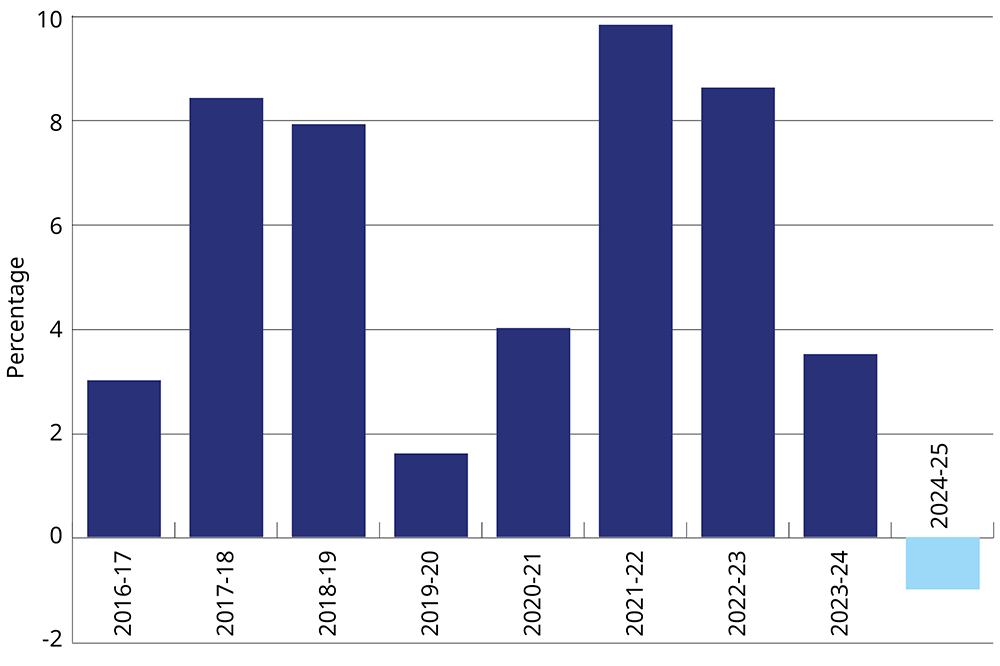
Overall sector income rose 55 per cent between 2015-16 and 2024-25, from £34.7 billion to £53.9 billion in 2024-25, climbing every single year – until 2024-25, when it fell for the first time by about £550 million (1 per cent) against the previous year.
All of the sector’s six main income streams grew substantially over that period, but research grants and funding body grants grew more slowly than the sector overall and lost ground as a share of total income (the latter falling by four percentage points of the total to 11 per cent). That reflects a decade in which government and public funding did not keep up with the sector’s overall expansion.
UK higher education income by stream, 2015-16 to 2024-25
Moreover, the institutions at the bottom of the income distribution did not keep up with the expansion at the top.
Of the 299 (out of 312) higher education providers whose financial data is available, three universities – Oxford, Cambridge and UCL – accounted for nearly 15 per cent of all income in 2024-25 – up from 13 per cent in 2015-16 and with Oxford moving from third to a clear first. The top 10 institutions – adding Imperial, Edinburgh, Manchester, King’s College London, Bristol, Birmingham and Glasgow – together commanded nearly a third (32 per cent) of the entire sector’s revenue – up from 29 per cent a decade earlier (when Leeds and Sheffield were in the list, instead of Bristol and Glasgow).
Income by stream for top 20 UK higher education providers, 2024-25
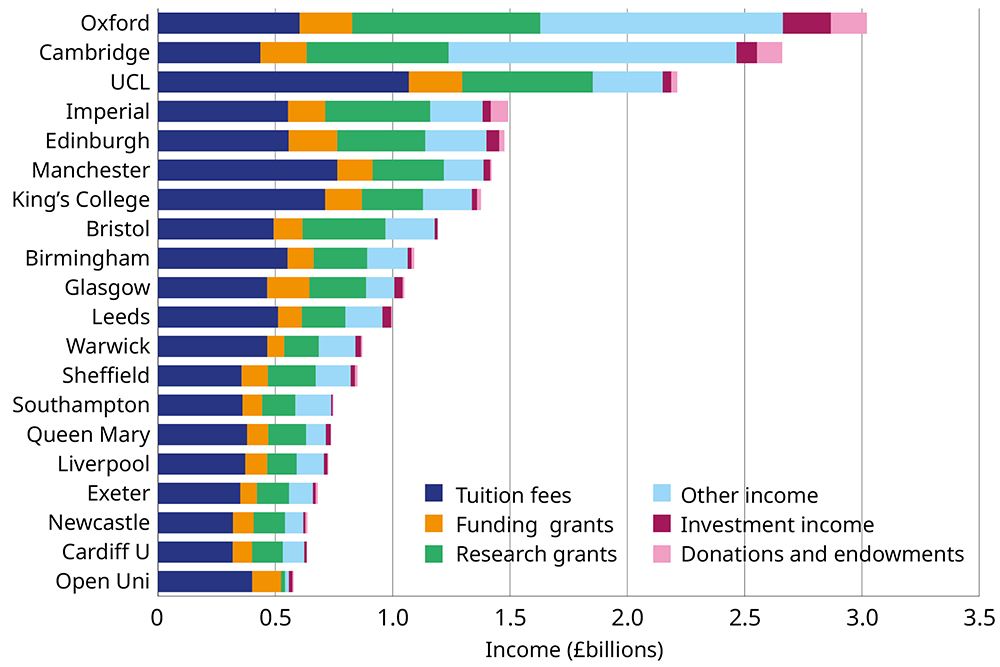
At the other end of the spectrum, the bottom 110 HEIs collectively earned £476.3 million in 2024-25, which is less than any single Russell Group university and less than 1 per cent of total sector income. Russell Group universities earned about half of all sector income.
In absolute terms, the expansion was driven overwhelmingly by one factor: surging international enrolments. In 2015-16, non-EU students contributed about £4.5 billion in tuition fees – 26.5 per cent of total tuition fee income and approximately 13 per cent of total sector income. By 2024-25, international students contributed £12.4 billion – nearly half (46 per cent) of all tuition fee income and 23 per cent of total sector income – up from about 5 per cent in the mid-1990s.
Proportion of total income accounted for by each stream
In a decade, then, international fee income nearly tripled. And for universities whose finances run primarily on fees, the dependency is far deeper than the headline figure suggests.
Across the sector as a whole, tuition fees and education contracts account for a significant and growing proportion of their total income. In 2024-25, the £28.3 billion generated from that source was 52 per cent of total income. That was a 68 per cent rise over the decade, from £16.8 billion in 2015-16: 48 per cent of total income. As other funding sources came under pressure, universities became progressively more dependent on international student fees to sustain their finances.
That dependency was not evenly shared, however. The top 20 institutions by total income accounted for 35 per cent of total tuition fees in 2024-25, compared with 32 per cent a decade earlier, meaning the institutions best placed to attract international students benefited more strongly from the income growth.
The most striking growth story of the decade was not tuition fees or research grants, but investment income. In 2015-16, this was a modest £261 million, barely a footnote in the sector’s finances. By 2023-24, it had reached a massive £1.3 billion. Even after falling back to £1.2 billion in 2024-25, the 10-year growth stands at 364 per cent.
Proportion of each funding stream accounted for by the top 20 institutions by overall income
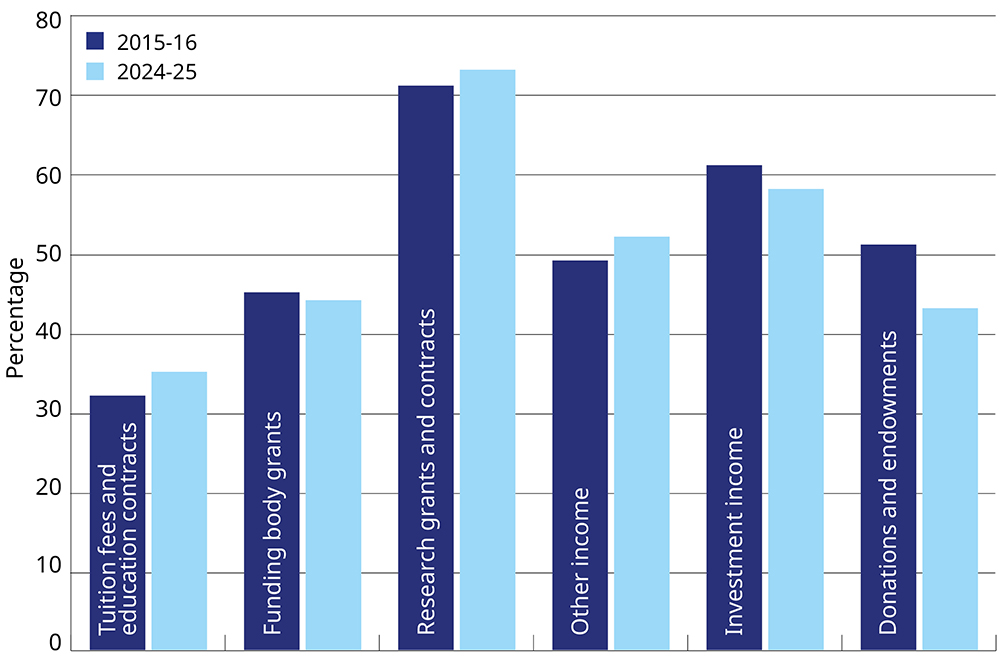
Investment income tells a more complex story. Unusually, the top 20 institutions by total income actually took a three percentage point smaller share of investment income in 2024-25 than a decade earlier. But narrowing the lens to the top five institutions reveals the opposite: their share of all investment income rose sharply, from 21 to 34 per cent. The gains were not spread downwards but compressed upwards.
Proportion of each funding stream accounted for by the top five institutions by overall income
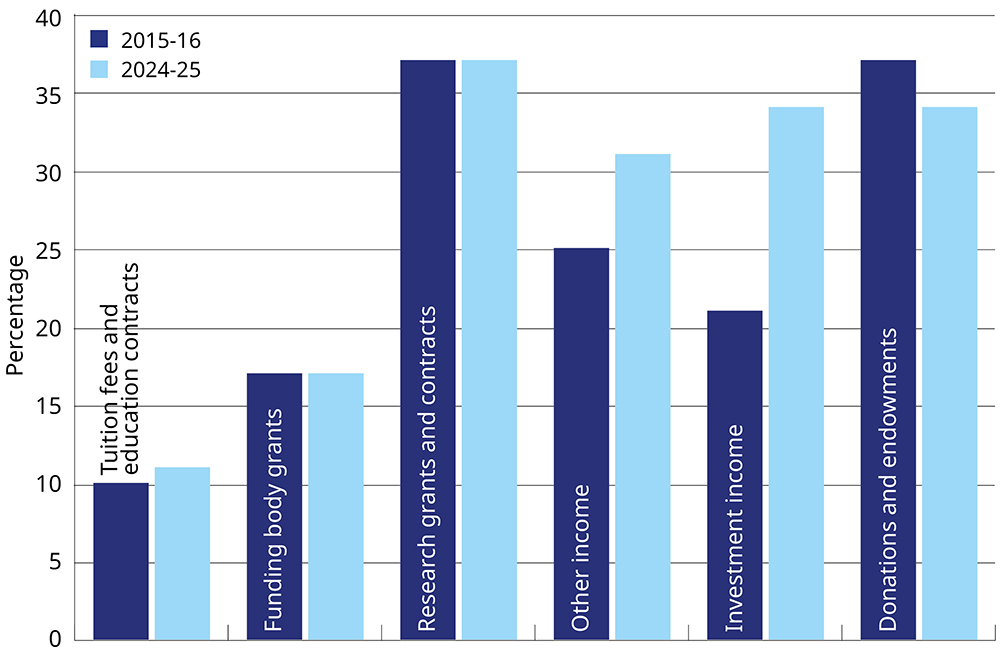
Oxford alone earned £205 million in investment income in 2024-25 – 17 per cent of the sector’s total. To put that figure in context, that exceeds the entire annual income of Teesside University, a 20,000-student institution. In 2015-16, Oxford’s income was just £8.8 million from the same source. In less than a decade, its investment income grew more than twentyfold.
Even Cambridge was a long way behind, earning £87 million in investment income (7.2 per cent of the sector’s total) in 2024-25. Edinburgh came next, with £54 million (4.5 per cent), followed by Leeds, UCL, Glasgow and Imperial, which each reported £35-37 million, roughly 3 per cent of the sector total. For most of the sector, however, the share of investment income remained negligible.
Oxford’s investment income consists of far more than interest on cash reserves and returns on spin-out equity stakes. The largest component of the investment income was the £162.5 million dividend from the Oxford Funds – the university’s £4 billion-plus endowment vehicle. There was also £35 million in other investment income and interest. For most universities, investment income is interest on a bank account.
Donations and endowments tell a similar story. Income from this source nearly doubled (97 per cent) over the same period, from £578 million to £1.14 billion, but the aggregate figure has two main distinctions: flexibility constraint and an extraordinary concentration of income.
Regarding flexibility, donations can be restricted to specific purposes, leaving institutions unable to redirect them when finances tighten. Endowments, meanwhile, are charitable trusts: the capital is retained and only the investment returns are available to spend, in principle, to the long-term benefit of the institution, including scholarships, faculty positions, research and institutional programmes, rather than its immediate financial pressures.
Oxford had less than 10 per cent of its philanthropic income freely deployable in 2024-25, against Cambridge’s 30 per cent. Despite Oxford’s larger total, Cambridge had more than twice the unrestricted giving in proportional terms.
Regarding concentration, while even the top five institutions saw their share of total sector earnings from this source decline by three percentage points across the decade, it still stood at more than one-third (34 per cent) in 2024-25. Oxford (£154 million) and Cambridge (£107 million) alone accounted for nearly a quarter (23 per cent), and 11 providers accounted for 70 per cent.
Three of those are specialist institutions – William Booth College (£181 million), Regents Theological College (£54 million) and the Institute of Ismaili Studies (£20 million) – whose income reflects charitable, faith-based and foundation funding models rather than conventional university philanthropy. The top 11 also includes City St George’s (£76 million), Imperial (£75 million), Northeastern University London (£42 million), LSE (£40 million), UCL (£26 million) and Edinburgh (£22 million).
Oxford and Cambridge also dominate the “other income” category, capturing everything from NHS clinical income, conference and catering operations, IP commercialisation, capital grants, royalty income and student accommodation. Having grown by 61 per cent to £9.7 billion since 2015-16, it now represents the second largest income stream, contributing almost one-fifth (18 per cent) of the sector income. Cambridge (£1.2 billion) and Oxford (£1 billion) dominate, together accounting for nearly a quarter (23 per cent) of the sector-wide total.

Taken together, investment income, “other income” and donations account for 22 per cent of total sector income, and the share of it accounted for by the top five institutions has risen from 26 to 32 per cent over the decade. Oxford and Cambridge derive 46 per cent and 53 per cent of their income, respectively, from other income, donations and investment returns; for every other institution in the top 10, the equivalent figure is between 14 per cent and 23 per cent.
But Oxbridge’s dominance gives a false impression of the financial security such sums offer. All three streams are unregulated and very sensitive to interest rates, donor sentiment and commercial conditions. Oxford’s “other income” fell £17 million in 2024-25, for instance, because the final payment of £40.8 million in royalty income from the Oxford-AstraZeneca Covid vaccine in developed markets was received the previous year and did not recur. Cambridge’s donations fell £42.9 million (29 per cent) in 2024-25, largely because the prior year included Dell Corporation’s donation of the Dawn AI supercomputer, recorded as a donation of fixed assets. At the very top of the sector, headline figures can swing dramatically on a single royalty payment or corporate donation.
For the wealthiest universities, then, these streams are simultaneously their greatest asset and their most significant exposure. The investment income boom of recent years reflected the impact of the Bank of England’s rapid interest rate rises, from near-zero until 2022, to above 5 per cent by 2024. As the rates are expected to fall, the substantial windfalls enjoyed by a handful of wealthier universities on their large cash reserves and endowments will also diminish.
For universities without such reserves, the cycle offers no cushion at all.
The divergence between wealthier and poorer universities became impossible to ignore in 2024-25, as this is the year the whole sector contracted for the first time.
Every major income stream was simultaneously flat or falling in that year: tuition fees down 1 per cent, funding grants down 2 per cent, investment income down 7 per cent, donations down 1 per cent, other income flat. Only research grants held ground, growing only 0.5 per cent in nominal terms, a real-terms decline when set against inflation.
UK higher education income growth, year-on-year, 2016-17 to 2024-25
The most consequential shift was the fall in international enrolment. At its peak in 2022-23, UK higher education enrolled 2.94 million students, before dropping to 2.86 million in 2024-25. UK-domiciled students have remained broadly stable throughout, hovering around 2.15 to 2.18 million since 2020-21. The growth – and now the contraction – has been driven almost entirely by international student enrolments.
Following Brexit, EU enrolment fell by 58 per cent, from 153,000 in 2020-21 to 64,000 in 2024-25 – a loss of nearly 90,000 students, who, prior to Brexit, had paid domestic tuition rates rather than the higher international fees. Non-EU enrolment surged to fill that gap, from 447,000 in 2020-21 to a peak of 663,000 in 2022-23, a growth of 48 per cent in two years. Non-EU was the engine behind the tuition fee growth seen in the sector over the same period.
But then the UK government tightened visa rules in 2023, restricting dependant visas and raising financial requirements. Applications for study visas fell 17 per cent in August 2024, compared with August 2023, with sharpest declines from India and Nigeria – the two countries that had previously driven the postgraduate taught boom. The sponsored study visas, including dependants, fell 31 per cent.
The UK has lost more than 73,000 international students (10 per cent) from its 2022-23 high. To put that figure in human terms: the UK lost more international students in two years than the entire combined student enrolment population of Oxford, Cambridge and Imperial College London.
At the same time, the ability of English universities to offset a long-frozen domestic home fee cap has steadily eroded. The £9,000 fee introduced in 2012 was not meaningfully raised until 2024-25, when it increased to £9,535 for the 2025-26 academic year. Over that 13-year period, cumulative inflation has reduced its real-term value by a third. Now the international numbers are falling, the impact is fully visible.
Nor is the lifting of England’s domestic tuition fee in 2025-26 the beginning of financial recovery or a structural solution. Universities UK estimates that the £5.5 billion gain will be more than offset by £9 billion in additional costs and income losses by 2029-30, leaving a net reduction of £3.7 billion overall. The financial position is projected to worsen every year until at least 2028-29. And that, of course, will hit hardest the post-92 universities and specialist providers that depend almost entirely on fees because they have little investment income, commercial revenue or endowment to fall back on.
The market response to these financial pressures is already visible at the top of the sector. Leading universities plan to increase international undergraduate fees by nearly 30 per cent over four years, according to Financial Times analysis. A medicine degree at Cambridge is projected to cost an overseas student at least £456,000 over their six years of study from autumn 2026; at Oxford, about £345,000.
If the implicit logic is that higher unit prices can offset lower volumes, the sector’s financial data makes this hard to sustain. Most of the 73,000 international students lost since 2022-23 were from lower-ranked institutions that have less capacity to price at elite levels.
A 1 per cent decline is not, in itself, a crisis. But the three forces that sustained a decade of growth – surging international enrolment, inflated investment returns and rising commercial and philanthropic income – have all weakened simultaneously for the first time. The institutions least equipped to absorb the impact, especially for those without endowments, commercial income or research strength, have no buffer left.
For the wealthiest universities, this is uncomfortable. For many others, it may prove an existential threat.
Fadime Sahin is course lead and senior lecturer on the MSc in accounting and finance at the University of Portsmouth.
Register to continue
Why register?
- Registration is free and only takes a moment
- Once registered, you can read 3 articles a month
- Sign up for our newsletter
Subscribe
Or subscribe for unlimited access to:
- Unlimited access to news, views, insights & reviews
- Digital editions
- Digital access to THE’s university and college rankings analysis
Already registered or a current subscriber?