
It will have come as a surprise to no one that 2024-25 saw a decline in the number of academics employed by UK universities. The government’s clampdowns on international student visas have added to pressure on the domestic unit of resource, prompting a wave of redundancies across the sector.
What might be more surprising is that the previous decade was such a period of sustained growth that even the pandemic only briefly stalled. Since 2014-15, the UK higher education headcount grew by almost a quarter (23 per cent), according to my analysis of data from the Higher Education Statistics Agency (Hesa), reaching nearly 247,000 academic staff in 2023-24, from about 200,000 in 2014-15. Hence, despite a 1 per cent fall, the number of academics employed by UK universities in 2024 was still the second highest on record, at just under 245,020.
But while numbers have grown, equity has not. What is striking about the growth – and the recent downturn – is that it has largely been concentrated in teaching-only roles. And those roles have remained more part-time, lower-paid and less connected to senior pathways than other academic roles are.
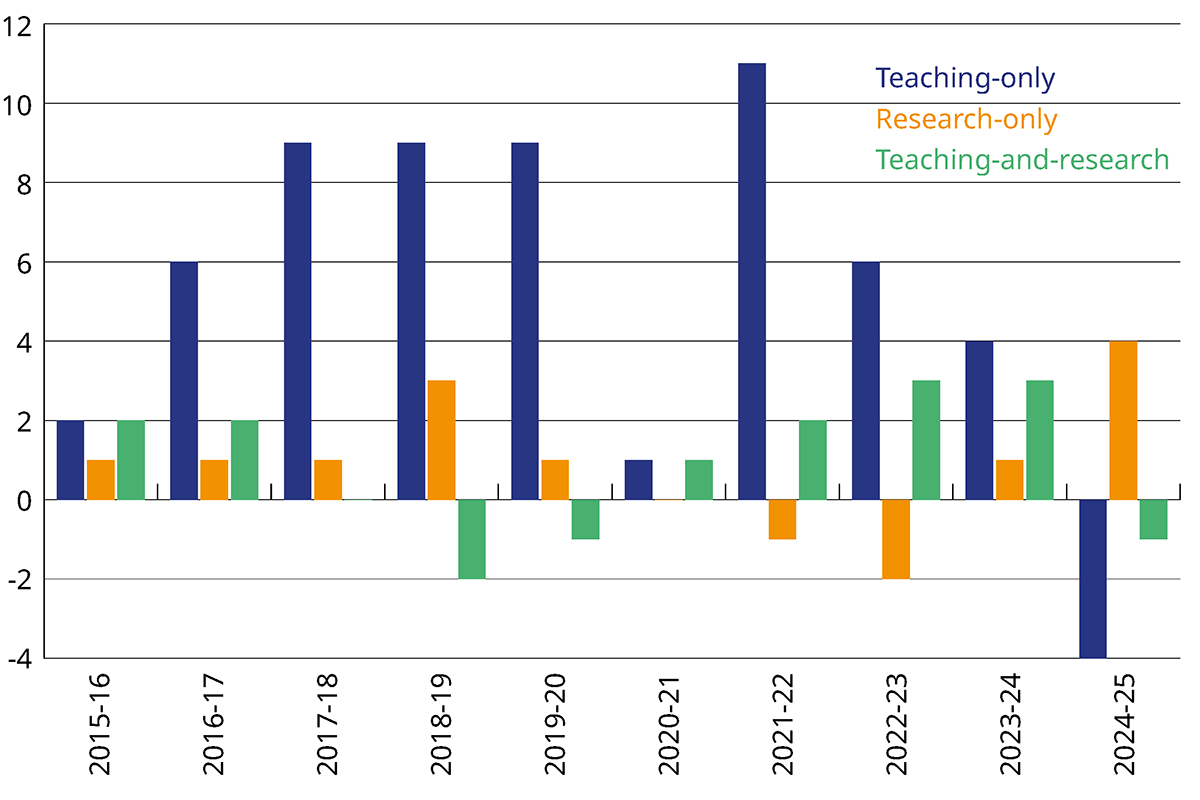
The clearest indication yet of the structural vulnerability of this segment of the workforce is seen in the fact that the loss of 2,200 academics overall in 2024 is actually smaller than the decline in teaching-only roles, which dropped by nearly 3,600 (4 per cent) individuals. And of those lost roles, about 70 per cent were part‑time and 53 per cent fixed‑term.
It is a timely reminder that the sector’s long-term rebalancing towards teaching-only posts has created a workforce that expands quickly in periods of student growth, but contracts sharply under financial pressure. While the overall sector expansion is positive, this dynamic raises the question of whether UK academia is evolving into a two-tier system.
Interestingly, the overall fall in academic numbers in 2024-25 also masks the largest rise in research-only roles in the past decade: 1,930 additional posts. This overall 4 per cent rise was driven overwhelmingly by full‑time posts (87 per cent), but 75 per cent of the posts were fixed‑term.
Despite last year’s rise, the proportion of all UK academic posts that are research-only was 3 percentage points less in 2024-25 (21 per cent) than in 2014-15. Teaching and research roles have also seen a decline over that period, from 49 per cent of the total to 43 per cent. That is because teaching-only roles have shot up from 26 to 35 per cent of the total over that period, from about 52,000 to 85,000 individuals: a 64 per cent increase.
Composition of academic staff by contract function
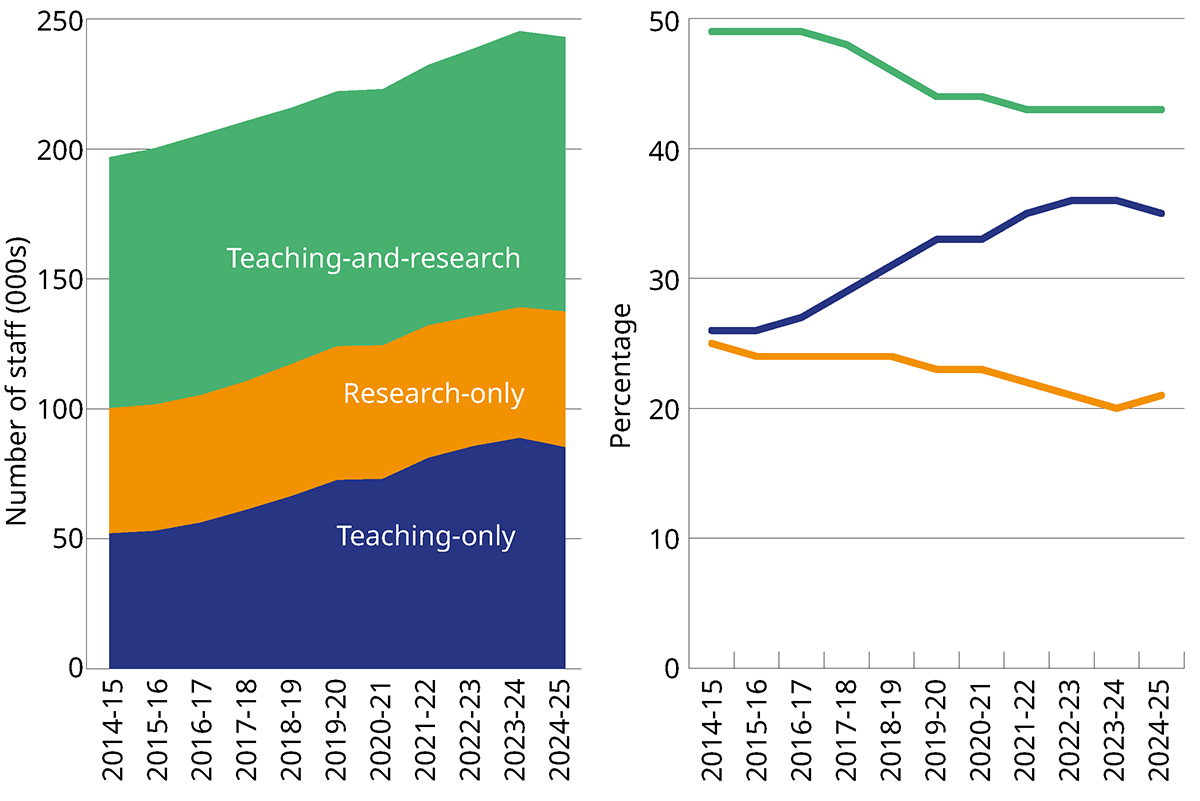
Before last year’s contraction, teaching-only posts showed sustained and often rapid year-on-year growth. After slowing to 1 per cent in 2020-21, at the height of the Covid pandemic, they rebounded sharply, hitting an 11 per cent increase in 2021-22 – the fastest year‑on‑year growth of the decade. Research-only roles grew slowly, by about 4,000, over the decade, while teaching-and-research roles grew by around 9,000.
Taken together, the Hesa academic workforce data suggest that what we have seen over the past decade is not a simple expansion but a restructuring of the sector, with the much newer category of teaching-only accounting for an ever-greater share of the total.
But if roles are diverging, do employment conditions diverge as well?
Yearly percentage change in roles
Over the past decade, contract security has improved across the workforce. The share of open-ended/permanent contracts has increased from 65 per cent in 2014-15 to about 70 per cent in 2024-25 across the sector. On the surface, this suggests an improved employment stability across the sector.
However, when the contract type is examined by role, clear differences emerge. Over the decade, teaching-only roles underwent the most significant transformation: shifting from a majority fixed-term workforce to a majority open-ended one. The share of permanent contracts within teaching-only roles rose from 46 per cent in 2014-15 to 65 per cent in 2024-25 over the decade.
That figure is very similar to that in research-only roles. Despite modest growth in open-ended contracts, the function remains structurally dependent on fixed‑term employment. Around two-thirds (64 per cent) of research-only staff were still on fixed‑term contracts in 2024-25, reflecting the ongoing influence of time-limited external funding and project-based grant cycles.
By contrast, teaching‑and‑research academics remained overwhelmingly on open‑ended contracts throughout, increasing slightly from 91 to 94 per cent.
Contract security also intersects with the mode of employment. Across the decade, teaching‑only roles have become steadily more full‑time, while research‑only and teaching‑and‑research roles remain remarkably stable. The teaching‑only function is the only one undergoing a structural shift in working patterns.
Percentage of all posts by job category
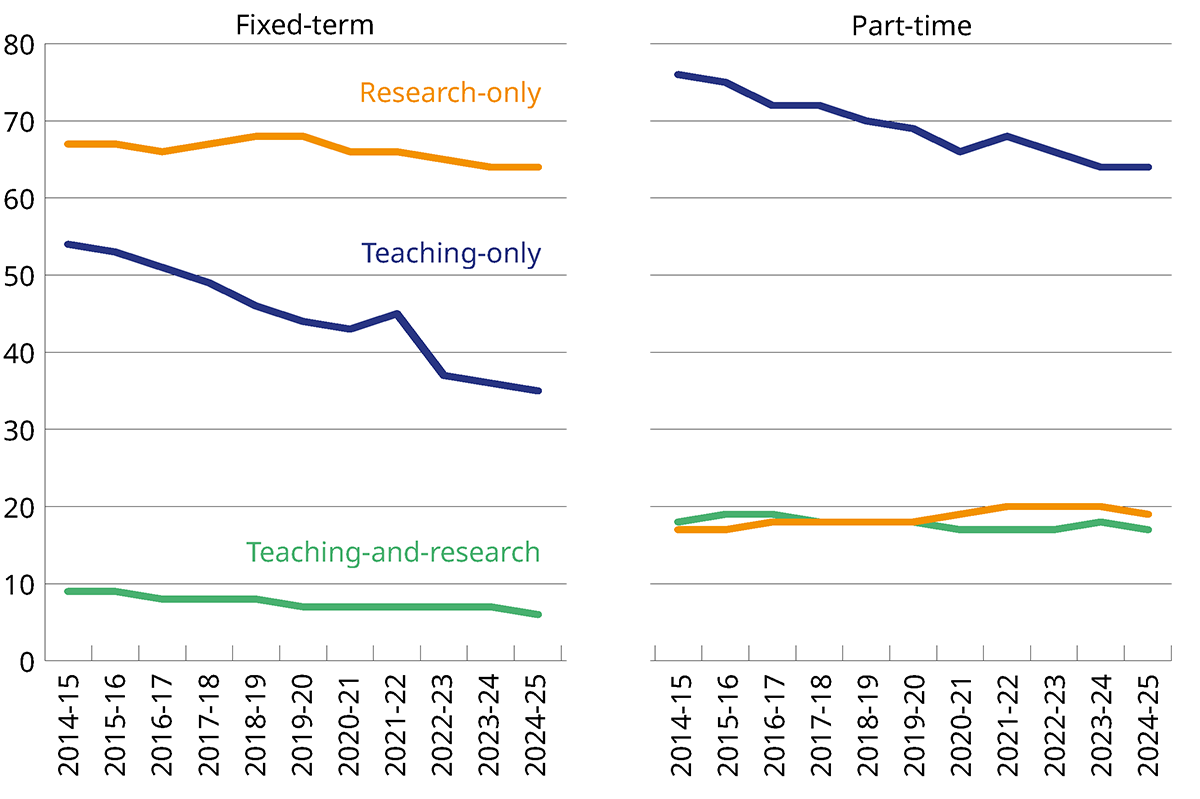
In 2014-15, around three-quarters of teaching-only staff (76 per cent) worked part-time, compared with only 18 per cent of those in teaching-and-research roles. Research-only posts were overwhelmingly full-time (83 per cent).
By 2024-25, the pattern had improved but not disappeared. Teaching-only roles still had a far higher share of part-time academic staff (64 per cent) than research-only (19 per cent) and teaching-and-research roles (17 per cent).
This highlights a persistent structural divide in working patterns across the academic workforce. Teaching‑only remains the most part-time‑intensive function despite clear movement toward greater full-time employment (from 24 per cent to 36 per cent). Part-time contracts are commonly associated with teaching hours, term-time delivery or fluctuating student demand, reinforcing the structural divide between teaching-only and teaching‑and‑research pathways.
Full-time teaching-only roles expanded far more rapidly (140 per cent) than part-time teaching-only roles (39 per cent). However, because teaching-only posts account for the largest share of part-time employment (around 55,000, compared with 10,000 for research-only and 18,000 for teaching-and-research), even modest growth in this group drives a faster overall increase in part-time roles across the sector. Hence, overall, part-time academic roles grew faster than full-time roles (28 per cent compared with 21 per cent) between 2014-15 and 2024-25 across the sector.
Since part-time and fixed-term roles tend to offer fewer progression opportunities, the rise of a mode of employment, teaching-only posts, that has lower contract security raises further questions about long-term career paths in the sector, despite some universities’ efforts to devise routes to seniority for people on the teaching-only track. Recent moves at Sheffield Hallam University to employ teaching‑only academics via subsidiary companies, whereby they would lose access to the Teachers’ Pension Scheme, underline how these posts are increasingly associated with reduced security and diminished employment rights.
Senior roles remain predominantly full-time, and while the data cannot track individual career progression, the concentration of workforce growth in part-time teaching-only posts indicates that the expansion is occurring in parts of the workforce less connected to established seniority pathways.
If the workforce is expanding at the bottom, are opportunities expanding at the top?
While the academic workforce expanded by 23 per cent over the decade, the number of professors rose by 33 per cent, from about 20,000 (2014-15) to 26,000 (2024-25), while other senior academic roles grew by 11 per cent, from around 6,000 to 6,600. However, the distribution of academic roles remained strikingly stable: professors consistently accounted for around 10-11 per cent of staff, other senior academics roughly 3 per cent.
Employment patterns reinforce this stability at the top of the academic hierarchy. In 2024-25, 79 per cent of professors and 88 per cent of other senior academics worked full-time, a pattern that has changed little since 2014-15. Terms of employment show a similar picture: 96 per cent of professors and 86 per cent of other senior academics had open-ended/permanent contracts in 2024-25, with minimal change over the decade.
Full-time dominance in senior levels is often functional rather than exclusionary. It reflects the nature of senior academic and managerial responsibilities, which typically require sustained leadership, line‑management and institutional oversight that are less easily accommodated within part‑time arrangements. Nonetheless, the stability of the upper tier, combined with growth concentrated in part-time teaching-only roles, suggests that expansion has reinforced, rather than diluted, hierarchical segmentation within the academic workforce.
The pay structure reinforces the emerging divide between academic pathways. The functions experiencing the greatest growth – teaching‑only (+64 per cent) and, to a lesser extent, research‑only (+8 per cent) – are both concentrated in the lower and mid-level pay bands.
Only around half of full-time teaching-only staff (48 per cent) earned above £52,183. Full-time research-only staff were concentrated overwhelmingly in the lower pay bands, with nearly 80 per cent earning below that threshold, consistent with the prevalence of postdoctoral and grant-funded roles. Together, these two functions represent 56 per cent of all academic staff and are located in the lower/mid-level pay bands, meaning that workforce growth, as a structural consequence, accumulates in these parts of the salary distribution.
In 2024-25, 58 per cent of the entire full-time academic workforce earned above £52,183, but the composition of the upper pay bands is highly uneven. Around 75 per cent of all full-time staff earning above that threshold were in teaching‑and‑research roles, about 15 per cent teaching-only and 10 per cent research-only.
Gender patterns also intersect with these structural differences. Perhaps surprisingly, women only accounted for 42 per cent of the decline in teaching-only roles in 2024-25, while accounting for the majority (66 per cent) of the growth in research-only roles compared with 2023-24.
But across the decade, there were only marginal shifts in the full-time/part-time balance while women remained significantly more likely than men to work part‑time, which tends to be less research-active, less secure and lower in seniority. Female full‑time employment hovered around 60 per cent: at least 10 percentage points lower than for men.
Percentage of each gender working part-time
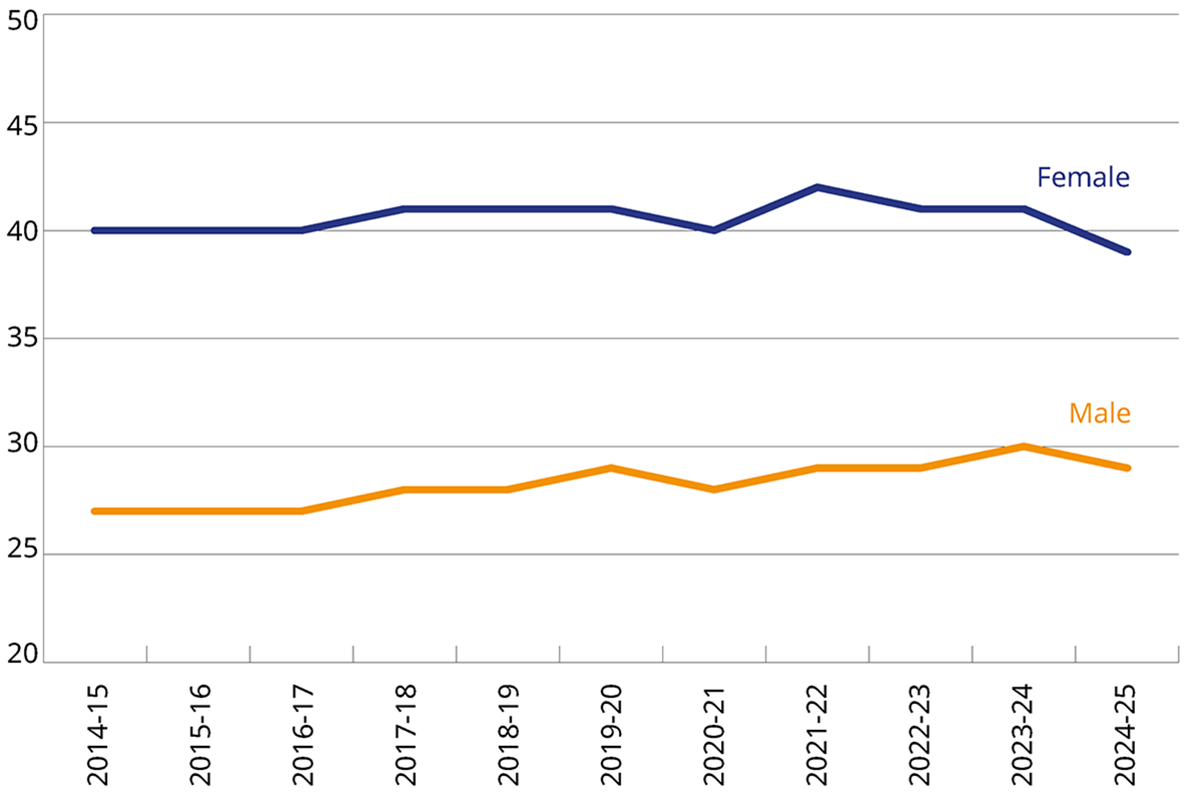
In 2024-25, women represented 45 per cent of full‑time academics, but 57 per cent of part‑time staff. And despite growth in the female academic workforce of around 34 per cent since 2014-15 (compared with only 13 per cent for men), the underlying pattern of gendered working hours showed little structural change. While part-time and fixed-term roles can provide flexibility, they also limit progression opportunities.
Accordingly, men continue to hold a higher share of senior roles (professors plus other senior academic positions), despite steady, but slow, improvements over the past decade; in 2014-15, 74 per cent of senior roles were held by men, falling to 65 per cent by 2024-25. And that gender difference in seniority is, of course, reflected in pay. In 2024-25, 46 per cent of full-time women academics earned below £52,183, compared with 38 per cent of men. And only 17 per cent of women academics were paid at the highest pay scale (around £70,000 and above), compared with 26 per cent of men.
The distribution of academic role types also shows a persistent gender pattern. In 2024-25, 55 per cent of teaching-only positions were held by women, compared with 45 per cent for men. This pattern has changed little over the past decade: in 2014-15, women held 52 per cent of teaching-only roles, compared with 48 per cent held by men.
Men remained more represented in teaching-and-research positions (56 per cent), while research‑only roles were at gender parity in 2024-25.
None of these trends imply that inequity has been deliberately sought. Rather, the inequity is a result of the system becoming pedagogically specialised, employability-focused and less research-intensive by design.
Nonetheless, this functional differentiation, driven by part-time, lower-paid roles with limited progression and seniority, risks producing a de facto two-tier workforce in terms of employment security, pay progression, access to seniority and institutional influence. And this might ultimately create broader challenges, including retention issues, talent misallocation and functional inefficiencies arising from silos between different academic roles and reduced collaboration.
At the very least, we need to be fully aware of these trends. And if we don’t like where they are leading, we need to do something about them.
Fadime Sahin is a course lead and senior lecturer on the MSc in accounting and finance at the University of Portsmouth.
Register to continue
Why register?
- Registration is free and only takes a moment
- Once registered, you can read 3 articles a month
- Sign up for our newsletter
Subscribe
Or subscribe for unlimited access to:
- Unlimited access to news, views, insights & reviews
- Digital editions
- Digital access to THE’s university and college rankings analysis
Already registered or a current subscriber?