Hungary will rejoin the Erasmus student exchange programme “as early as the next academic year” and “phase out” state-linked foundations that have taken control of universities, the European Commission president has announced.
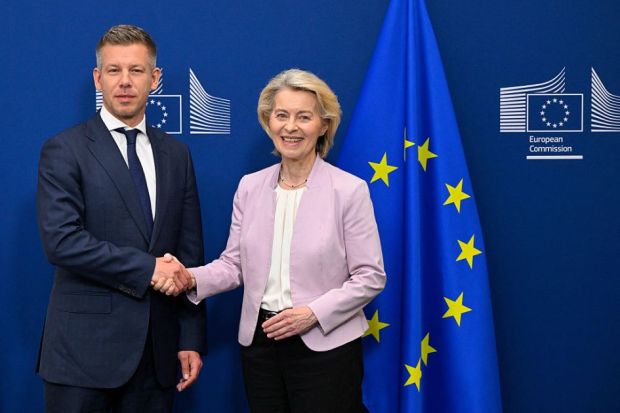
Ursula von der Leyen praised the country’s new leader, Peter Magyar, for making “great progress” on academic freedom as she welcomed him to Brussels on 29 May.
The leaders have reached a deal to unlock €16.4 billion (£14.2 billion) in European Union recovery and cohesion funds that were previously frozen under its former leader, Viktor Orbán.
“We have also made great progress on the protection of fundamental rights in Hungary, notably on academic freedom,” Von der Leyen said in a statement released as initial talks concluded.
“Hungary will be gradually phasing out the Public Interest Trusts, the PITs, and pass legislation to address concerns about conflict of interest and integrity rules. This is a big step forward,” she added, referring to the private entities, or foundations, created by Orbán’s government to manage universities that have been criticised for their lack of transparency.
“The academic freedom was long awaited. Therefore, this will unlock another €2.2 billion of Cohesion funds for Hungary.”
The timeline for phasing out the PITs remains unclear. Participation of Hungarian universities in the EU’s flagship research programme, Horizon, after they were suspended in 2022 over governance concerns was not part of the initial talks and still remains unresolved.
The return to Erasmus ends years of exclusion that cut off Hungarian students from one of Europe’s most popular programmes, which funds young people to study and live abroad in other EU countries.
Von der Leyen said the “iconic programme is one of the great trademarks of the European Union”, adding that it has shaped “entire generations”.
She said it was important that young Hungarians “can benefit from this wonderful experience too”.
“So as early as the next academic year, Hungarian students can also be again part of the Erasmus community – this is good news.”
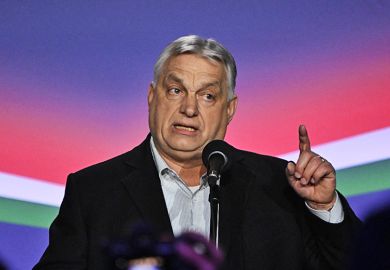
Under Orbán, the commission had raised concerns over the government’s move to transfer control of the country’s public universities to state-linked foundations, whose boards were packed with Orbán loyalists. The initial board members were hand-picked by the government and given lifetime positions. By 2022, there were 21 foundation-run universities, according to the European University Association.
Orbán’s rule came to an end in April after Magyar led his Tisza party to a landslide victory in parliamentary elections.
In her statement, von der Leyen commended the new leader for “sending to the world powerful messages”.
“In record time, you formed a government, with ministers drawn from the top ranks of their professions who have stepped up for the public interest. Your government is moving with speed and determination to deliver on the promises you made to the Hungarian people, kickstart economic recovery, fight corruption, and restore the rule of law,” she said.
“And in a very short time, we already have concrete progress to share. We will take no shortcuts, we will address all issues, and work hand in hand for the good of Hungary and the European Union.”
Register to continue
Why register?
- Registration is free and only takes a moment
- Once registered, you can read 3 articles a month
- Sign up for our newsletter
Subscribe
Or subscribe for unlimited access to:
- Unlimited access to news, views, insights & reviews
- Digital editions
- Digital access to THE’s university and college rankings analysis
Already registered or a current subscriber?