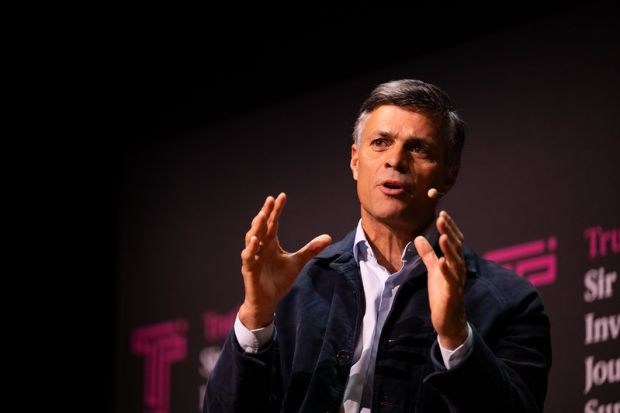
Four months ago Leopoldo López’s home in Caracas was ransacked. “They stole everything and tore my house down completely – the walls, the ceilings, everything. And they killed my dogs.”
“We had two Labrador dogs being cared for there, and they killed them. The day after that, I was stripped of my Venezuelan nationality,” explained López, who has lived in exile in Spain since 2020. That attack came a day after the 55-year-old former professor welcomed the dramatic seizure by US forces of president Nicolas Maduro on narco-trafficking charges – a move that could soon bring the pro-democracy campaigner back to his South American homeland.
Widely regarded as a future presidential candidate, López began his career as an economics lecturer at Andrés Bello Catholic University in Caracas before becoming mayor of the Venezuelan capital’s affluent Chacao district in 2000. A fast-rising opposition leader, he was repeatedly targeted by Hugo Chavez and his successor Maduro and arrested in 2014 on charges of “incitement to riot” after calling for peaceful protests.
López was jailed for 13 years on charges of terrorism in a trial condemned by the European Union and Amnesty International, with world leaders including Barack Obama, Donald Trump and the Dalai Lama calling for his release over the years.
López served three years in the notorious maximum-security Ramo Verde military prison before he was moved to house arrest. After a warrant was issued for his arrest in May 2019, he lived for a year and a half at the Spanish embassy in Caracas. In October 2020 he eventually escaped to Colombia dressed as an electrical repairman.
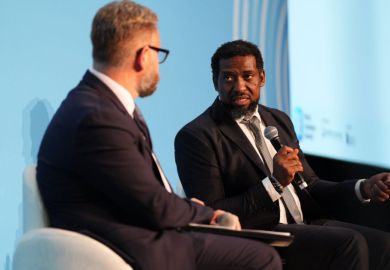
Speaking to Times Higher Education at the recent Truth Tellers Sir Harry Evans Investigative Journalism Summit, co-hosted by Durham University, López said his time as an economics professor “seemed like two lifetimes ago” given his privations in custody.
Now a visiting lecturer at Stanford University, however, López remained an academic at heart even in his darkest moments. Held in solitary confinement for months and denied reading material and an electric lamp at night, he still managed to write a book on economics, he recalled.
“I was allowed to write; that was hugely important for me,” said Lopez, who has degrees from Kenyon College in Ohio and Harvard University.
His connections with higher education in Venezuela go back even further, with his father, economist Leopoldo López Gil, overseeing the country’s main international scholarship award programme at one point. Yet political interference in Venezuelan universities meant they were hollowed out intellectually and financially throughout the 1990s and 2000s, he explained.
“Venezuela’s universities were among the strongest in South America for many years but freedom of thought was criminalised and its institutions were massively underfunded,” López said.
Financial crises in the oil-rich country led to spiralling inflation under Maduro and severe budget cuts by 2019, with university professors only paid about $15 a month, leading to a huge scientific brain drain. About 8 million people – almost a third of the population – have left the country since 2015, including many academics disillusioned by state control and poor pay, said Lopez.
“The sector used to have a good reputation for quality but this disappeared as education was politicised at every level from K-12 to universities. For instance, we used to graduate 2,000 medical doctors a year – all that is gone, and it’s down to about 200 or 300,” he said of his home country, which has about 28 million people (in comparison the UK graduates about 9,000 medics a year for its 70 million population).
Although Viktor Orbán’s reforms in Hungary are often cited as the autocrat’s playbook for controlling higher education, López said Chavez made similar changes decades earlier. “They prohibited elections of rectors and university boards became much more political. Then they cut the funding and controlled what academics could teach,” he said.
With Maduro awaiting trial in a New Jersey prison, there are hopes that Venezuela’s civil society could rebuild, with universities leading the way. That is impossible with the current interim regime led by interim president Delcy Rodríguez, who was Maduro’s vice-president, said López, who noted that there are still nearly 500 political prisoners in the country. “The repressive state is still in place,” he explained.
“The laws that criminalise free speech, the laws that criminalise NGOs and control education are still in place and the judges that execute the laws are still there – and there is not a single judge that is independent. We want elections but the dismantling of the repressive state must happen now,” he said.
López has refused to rule out running for president in these elections, although it seems his protégé Juan Guaidó or fellow opposition leader María Corina Machado, the 2025 Nobel Peace Prize winner, are better placed to run.
Rebuilding the country’s universities will be vital for his country’s future, said Lopez. “It will be important to build partnerships with universities in Europe and the US, and there are many successful Venezuelans abroad who want to financially support their old universities. Many of them want to come back to help the country and, of course, I want to return too.”
Register to continue
Why register?
- Registration is free and only takes a moment
- Once registered, you can read 3 articles a month
- Sign up for our newsletter
Subscribe
Or subscribe for unlimited access to:
- Unlimited access to news, views, insights & reviews
- Digital editions
- Digital access to THE’s university and college rankings analysis
Already registered or a current subscriber?