“Virtual fellowships” have allowed academics in Gaza to continue their research despite the widespread destruction of universities in the Israel-Hamas war.
Speaking at Times Higher Education’s Digital Universities UK event, Basma Hajir, a lecturer in comparative and international education at the University of Bristol, explained that she set up a fellowship scheme to support Gazan academics with an initial grant of just £10,000.
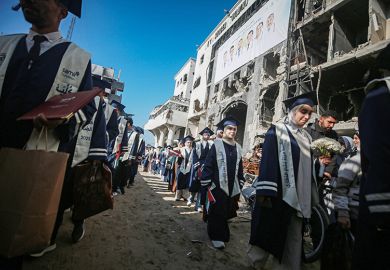
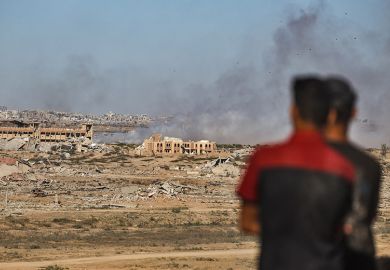
Hajir stressed that despite the destruction of physical infrastructure in Gaza, higher education has continued virtually, and academics have remained active despite the conditions.
The Gaza Education Research Virtual Fellowship (GERVF) provided fellowships to three academics across Al-Aqsa University and the Islamic University of Gaza, virtual access to research resources, networking and mentorship, and online professional development workshops to work on projects based on the topic of “scholasticide” – a term coined by researchers to describe the destruction of education in Palestine.
Projects have included “the crisis of learning” in Gaza, and “the experience of displaced female higher education students in Gaza”.
Hajir said the scheme was “a direct response” to the calls of Gazan university leaders following the damage done to universities and it was a “bottom-up initiative”.
“This matters because it shows that even individual scholars with very little resources are capable of doing something that could be meaningful and yield material solidarity, and support.”
But, she said, there were limits to what could be done by individuals alone and initiatives like this required support of senior leaders.
The scheme drew inspiration from existing virtual scholarships provided by the University of Leeds, SOAS, University of London and the University of Liverpool, and “tailored” these approaches to support academics living amid conflict.
The scholars have described the scheme as “transformative” and “a lifeline” in feedback.
One said: “I felt my academic identity dissolving. This fellowship didn’t just help me heal…It opened doors for me I didn’t think were possible. It was a lifeline.”
Hajir said the response shows “how significant such initiatives are for these scholars in Gaza, not only to sustain their academic careers, but also to sustain their sense of identity and purpose as scholars”, adding it had had a “ripple” effect among the academics’ communities.
“What the scholars described as an incredibly positive impact was not only on them, but on their peers, and their communities, and their students. They talked about how they passed everything they learned to their students.
“One scholar was talking about how sometimes she needed to go to her neighbour in order to get an internet connection to join the meetings, and how her neighbour would experience a morale boost just knowing that academic work is still ongoing.”
But the scholars involved also faced challenges, and Hajir described how one of the academics was getting “thinner and thinner in every meeting” amid the famine seen in Gaza last summer: “He was struggling to sustain his academic career because he was literally hungry.”
Hajir is looking to extend the programme with the aim of it becoming an annual offering, adding she has been contacted by several other universities around the world about developing similar programmes at their institutions.
Omar Shweiki, director of Friends of Palestinian Universities, added that there is an “urgent need” for global universities to “provide material support” to Gazan universities to allow them to continue teaching.
“Although there was a ceasefire agreement last autumn, the conditions under which people are teaching and learning remain extreme. There isn’t the possibility yet for proper rebuilding, so it’s a question of survival. And our universities can play a really vital role in supporting the efforts of faculty and Palestine to maintain their academic communities.”
Register to continue
Why register?
- Registration is free and only takes a moment
- Once registered, you can read 3 articles a month
- Sign up for our newsletter
Subscribe
Or subscribe for unlimited access to:
- Unlimited access to news, views, insights & reviews
- Digital editions
- Digital access to THE’s university and college rankings analysis
Already registered or a current subscriber?