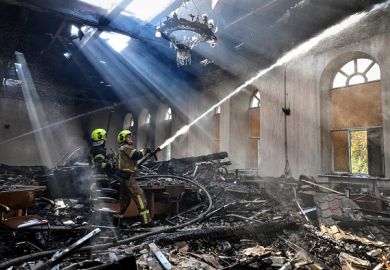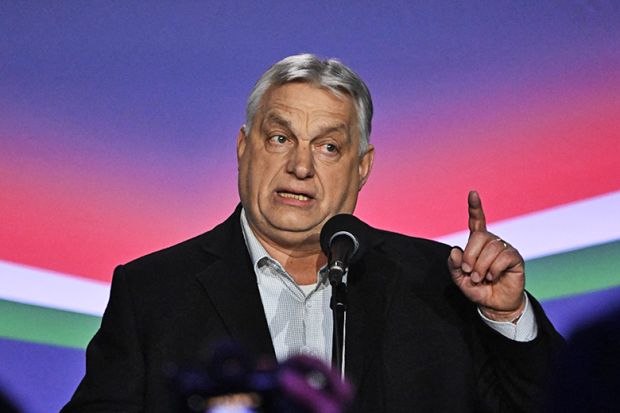
It has been eight years since the Central European University (CEU), a pillar of Budapest’s academic scene for decades, was forced out of Hungary in a stand-off with the government that made headlines around the world and became a symbol of the pressures higher education institutions faced under Viktor Orbán’s rule.
Now, as Hungary prepares to head to the polls on 12 April, the questions raised by CEU’s expulsion about political interference and academic freedom have resurfaced in an election that has been dubbed Europe’s most consequential in years.
For the first time in 16 years, Orbán faces a serious threat to his grip on power. Péter Magyar, a former Fidesz insider who broke with the government following a scandal and launched his Tisza party, has galvanised an opposition movement that polls suggest is far ahead of Fidesz. The centre-right politician has promised to repair Hungary’s fractured relationship with the European Union and has said restoring academic freedom is one of his priorities.
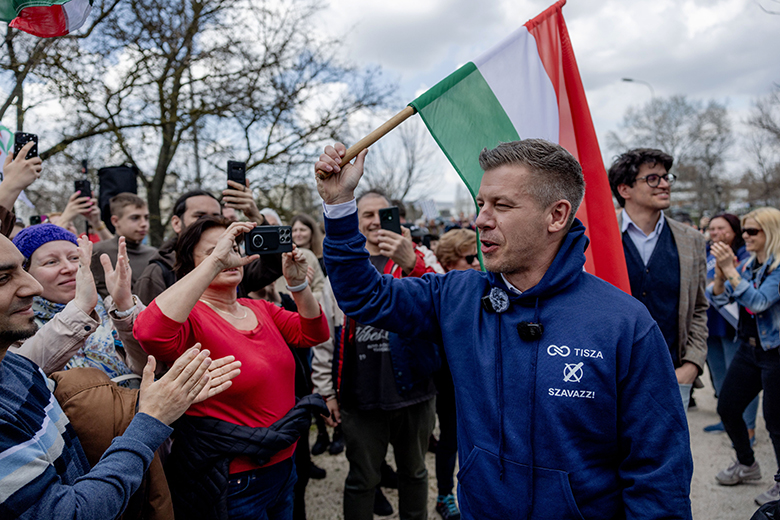
For universities, the stakes could not be any higher. “Most people think that 12 April will decide our fate for a very long time,” said Zoltán Gábor Szűcs, a political scientist at Eötvös Loránd University (ELTE), one of Hungary’s oldest universities, which has refused to adopt some of the changes introduced by the government. “It’s really just this feeling that it makes no sense any more to have plans for the future because things could really change, even if Orbán stays in power, as the mood in the country has changed. It’s in crisis mode.”
When Orbán returned to power in 2010 with a parliamentary supermajority, he wasted little time in identifying universities as political battlegrounds. Few institutions represented what he opposed more than the CEU, founded by the Hungarian-born American billionaire George Soros, who Orbán had turned into a national bogeyman, the embodiment of the liberal values he had spent his career opposing as part of his vision to establish an “illiberal state”.
The university moved its accredited teaching to Vienna in 2019, saying legal changes under Orbán made staying in Budapest untenable. “It was a personal tragedy for me. I never really accepted it,” said Ferenc Laczó, a professor at Maastricht University who completed his PhD at the CEU and is now helping the university set up research infrastructure in Budapest. “A huge part of my personal identity is connected to this institution.”
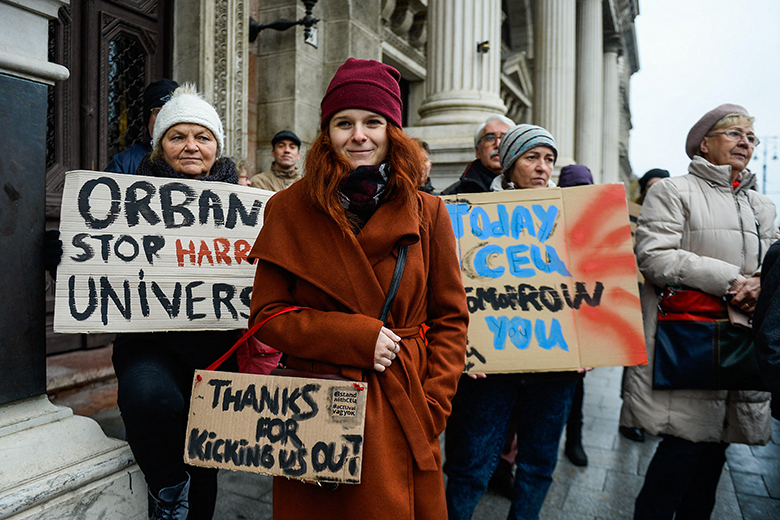
The expulsion sparked an international outcry, but academics in Hungary say some of the most transformative changes to higher education were quieter and more systematic.
In 2019, the government introduced the “foundation model”, transferring many public universities out of direct state ownership into privately governed foundations, each overseen by a board of trustees controlling its budget, strategy and senior appointments. The initial board members were hand-picked by the government and given lifetime positions. By 2022, there were 21 foundation-run universities, according to the European University Association.
The composition of the boards, stacked in many cases with politicians and people in business close to Fidesz, prompted the European Union to act. Since 2022, foundation universities have been barred from receiving Erasmus+ and Horizon Europe funds.
Viktor Lőrincz, vice-president of the Hungarian Academy Staff Forum, a body set up in 2019 to defend researchers’ interests, has been one of the leading voices pushing back against the changes under Orbán. He said the loss of EU funding has been the single most damaging practical consequence for researchers, with government substitute programmes failing to fill the gap. “The main grievance [for researchers] is the loss of Erasmus and Horizon programmes,” he said.
While he believes the EU was correct to act, he is frustrated by how it played out. Rather than turning university leaders against the government, the ban had the opposite effect. “The university rectors and presidents did not attack the Hungarian government because of this,” he said. “They attacked the EU.”
Before the foundation model, the government had installed state-appointed “chancellors” alongside elected rectors, creating two executives with equal standing but different loyalties. The results were often paralysing. “In some institutions it was impossible to manage the university,” said Gergely Kováts, an associate professor at Corvinus University of Budapest, which was among the first to adopt the new foundation model, and whose research examines its weaknesses. The foundation model that replaced this two-stranded management brought different problems. Boards were small, opaque and self-perpetuating, he said.
“The foundation’s goals, its operations, motivations, and decision-making practices are neither transparent nor subject to oversight,” Kováts added. He points out that foundation universities exist across Europe without controversy, “but in Finland, Sweden, Portugal and Germany, the boards are under public control. That’s the really important distinction,” he stressed.
The pressures the model creates are more subtle than outright censorship, what Kováts calls “smart repression”. The goal is not to silence academics directly but to make self-censorship the rational choice, he added.
Researchers have adapted accordingly. “Certain topics became very sensitive, gender and migration the two most obvious,” said Laczó. “I know a lot of colleagues who say they are still doing the same thing they have always done, but now they label it differently. You can study gender if you call it family studies.”
Kováts notes, with some irony, that he has not personally faced pressures despite his critical research as he does not take part in public debates. “Those who participate in public debates despite these pressures are subjected to attempts to discredit, devalue, or pigeonhole them, thereby making an example of them to deter others, in order to minimise their impact,” he said. “They can also be used as tokens to demonstrate that academic freedom exists within the regime.”
Bruno van Pottelsberghe, the Belgian economist who serves as president-rector of Corvinus, describes the model change as a “smart move”, arguing that the foundation funds a substantial share of the university’s budget while leaving day-to-day decisions to university leadership. He also criticised the EU for revoking funds. “I don’t understand the logic and the collateral damage means they hit precisely those they want to support with this ban,” he said. “They are jeopardising the professional dreamers, the students and the researchers, who are all pro-European.
“An adverse effect of the misunderstanding surrounding the decision is that some universities do not wish to enter into exchange agreements, or are reluctant even to begin discussions about Horizon 2020 or other collaborative projects,” he added.

Hungary’s minister for culture and innovation, Balázs Hankó, has insisted the reforms were proposed by the universities themselves and voted through with two-thirds majorities in their senates. “When you are a state-owned university your structure is so strict, but when you are talking about education and innovation there should be flexibility,” he told Times Higher Education in a previous interview. The ministry, which was approached for comment but did not respond before publication, has also trumpeted the improved visibility and performance of Hungarian universities in global university rankings in recent years.
ELTE, which declined to transition to the new model, has continued to access EU funding, but at a financial cost as it receives significantly less government funding than universities that made the switch. “The single biggest problem is that we were underfunded and we remained in the same situation,” said Szűcs. For him, the trade-off has been worth it. “I would always go for more autonomy,” he said. “Independent, self-governing bodies, independent standards, we know that these things matter a lot,” he said, adding that the EU’s funding ban on foundationalised universities shows the institution is taking academic freedom seriously.
Orbán’s brand of politics has found admirers well beyond Hungary’s borders. In 2024 he co-founded Patriots for Europe, which became the third-largest group in the European Parliament, with Marine Le Pen’s National Rally and Geert Wilders, leader of the Netherlands’ far-right Party for Freedom, among its members.

Across the Atlantic, the picture looks familiar. The CPAC conference, the annual gathering of American conservatives, has been held in Budapest multiple times in recent years. Laczó, who spent time recently as a visiting academic at Columbia University, has watched the Trump administration's moves against American universities with grim recognition – not least, Trump’s bold “Compact for Academic Excellence” offer in October 2025, which asked institutions to trade institutional autonomy in exchange for guarantees of enhanced funding.
“Fidesz methodically attacked almost all the independent sources of any kind of power,” he said. “Culture and education came relatively late for them, which is exactly what we are seeing now in the US.”
In 2018, the government deaccredited gender studies at the only two universities that taught it, ELTE and CEU. The official justification was that the subject lacked economic rationale. Eva Fodor, a professor of gender studies at CEU in Vienna, said the move sent a signal that travelled far beyond Budapest. “It was more a political move than trying to solve a substantive problem,” she said. She sees the same logic playing out now in the United States. “The restrictions on education, blaming academics as lefty liberals who teach terrible things to the youth, the arguments are very similar.”
Poland offers a different kind of lesson. Like Hungary, it elected an authoritarian nationalist government that exerted control over universities before losing power in 2023, yet its successor has struggled to undo the damage. “They entrenched the Constitutional Court, the ordinary judiciary,” said Gábor Halmai, the chair of constitutional law at the European University Institute in Florence and an emeritus professor at ELTE. “These so-called enclaves within even a new democratic government are still there.”
Magyar has committed to abolishing the foundation model and returning university assets to public ownership, according to Lőrincz. But the legal obstacles are formidable. Reversing the model requires a two-thirds majority in parliament, the same supermajority Fidesz used to entrench it, and even a convincing Magyar victory is unlikely to deliver that threshold. “I’m afraid the situation is very bleak for universities, regardless of what happens, unless the new government gets the two-thirds majority,” Halmai warned.
Lőrincz is less pessimistic, believing board members appointed under Fidesz would be quick to realign if the political winds shifted, and that a new government could find creative legislative routes without needing a supermajority.
László Kontler, the pro-rector for Budapest at CEU who watched its expulsion unfold from the inside, warns that the deepest damage will be the hardest to repair. Rebuilding funding and governance structures is conceivable. What is harder to legislate for is something less tangible: “Restoring the respect for academic work, which has been consistently and severely undermined under a profoundly anti-intellectual regime,” he said.
Register to continue
Why register?
- Registration is free and only takes a moment
- Once registered, you can read 3 articles a month
- Sign up for our newsletter
Subscribe
Or subscribe for unlimited access to:
- Unlimited access to news, views, insights & reviews
- Digital editions
- Digital access to THE’s university and college rankings analysis
Already registered or a current subscriber?