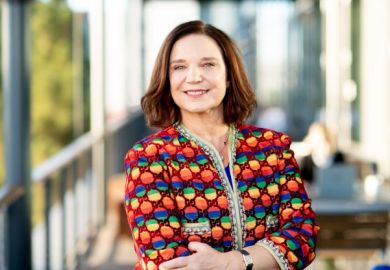
Jenny Chatman’s links to Haas Business School run deep. Not only has she worked at the institution for more than 30 years, it was also where she studied for her own PhD after completing an undergraduate degree within the wider University of California, Berkeley system.
Taking over as dean of the world-renowned business school, which she did on an interim basis in 2024 before being made permanent last year, has therefore been “surreal”, Chatman told Times Higher Education, and she has a keen sense of “responsibility” for it to be “the very best it can be”.
“When I walk around on campus, and I see a little bit of litter in our courtyard, I now pick it up,” she explained. “I might not have noticed it before, but now I pick it up and I think, I’ve got to keep this place together.”
Her premiership has coincided with a period of intense turmoil in US higher education, with Donald Trump’s second presidential term posing successive challenges for its universities, as well as the wider disruptions of generative artificial intelligence and global economic challenges.
So far, Chatman has led a refresh of Haas’ “brand narrative” and strategy. At a time when questions have been raised over the value of universities, and MBA courses in particular, it is important that “the world knows what we stand for”, she said.
These questions are not exactly new, Chatman highlights, pointing to “at least” three other occasions during her career when the “value proposition” of a costly MBA has come under the spotlight.
What’s different this time is that these questions now seem more existential: “If all of these jobs are going to be gone, why should I bother, right?”
For Chatman, this underlines the need to “ensure that there’s a value” in what business schools are offering.
Part of this comes from their ability to be “the translational arm” for “upstream discoveries” made by the rest of the university, she said. For example, by transforming health research into “scalable solutions” that can benefit the public.
Business schools can “accelerate” the ability to get research to market so that people can start “using it and benefiting from it more quickly”, Chatman said.
This job has been made harder by policy changes that have come out of Washington, she said, some of which have been “head-scratching”. Attacks on universities themselves cement the need for universities to shout about their successes, and “making sure that our broad constituents understand what we’re actually doing and providing, and that we’re not some isolated ivory tower talking to ourselves”.
But these challenges have provoked internal reflection, and she believed that Haas has, up until now, been “underselling” itself. One of the core leadership skills it teaches students is “confidence without attitude”, and Chatman believes it might be time for a bolder approach.
Haas has 40 courses that now have “significant” AI-related content, and has recently introduced a new AI certificate that teaches students about core skills and ethical considerations of the technology.
Chatman said she is also in the process of hiring an “AI consultant” to help faculty members “adapt” their curricula to include more AI content, which she believes academics will increasingly have to do amid technological advancements.
How much of a challenge does this pose for academics? “Faculty like to get good at what they do and getting good takes repetition. It makes people nervous when they have to change up things all the time. But it’s a reality,” she said.
Although Haas used to change its core curriculum “about every 10 years”, or “five at a real push”, the rapid rise of AI means that “we need to look at it every year for now”.
Haas has also not been immune to political challenges, and Trump’s decision to cut visa lengths for international students – who form about 40 per cent of Haas’ MBA intake – has meant that Chatman believes students are “a little bit more sceptical” about studying in the US.
The business school launched a “daily SWAT team” last year amid the visa changes to discuss how it could ensure that students with offers could take up their places. Of 90 people, all but one were able to take up or differ their offer. Haas has also hired lawyers to help students with visa issues.
Despite the attacks on diversity and international students, Chatman remains committed to these approaches: “Our full-time MBA programme is so enriched by the international diversity…massive polarisation exists in the world generally, but in the US especially, in a profound way right now. These cross-cultural experiences, I think, are a key to resolving these,” she said.
Rather than seeing such aims as a challenge, Chatman sees them as an “extraordinary opportunity” to take the business school to greater heights.
“Of course we have our challenges but I’m not daunted by them,” she said.
Register to continue
Why register?
- Registration is free and only takes a moment
- Once registered, you can read 3 articles a month
- Sign up for our newsletter
Subscribe
Or subscribe for unlimited access to:
- Unlimited access to news, views, insights & reviews
- Digital editions
- Digital access to THE’s university and college rankings analysis
Already registered or a current subscriber?