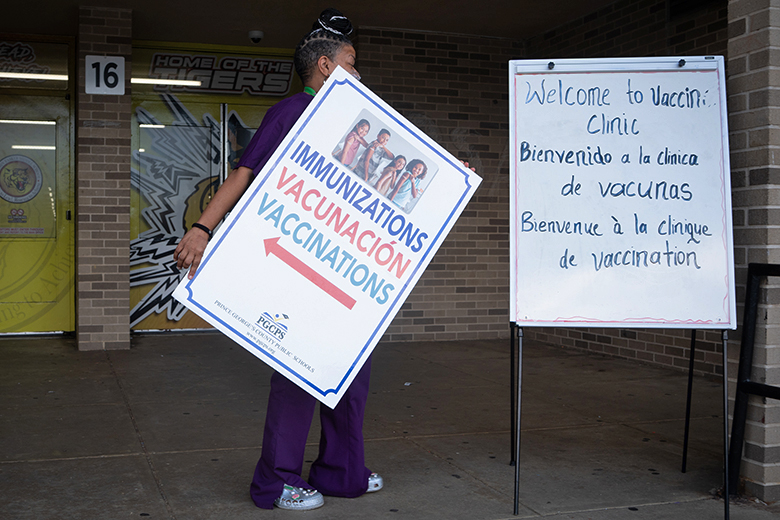
In the first seven weeks of this year, the number of measles cases in the US surpassed the total number recorded between 2020 and 2024. Whooping cough cases have surged, infecting tens of thousands of people last year. And two decades of progress in HIV prevention is said to be in reverse.
These are just some examples of the immediate consequences of anti-vaccine rhetoric and the widescale cuts to science funding in the early months of the second Trump administration, according to David Sanders, an associate professor of biological sciences at Purdue University.
And such cuts are likely to continue as the Department of Health and Human Services doubles down on its opposition to vaccination programmes and vaccine research under the leadership of long-term vaccine sceptic Robert F. Kennedy Junior.
“It’s largely ideological, and it’s being reinforced by messaging from people who should be involved in protecting our health,” Sanders told Times Higher Education. “It is troubling in the short term, but it also potentially has long-term consequences for the health of the American public.”
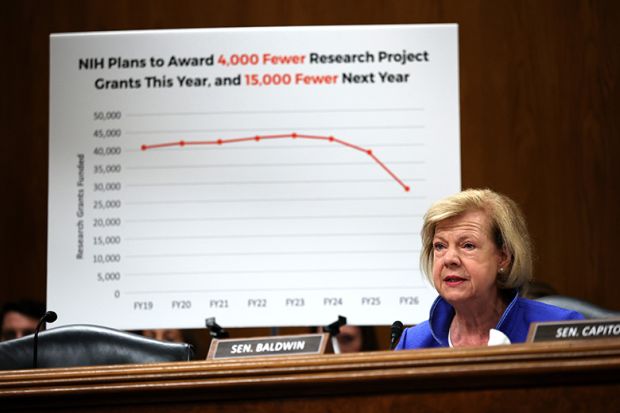
This is just one of many reasons why scientists are not loudly celebrating the fatal blow that Congress recently dealt to the administration’s attempts to slash the budgets of the country’s leading science agencies. In January, congressmen and senators approved funding bills that will preserve the budgets of the National Institutes of Health (NIH) and the National Science Foundation (NSF) more or less at current levels – in sharp contrast to the White House’s budget request, which would have slashed the NSF budget by more than 50 per cent and the NIH’s by nearly 40 per cent.
Yet Joanne Padrón Carney, the chief government relations officer for the American Association for the Advancement of Science (AAAS), described the news as a “double-edged sword”.
“We’re extremely pleased that Congress has rejected the proposed cuts,” she said. “Typically, we would not necessarily be celebrating flat budgets, but in consideration of the alternative, we are quite pleased by that. But I wouldn’t say that we’re out of the woods necessarily.”
Scott Delaney agrees. After the former Harvard scientist saw his research funding cut last year, he lost his job but was able to secure philanthropic funding to lead the Grant Witness website, which tracks the termination of research agency grants under the Trump administration.
“A lot of people in the US have said that science funding has been restored, grants are back and all the money’s out the door, so no harm, no foul, right?” he said. “Actually, no. There are probably thousands of people that are out of jobs and there are disruptions to the scientific enterprise more broadly that are just not as obvious. The idea that science in the US is back to full speed is just not consistent with what’s happening on the ground.”
According to Grant Witness, more than 5,400 NIH grants, worth about $520 million (£390 million), and almost 2,000 NSF grants, worth $700 million, have been terminated or frozen. Analysis by Nature, published in January, of Trump’s first year in office found similar numbers. It noted that the courts have ordered that many of the grants be reinstated, but it is unclear how many have been in practice, and around 2,600 remain frozen or cancelled.
Meanwhile, the total number of new grants funded by both the NSF and the NIH dropped by around a quarter compared with the average of the previous 10 years, Nature found. And a New York Times analysis published in December revealed that while the NIH disbursed huge amounts of money in the second half of 2025 in an effort to get previously stalled money out the door, the money went on many fewer individual projects than in previous years. As a result, the average payment for competitive grants shot up from $472,000 in the first half of the fiscal year to over $830,000.
Nature also found that science agencies lost around 20 per cent of their administrative staff last year (and about 25,000 staff and scientists in total). David Ho, a professor in the School of Ocean and Earth Science and Technology at the University of Hawai’i at Mānoa, noted that those staff losses include “programme managers in charge of giving out funds. As a result, even though Congress has appropriated the funding, federal agencies are finding it difficult to distribute it in the most optimal way,” he said.
Remaining staff have reported struggling to keep up with workloads and Ho also fears that in such circumstances the agencies are likely to favour established scientists rather than junior ones for funding since, without the time to properly scrutinise applications, programme managers are likely to err on the side of caution.
Sanders said younger colleagues have already been “devastated by the cuts” because of the disruption they have caused to their research programmes.
“The grant process is fraught and time-consuming,” he said. “This has put on additional burdens that are really discouraging a lot of people at multiple levels of career engagement with the sciences. The chaos that has been thrust upon researchers is at least as important as the actual cuts.”
All this has prompted concerns that the US is at risk of losing a generation of scientists.
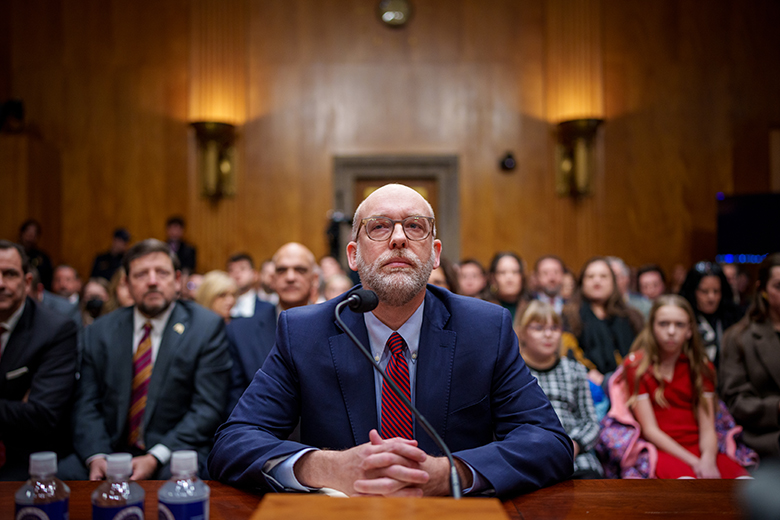
Another reason for scientists’ ongoing anxiety is that even though Congress has rejected Trump’s cuts, the designated funding is still not being distributed at anything like the expected level – largely because the White House appears to be dragging its feet on releasing it to the agencies. Recently, funding for the NIH, NSF and even Nasa has been delayed or permitted only with restrictions.
Russell Vought, director of the Office of Management and Budget (OMB), the White House agency that releases funding to the agencies, has advocated cutting science funding for years and has stated his belief that the OMB has the power to withhold funding for programmes it does not support. Last July, he tried to block the NIH from spending its remaining budget, only relenting when Republican senators objected.
Accordingly, while it is a “big deal” that Congress passed the budget it did, Delaney expects the OMB to find ways to “delay, defer and deny payment” of grants, or for the administration to use accounting tricks to make it appear that the money has been spent when it hasn’t.
“The OMB has already started to prevent science agencies, including ones that are not politically hot topics, from spending the money that Congress said they’re going to spend,” he said.
Recent reporting bears that out. In line with an OMB circular issued last year saying it can, for 30 days, limit an agency’s spending to salaries and other essential expenses, the NIH is currently issuing grant calls and releasing grant funding at much slower rates than usual, Nature and Science have found.
Analysis of NIH data by Jeremy Berg, professor of computational and systems biology at the University of Pittsburgh and the former director of the National Institute of General Medical Sciences, part of the NIH, found that the NIH has so far made about two-thirds of the usual number of grant awards it normally makes by this time in the year, and the NSF has made around one-quarter.
“I expect this [reluctance to release funding] to continue at all of the agencies for the year ahead and I think there’s going be lots of ways they do that,” Delaney said. “We’re going to just have to continue to evolve and find ways to track that. While Trump himself might not be focused on research budgets, the pressure from the OMB and from other agency leadership will persist.”
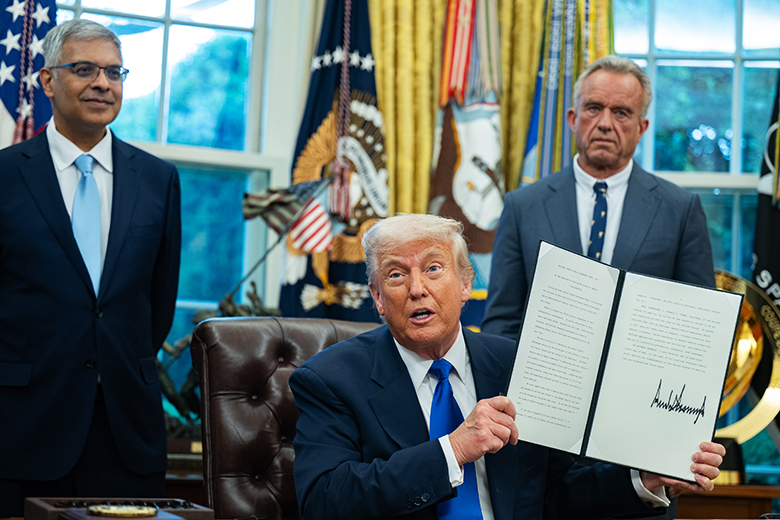
That concern about the agencies’ own motivations about disbursing their allocated budgets is very real.
Arthur Daemmrich, director of the Arizona State University Consortium for Science, Policy and Outcomes (CSPO), said there were exceptions to the notion that all Trump appointees were out to gut science, noting that the Department of Energy has shifted priorities to emphasise nuclear power in a way that is more attuned to consumer market energy needs than recent administrations have done.
But scientists are concerned that biotechnology investor Jim O’Neill has been nominated by Trump to be the next director of the NSF. If appointed, he would be the first non-scientist or non-engineer to lead the agency.
And “in the health area, it’s a very messy situation,” Daemmrich conceded. “You have people who are avowed anti-vaxxers running agencies whose public health mission can, does and ought to include vaccination, which is a very proven effective approach to reduce the spread of disease.”
Jay Bhattacharya is director of the NIH and acting director of the Centers for Disease Control and Prevention. The former Stanford University professor has been criticised by the scientific community for years for his opposition to Covid vaccines. And Berg, who is also the former editor-in-chief of Science and an adviser to the Stand up For Science non-profit, said the scientific community is in a worse position now than it was a year ago.
“The bottom line is that it’s good news [that agency budgets have been protected by Congress], but it’s not the end of the story by any means,” he said. “The assertion that political appointees without any scientific expertise are now going to be empowered to actually make funding decisions is probably the most worrying.”
Also worrying is that of the 27 institutes and centres within the NIH, 16 were missing permanent directors as of mid-February. Critics worry this gives more power to political appointees to make decisions about which grants get funded – and even who is allowed to speak. Berg noted on Bluesky last week that a friend had been scheduled to give a “purely scientific” talk at the NIH but it had been cancelled “because of a ‘new process’ where all speakers/talks have to be cleared by a political appointee”.
Referring to the ruinous famines caused by the Soviet Union’s ideological commitment to the mistaken genetics of Trofim Lysenko, Berg said “the worst-case scenarios, which are not at all hard to imagine, are Lysenko-esque government-driven decisions about what is scientifically valid and what isn’t.”
Of course, different administrations always have their own priorities, to which the NIH and other agencies were subject. George W. Bush, for instance, severely restricted research using human embryonic stem cells on ethical grounds.
And while the defunding of certain areas of science is “upsetting for the scientists whose grants were cut”, the system has never funded everyone with good ideas, Daemmrich pointed out: “There have always been disappointed people. The fact that the administration laid out new priorities is actually quite similar to every past administration. So I think some of the criticisms are a little extreme.”
Nevertheless, he conceded that changing scientific priorities so quickly causes significant disruption to the innovation ecosystem: “Turning [science] into either knowledge or into technology is not linear: it’s a very messy set of pathways.”
Berg, meanwhile, worries that expertise in whole areas of important science could be lost if grants are restricted. “You may care deeply about infectious disease or climate change and have a lot of expertise in those areas, but if those grants are unfundable or their chances of being funded are much less than…something less politically charged, many people inevitably are going to shift to areas where they have a better chance of surviving, so that’s definitely a concern,” he said.
For this reason, supporting fields that are “out of fashion politically” is where philanthropic donations could have an important role to play in Trump era. However, “the scale of federal funding in the US for research is outside the reach of any existing philanthropy”, Berg warned.
Moreover, given that huge amounts of the corporate wealth that underwrites philanthropy comes from contracting with the government in some way, “the philanthropists themselves are dependent on federal funding for some things, so they’re keeping their heads down too and don’t want to do anything that’s going to place a target on their back,” Berg said.
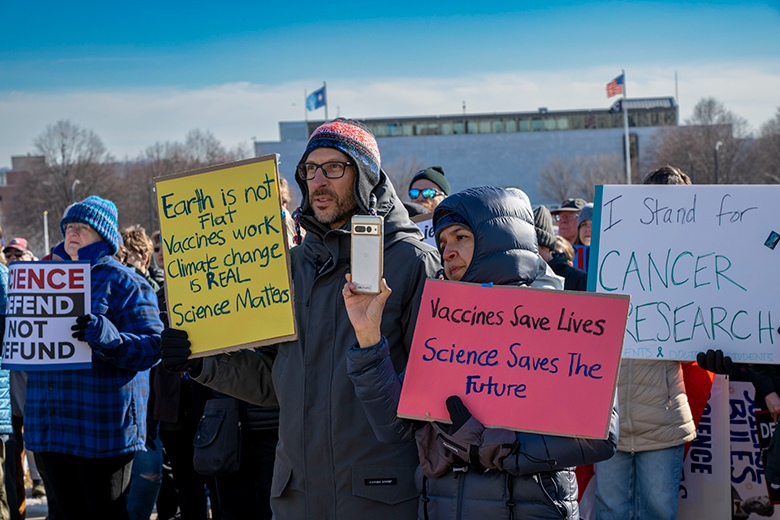
For her part, the AAAS’ Carney believes the long-term threat to US science is “existential” despite Congress’ rejection of Trump’s cuts.
“I would not say that the research community writ large feels safe and secure,” she said. “There is this expectation that tomorrow things could [get worse]. You don’t know what policies, or decisions, could impact your discipline, your institution, or your specific lab.”
She said the challenge for 2026 will be in tracking what agencies actually receive and spend: “We do not expect that [the reality] will reflect the same spending levels as Congress just appropriated; we fully expect that the 2027 budget will more or less mirror the 2026 budget request level.”
So when it comes to the 2027 budget requests, due in the spring, “we’ll be having yet another battle over the size of the government and the investments we should be making as a nation in research,” Carney predicted.
But Grant Witness’ Delaney is reasonably optimistic that wise heads will prevail again, crediting lawsuits and science advocacy groups for helping persuade Congress of the importance of maintaining science funding, leading to a situation that “could have been a lot worse” – particularly given the political reality.
“The Republicans in Congress have largely done exactly what Donald Trump wanted them to do, even if it was entirely inconsistent with Republican doctrine up to this point,” Delaney said. “There’s really very little congressional pushback on things that the administration has done. So it’s notable that on the question of science funding, they did not do what Donald Trump wanted.”
Yet Purdue’s Sanders remains depressed, particularly about the ongoing damage being done to infectious disease research. Nature estimated that more than 800 grants were terminated in this area in Trump’s first year, with the most high profile probably being last August’s cancellation of $500 million in funding for mRNA vaccines, the Nobel prizewinning new technique underlying the Pfizer and Moderna Covid vaccines.
“I am a strong believer that science needs to be tested rigorously,” Sanders said. “But just making an arbitrary, ideologically driven decision that a whole field of research should not be conducted is undermining the future of American science and the future of American health.”
Still, Sanders sees at least one silver lining to the current crisis. “We have become so spoiled by the success of our public health measures that we no longer realise how important they are,” he said.
“Sometimes the public only becomes aware of how valuable public health and our research infrastructure is when there are bad things happening. I never hope for those bad things to happen…but that complacency will cause people to realise the benefits of these.”
Register to continue
Why register?
- Registration is free and only takes a moment
- Once registered, you can read 3 articles a month
- Sign up for our newsletter
Subscribe
Or subscribe for unlimited access to:
- Unlimited access to news, views, insights & reviews
- Digital editions
- Digital access to THE’s university and college rankings analysis
Already registered or a current subscriber?