For most of the past two weeks, Iran has existed in a state of near-total informational darkness. Internet access has been repeatedly shut down nationwide; mobile phone networks in major cities, including Tehran, have gone silent for hours at a time. Even text messages fail to be delivered. For universities that have long relied on digital platforms for teaching, assessment and coordination, the blackout has been paralysing. But it has not fulfilled the regime’s aim of paralysing the protests.
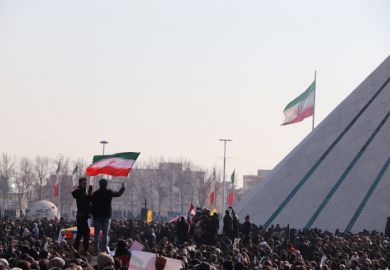
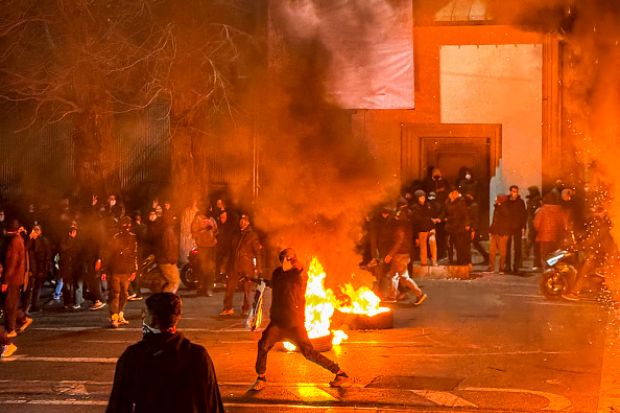
Quite the opposite has happened, in fact. When you cannot message, post, or even call, the only way to know whether others are still there is to go out on to the streets and see. And in dozens of Iranian cities, that is exactly what students have done. Campuses from Tehran to Shiraz, from Babol to Bandar Abbas, from Birjand to Urmia, have become sites of assemblies, sit-ins and confrontations with security forces. Physical presence has become the new network.
That wide geographical spread of the protests marks one important sense in which the current protests differ from previous waves. Another is that the uprisings of 1999, 2009 and 2022 were sparked by students; this time, the sequence has been reversed. The protests did not begin on campuses; they began in society at large and then flowed into universities. Hence, students are not the main drivers of this uprising – but they are deeply embedded within it, giving it organisational density, strategic focus and symbolic power.
This matters. In the previous protests, university spaces were treated by the state as isolated hotbeds of dissent that could be sealed off. Now that is not true, fuelling a widespread belief that this time the unrest may lead to a fundamental political rupture. That belief is especially strong among students, however – and the government’s response suggests it still fears students disproportionately.
This mass protest is unfolding in a country shaken by a collapsing currency, soaring inflation and an intensifying wave of executions, and students quickly joined in. For example, a gathering at the University of Tehran on 30 December was met with a security crackdown, during which five students – both undergraduate and postgraduate – were arrested.
From the first days of the protests, authorities began closing universities under thin pretexts, such as cold weather or air pollution. Then exams were postponed, classes shifted online and, in some cases – such as Tehran’s Amirkabir University of Technology (Tehran Polytechnic), Shahid Beheshti University and Khajeh Nasir University of Technology, as well as several regional campuses – dormitories and cafeterias were closed.
These administrative decisions are not neutral. Shutting down dormitories and cafeterias breaks the spatial concentration that allows student protest to flourish. Moving teaching online while the internet is blocked effectively suspends academic life altogether.
Perhaps the most striking feature of the current student movement is not just its scale, but its ideological clarity. The slogans heard across campuses and in the streets are no longer merely critical of the Islamic Republic; they openly call for its replacement.
Chants such as “Long live the Shah”, “This is the final battle; Pahlavi [the Shah] will return” and “This year is the year of blood; [supreme leader] Khamenei will be overthrown” have become ubiquitous. For the first time since the 1979 Islamic revolution, explicit advocacy of a constitutional monarchy is being voiced loudly and publicly by large numbers of young Iranians.
Even more telling is how once-taboo slogans have escaped the campus and entered wider society. What were previously dismissed as radical – even obscene – chants against the supreme leader and the Islamic Revolutionary Guard Corps are now being shouted not just by students but also by shopkeepers, taxi drivers and families in the street.
The symbolic shift has been reinforced by acts of open defiance from within the academic elite. After regime forces opened fire on a mass rally of young people in the city of Malekshahi on 3 January, killing at least 11 and critically wounding another 30, Ali Sharifi Zarchi, a prominent professor of computer engineering at Sharif University of Technology, publicly declared that “Ali Khamenei is not my leader” and that there is no viable path out of Iran’s crisis other than supporting the former Shah’s son, Reza Pahlavi, as the figurehead of a democratic transition.
Zarchi, who is chair of the Scientific Committee of the International Olympiad in Informatics, has also used his public platform to record the names of the dead – defying the regime’s attempts to erase them. On 14 January, he wrote on X: “My friend Parsa Saffar, a brilliant 5th-semester medical student at Mashhad University and a graduate of Iran’s elite talent schools, was murdered with military weapons during the January 10, 2026 massacre. His death exposes the regime’s shameful lie of labeling thousands of slain civilians as ‘terrorists’. This is a crime against humanity. The world must not stay silent.” The day after, he wrote about another victim: “Aida Heydari, a first-semester student at Tehran University of Medical Sciences, was directly shot and murdered.” These two deaths are also reported on a Telegram channel set up by the Iranian student movement.
Independent Iranian media have also documented a growing list of other students killed by regime gunfire. They include Sorena Golgoon, an 18-year-old first-semester student and only child of a well-known family that had already lost two relatives in the Iran-Iraq war; Yasin Mirzaei Qaleh-Zanjiri, who had been living in Italy but was in Iran to visit his family; and Ahmad Khosravani, a 21-year-old Sharif University student who had recently won the Tehran three-on-three basketball championship and been named the league’s best player.
They are among dozens more students and young protesters reported killed across the country in recent days, though precise numbers are impossible to verify because of the blackout.
The repression has not been limited to killings. Security forces have also stormed university grounds and dormitories – spaces that are legally supposed to be protected. At the University of Birjand, security units raided student housing on 5 January, locking gates, firing shots nearby and arresting at least 10 students. Two young women, Sheida Namjoo and Zeinab Ivani, remain in detention with no information about their whereabouts.
At the University of Tehran, Milad Kakavand, a PhD student in environmental studies, and Parsa Qabakhlu, an undergraduate in electrical engineering, were arrested without warrants and cut off from communication.
Meanwhile, the government claimed that 12,400 university professors had signed a statement calling for a firm crackdown on the “rioters”. In the midst of the digital blackout, this claim was widely regarded as an unbelievable lie.
The government’s current strategy is clear: if people cannot see or communicate, they cannot organise. But they are organising face-to-face. And many believe this uprising represents a last chance to escape a system that has destroyed the economy, militarised everyday life and stolen their futures.
Iran’s universities are no longer merely places of learning. Under blackout and bloodshed, they have become arenas where a generation is seeking to determine what kind of country it will live in.
Roohola Ramezani has a PhD in philosophy from Shahid Beheshti University, Tehran. He was formerly a research fellow at the IFK International Research Centre for Cultural Studies in Vienna.
Register to continue
Why register?
- Registration is free and only takes a moment
- Once registered, you can read 3 articles a month
- Sign up for our newsletter
Subscribe
Or subscribe for unlimited access to:
- Unlimited access to news, views, insights & reviews
- Digital editions
- Digital access to THE’s university and college rankings analysis
Already registered or a current subscriber?