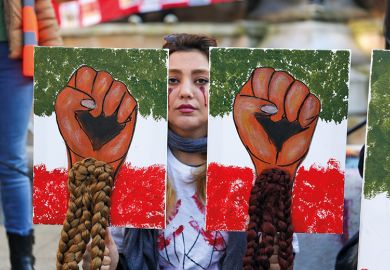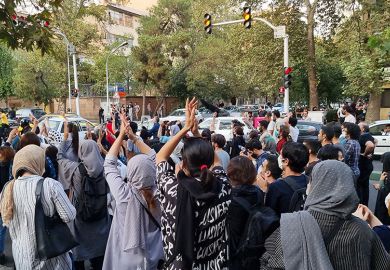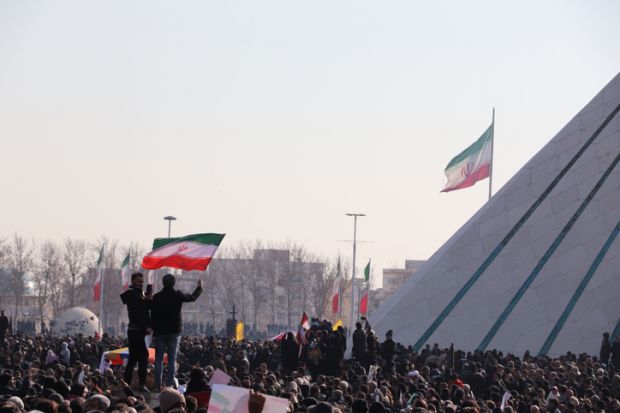
Universities across Iran have been forced online as nationwide protests sparked by economic collapse spread, prompting warnings from scholars that the country faces accelerating academic brain drain unless the unrest leads to meaningful political change.
As demonstrations moved from bazaars and city centres on to campuses, authorities acted quickly to limit student mobilisation by shutting universities and shifting teaching and examinations online.
The measures echo tactics used during previous protest cycles and the pandemic, but academics say they reflect political calculation rather than practical necessity.
Saeed Talajooy, senior lecturer in Persian at the University of St Andrews, said the government was trying “to keep the students away from the universities and from gathering together”, despite official claims that fuel shortages and winter conditions were to blame.
“Even if the universities are closed, it doesn’t mean that university students are not involved,” Talajooy said. “They go and join others in the streets without claiming that they are students.”
However, academic dissent inside Iran is tightly constrained, he said, with most openly anti-government scholars long since dismissed.
“The process of employing the academics has been very rigorous in order to control the types of people who may protest against the government,” Talajooy said, adding that those who do speak out risk losing their jobs or being expelled from study, with long-term consequences for their livelihoods.
International academic collaboration, already limited, has become even more difficult, Talajooy added.
He said he now hesitates before engaging with Iranian institutions, even when approached to review academic work, because it is often impossible to know who is “behind” a request.
Travel to Iran is widely discouraged, particularly for dual nationals, cutting off opportunities for research collaboration, teaching exchanges and year-abroad programmes.
Siavush Randjbar-Daemi, assistant professor in modern Middle Eastern history at St Andrews, said the lack of sustained university-to-university links makes it especially hard for scholars outside Iran to assess what is happening on campuses.
“We don’t really have any form of real exchange with Iranian universities in the normal academic sense,” he said.
Although students have joined demonstrations, he cautioned against portraying the current unrest as primarily university-driven.
Unlike the 2022 Woman, Life, Freedom movement, which mobilised large numbers of students around compulsory hijabs for women, the present protests were triggered by economic collapse and currency devaluation.
Both scholars warned that the longer-term consequences for higher education could be severe.
Iran already suffers from one of the world’s highest rates of academic emigration, particularly among graduates of elite technical universities.
“Iran [has] the biggest brain drain. It has been so for about five decades,” Talajooy said. He added that unless the current unrest leads to substantive political change, another wave of departures is likely.
“If this process doesn’t come to any real result, again we will see another group of academics trying to get out of the country.”
Randjbar-Daemi argued that the protests build on an already “fraught” relationship between the state and universities, marked by politically motivated dismissals of academics in recent years.
During the previous administration, he said, there was “a mass firing of university professors”, adding that although some had since been reinstated, tensions remained and outspoken academics continued to face repercussions.
Talajooy said the protests reflect decades of accumulated social and economic pressure, with students acting because “they know that the future has to be determined now”.
Register to continue
Why register?
- Registration is free and only takes a moment
- Once registered, you can read 3 articles a month
- Sign up for our newsletter
Subscribe
Or subscribe for unlimited access to:
- Unlimited access to news, views, insights & reviews
- Digital editions
- Digital access to THE’s university and college rankings analysis
Already registered or a current subscriber?