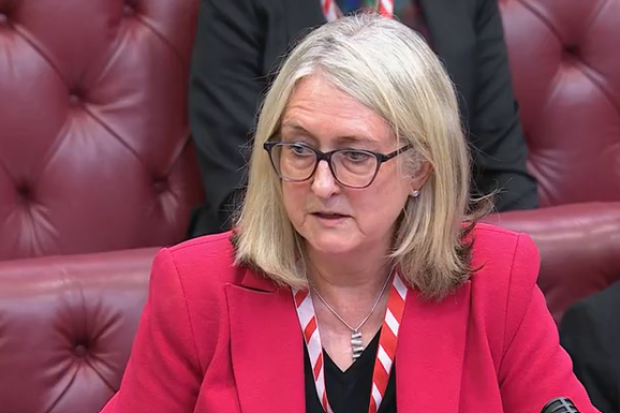
The University of Cambridge’s vice-chancellor, Deborah Prentice, has given personal reassurances to ministers that an investigation into Jason Arday’s professorial appointment will be independent and rigorous, the skills minister, Jacqui Smith, has said.
Answering questions in the House of Lords on 3 September, Smith told peers that she and the education secretary, Lucy Powell, had spoken to Prentice and other senior leaders at Cambridge the previous day to hear more about how it was investigating matters relating to Arday, who became the university’s youngest ever black professor in February 2023.
Cambridge announced an investigation on 5 August, promising to review how senior academics are appointed in light of a plagiarism row over Arday’s work.
Arday, who denied any wrongdoing, was found dead in an apartment in south London on 14 August. His memoir, Great and Unfortunate Things, was published posthumously last month.
Describing his death as a “tragedy”, Smith said her “heartfelt condolences are with his family, his friends and everyone who cared about him”.
“Cambridge is rightly establishing an independent investigation,” continued Smith, adding that she had had the “opportunity yesterday, with the secretary of state, to talk to the vice-chancellor and senior leaders at Cambridge University about that”.
“They will be imminently announcing the details of the terms of reference for that investigation, and, importantly, they gave assurances to myself and the secretary of state that it would be independent and rigorous,” said Smith.
The Labour peer said it was “important to allow a relatively speedy, I hope, and independent investigation into the issues that are raised by this very sad case which may relate to the recruitment of academics…the levels of academic or research standards and processes in place, both within the institution and across the sector, for ensuring that in our higher education system those are maintained at the very highest levels”.
Asked by Conservative peer Toby Young if the Office for Students (OfS) required additional powers to initiate independent investigations into cases of this type, Smith insisted that the sector’s standards body already “does have that power”.
However, several peers challenged Smith on the decision to leave the investigation to Cambridge. Annabel Goldie, a former defence minister, suggested that the minister’s response “inadvertently creates the impression of complacency or inertia” given that the OfS had not been instructed by ministers to look into the matter.
Seeking assurances that “universities are also held to standards of candour” now required of public sector officials, cross-bench peer Claire Fox warned that “institutional autonomy cannot be used as an excuse for marking one’s own homework – as, in this instance, Cambridge proposes”.
Asked by Fox to provide assurances that the minister would “keep an eye” on the investigation given that “it is very, very serious what has gone on”, Smith said she was “more than just keeping an eye on this”.
“It was important for us [Smith and Powell] to have assurances that the inquiries will be both imminently announced in terms of the detail…and the recommendations that come from them will be made available for all of us, to consider whether any further action is necessary,” said Smith.
While other peers also called for a review of whether OfS powers needed “beefing up”, Diana Warwick argued that “universities are already subject to a range of checks and balances”, although this was a “serious and difficult case that surely raises legitimate questions”.
“Cambridge has already started its review process, [and the] most responsible course of action is to let the investigation establish the facts…look carefully about what they tell us about the robustness of the existing checks and then to consider whether any regulatory or other intervention is indeed necessary,” said Warwick, a former chief executive of Universities UK.
Welcoming that advice, Smith said the government would “keep [regulatory] powers under review [though] I am sure [the OfS] and others will want to look very carefully at any of the recommendations that come out of the independent inquiry that Cambridge University has instituted”.
“Universities UK may also want to think about how any lessons learned from this episode can be reflected across the whole of the sector,” said Smith.
Register to continue
Why register?
- Registration is free and only takes a moment
- Once registered, you can read 3 articles a month
- Sign up for our newsletter
Subscribe
Or subscribe for unlimited access to:
- Unlimited access to news, views, insights & reviews
- Digital editions
- Digital access to THE’s university and college rankings analysis
Already registered or a current subscriber?