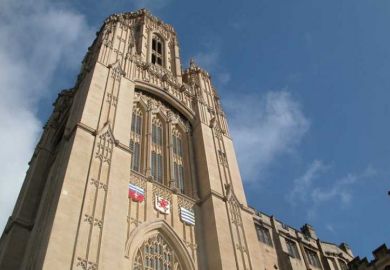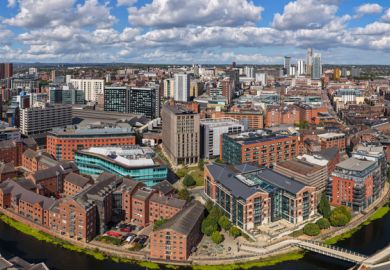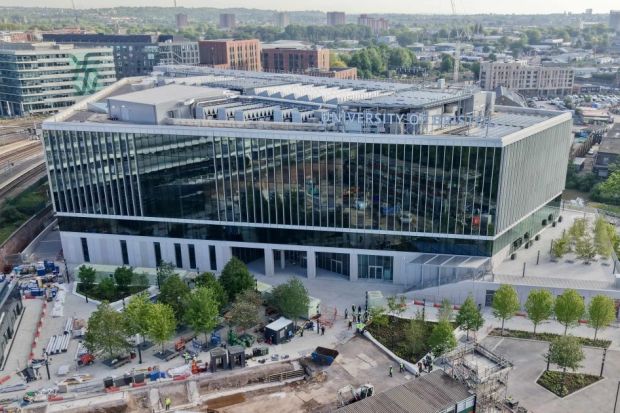
Visitors to Bristol Temple Meads station were once greeted by the bleak sight of a derelict 1930s Royal Mail sorting office – famously once compared to the “entrance to a war zone” by former Conservative prime minister David Cameron.
The site has now been transformed by the University of Bristol which is preparing to open its new £241 million Sloane Robinson building this autumn.
Aiming to breathe new life into a neglected neighbourhood, the building is the standout feature of the wider Temple Quarter Enterprise Campus (TQEC), which launches on 7 September.
It is hoped the opening – which comes ahead of the university celebrating its 150th anniversary – will help Bristol forge fresh ties with its local community, and offers a range of new spaces to accommodate the changing needs of students.
Construction was originally meant to have finished in time for the 2021-22 academic year but was delayed due to Brexit and pandemic-related “uncertainties”.
The £500 million campus will be home to the institution’s business school, Centre for Innovation and Entrepreneurship (CFIE), and research groups from the Faculty of Science and Engineering.
As well as teaching and learning rooms, IT suites, Student Union-run areas, and three internal gardens, the building features an in-the-round lecture hall of 314 seats.
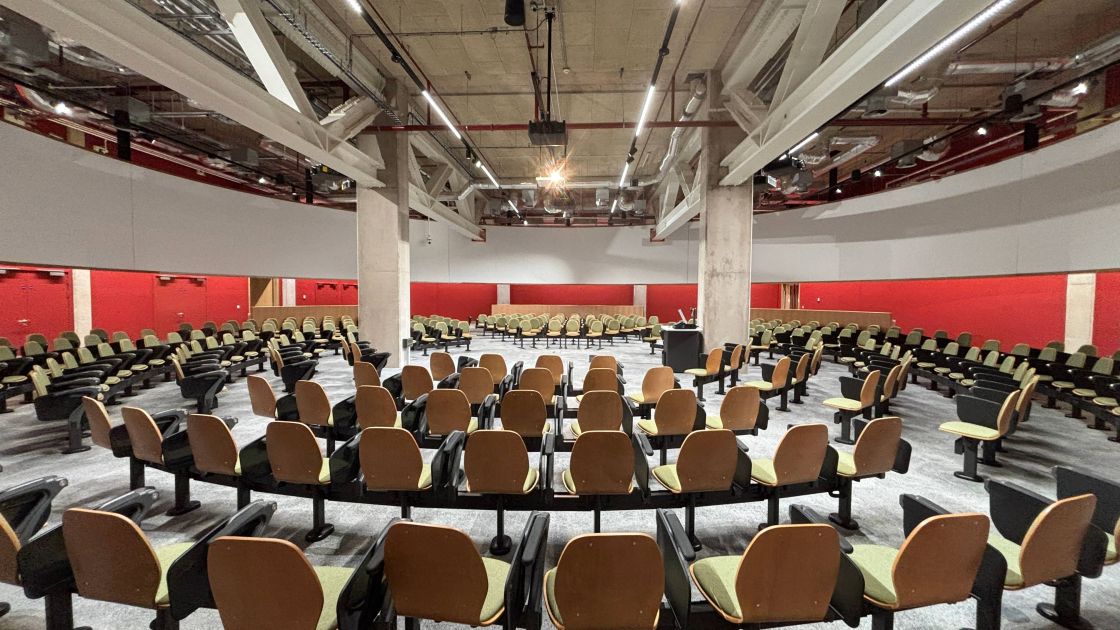
Such spaces are more common abroad, with notable examples including the University of California, Riverside. The team at Bristol looked to the likes of Oregon State University to understand how in-the-round lecture halls had impacted study.
Academics have also been freshly trained on how to teach in the circular space, with Mark France assisting his fellow educators by leading sessions on the skill of presenting in the round.
The lecturer in theatre and performance said the form, which he’d always loved for “its inclusivity”, would help make academic teaching feel “more democratic”.
Traditional lectures, with their lecterns and raked seating, introduce “a barrier” between teaching staff and students, France said.
He admitted some academics had been nervous about the model, saying: “That’s why we’ve done two mock-ups. Everyone was invited to bring a five-minute presentation and talk on something, and collectively, we workshopped it.”
One of the advantages of the building is its proximity to Temple Meads train station, university officials said.
Mia Stevens, outgoing education officer at Bristol Students’ Union, suggested “having this space down here means our commuter students are much more easily involved in student group activities”.
Currently, only about 5 per cent of students at Bristol are commuter students. But Judith Squires, deputy vice-chancellor and provost, said the university “hopes that it would be more”, with trends in the wider sector changing fast.
“And the fact that the building is open to the public and porous will encourage all sorts of people to come in and find the university, feel it to be more welcoming than perhaps they might have done historically,” she said.
One of the university’s goals in ensuring the campus is open to the local community is to encourage use by nearby charities, community groups and businesses.
A “civic lounge”, called the Bristol Rooms, will provide opportunities for organisations working with university staff and students on “shared challenges faced by our city-region and others around the globe”.
Peter Bartlett, a senior lecturer in design thinking and interim director of the CFIE, said that his discipline’s emphasis on “active classrooms” and group work had influenced the learning space in the building, as well as its links to local enterprise.
But there are also explicitly student-facing and academic-facing facilities, too. Lecturers will be able to record their teaching in professional video booths located in the building, which also has a range of sensory rooms, a multifaith space and Islamic prayer rooms.
For Tansy Jessop, pro vice-chancellor for students and education, that the building as a whole will cater to such a range of interests and subject matters will encourage Bristol students to “think across boundaries, so they’re not siloed in their one discipline”.
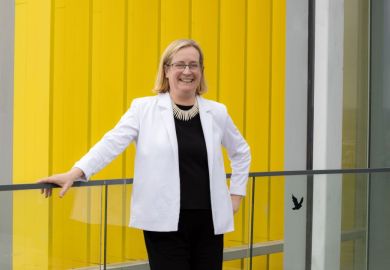
Ultimately, Bristol vice-chancellor, Evelyn Welch, who has recently become chair of the 24-strong Russell Group, said she was “incredibly fortunate” to “inherit a building project” from her predecessor, Hugh Brady, now president of Imperial College London.
“I want to give him a huge amount of credit for what was a visionary plan and a visionary idea at a time when localism and civic universities weren’t a big thing,” she said.
Register to continue
Why register?
- Registration is free and only takes a moment
- Once registered, you can read 3 articles a month
- Sign up for our newsletter
Subscribe
Or subscribe for unlimited access to:
- Unlimited access to news, views, insights & reviews
- Digital editions
- Digital access to THE’s university and college rankings analysis
Already registered or a current subscriber?