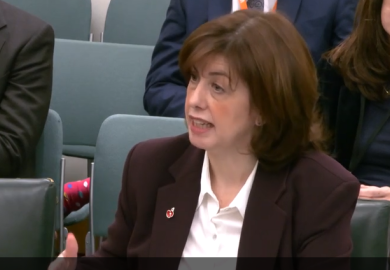
The Office for Students (OfS) will devise “quantitative as well as qualitative ways” to measure whether its new free speech duties are having an impact, Arif Ahmed has said.
The philosopher-turned-OfS-director of free speech and academic freedom said the regulator was exploring how it can better understand if new protections are making it easier for staff and students to say what they think on campuses.
Rules were toughened last year amid concerns that so called “cancel culture” was restricting a diversity of thought at universities. Institutions are now explicitly required to promote free speech and academic freedom. A new complaints scheme allowing academics who feel wronged to challenge decisions also launched this summer.
Ahmed said the watchdog may conduct more regular surveys of the kind released by the OfS in May this year, exploring student perceptions of the issue.
That survey found that only around half (52 per cent) of students reported receiving any communication about their rights to freedom of speech directly from their institution.
In the US, the Foundation for Individual Rights and Expression (FIRE) produces an annual ranking of American universities, reflecting how liberated attendees feel to express their opinions without violence, retribution, or self-censorship.
In the UK, the National Student Survey (NSS) does ask students about how well-protected they feel freedom of expression is on campus, but Ahmed suggested that this may not paint a full enough picture of the situation.
Speaking at Times Higher Education’s Student Success UK&IE 2026 conference at the University of Bath on 4 November, he said the OfS thought it “may well be sensible” to repeat its insight report from earlier this year.
“We are thinking now about what are the best quantitative as well as qualitative ways to understand the impact of our own work and understand more broadly the progress of freedom of speech and academic freedom in time in universities,” Ahmed said.
“One sensible way to do it would be to repeat these surveys and to ask, for instance, in a couple of years’ time how free academic staff feel, how free do students feel. We’ve got a freedom of speech question in the NSS already, but that’s just one question, and it’s pretty broad brush.”
Ahmed was speaking shortly after the regulator was told it must pay the full costs incurred by the University of Sussex, following a High Court clash between the two parties over free speech.
Sussex successfully appealed after the OfS raised concerns about the university’s Trans and Non-Binary Equality Policy Statement and its potential to quash lawful speech.
Ahmed did not mention the controversy in his speech but did refer to the gender-critical debate on university campuses.
Giving the example of a scenario in which institutions might need to tread carefully to protect free speech, he described how a university code of conduct mandating that one must “always” refer to a person by their chosen pronouns could breach statutory duties.
A criminology student who believed, for clarity, it was important to refer to a transwoman in their dissertation using male pronouns would be justified in doing so, Ahmed suggested.
Nevertheless, this was to be understood differently from instances of genuine harassment, he stressed, which would entail targeting transgender people and would constitute a clear contravention of the Equality Act.
But Ahmed said the rules were “clear” that this was true for speech on both sides of “the debate”.
“If you had a speaker for instance who was expressing pro-trans views in a way that many students found unacceptable… they absolutely do have the right to express their views and those ideas, and the limitations are exactly the same,” he added.
Register to continue
Why register?
- Registration is free and only takes a moment
- Once registered, you can read 3 articles a month
- Sign up for our newsletter
Subscribe
Or subscribe for unlimited access to:
- Unlimited access to news, views, insights & reviews
- Digital editions
- Digital access to THE’s university and college rankings analysis
Already registered or a current subscriber?