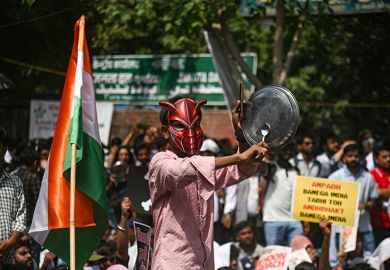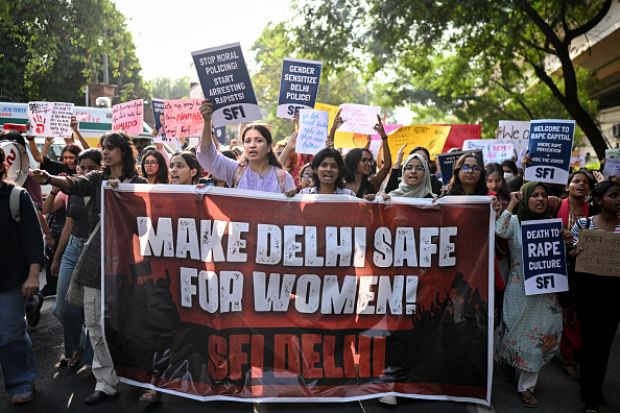
Indian universities have been accused of not doing enough to protect female students after a series of alleged sexual assaults sparked widespread protests.
Demonstrations erupted on the Delhi University campus following a series of rapes in the capital which grabbed headlines, including the alleged gang rape of a 17-year-old by three men posing as police officers in a park near Lady Shri Ram College for Women (LSR), affiliated with the university.
Meanwhile in the north west of India, an allegation that a female student was raped at the Lovely Professional University (LPU) campus in Punjab sparked large-scale protests that led to the suspension of classes and postponement of exams. LPU has denied the allegation and the police are trying to verify the case.
Along the west coast in Gujarat, students clad in black and carrying placards held a “Black Day” protest at Nirma University after a video circulated on social media raising concerns about women’s safety there.
Much of the anger driving the protests across the country has been directed at the response of the universities involved.
LSR responded to women’s safety concerns by putting classes online and female students at Nirma University were told not to wear anything short. Meanwhile, female student accommodation sites have imposed stricter curfews.
Rituparna Patgiri, assistant professor in sociology at IIT Guwahati, told Times Higher Education: “It is very important to put on record that the response should never be about asking women to cover up. Or that women should be attending online classes.”
According to Patgiri, universities should recognise these cases as a “criminal issue” while also initiating “very frank conversations about sexual harassment” with the wider community.
“What universities do is they generally do one workshop and that’s it. But this workshop is only for people within the university…we also need mass sensitisation programmes outside the university and colleges.”
Against the backdrop of growing female student enrolment, Patgiri argued there has been a backlash to Indian women’s visibility in public spaces and institutions.
“I really feel that a lot of people, including older women, are very uncomfortable with the kind of life that young women are trying to carve out for themselves.”
Saikat Majumdar, professor of English and creative writing at Ashoka University, shared Patgiri’s view. He said some people “may not be used to seeing women in certain roles” or “certain kinds of clothing”.
Majumdar said that such incidents are typically happening outside urban centres where the culture is “not necessarily very progressive”.
“The growth of new colleges and universities in rural landscapes where men are not used to educated, empowered women are sustaining a culture of sexual violence.”
Meanwhile in a metropolis like Delhi, part of the problem is that students do not live on campus, Majumdar added. A shortage of campus accommodation means many students reside in private hostel accommodation in areas around the universities.
The support and safety afforded to students in these private hostels has also been in the spotlight following the collapse of a five-storey building housing university students in Delhi.
Independent journalist Nayva Mishra, who has been attending the women’s safety protests in Delhi over the past three weeks, said that one of the main impacts of the alleged sexual assaults is that female students are considering pursuing higher education outside India.
“Many cannot obviously go because not many have that much money and resources at their disposal to leave the country. But for those who can, one of the main reasons is also that we will be much safer in other countries.”
Mishra told Times Higher Education that the feeling among students “of being ignored” has lingered since the Cockroach Janta Party (CJP) demonstrations when hundreds of thousands of young people protested against the leaking of a national medical exam paper, which led to the toppling of the education minister.
“The CJP protests gave that anger a public vocabulary and, arguably, a fresh momentum.”
Register to continue
Why register?
- Registration is free and only takes a moment
- Once registered, you can read 3 articles a month
- Sign up for our newsletter
Subscribe
Or subscribe for unlimited access to:
- Unlimited access to news, views, insights & reviews
- Digital editions
- Digital access to THE’s university and college rankings analysis
Already registered or a current subscriber?