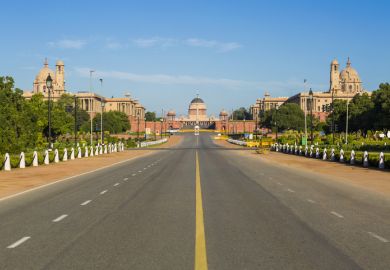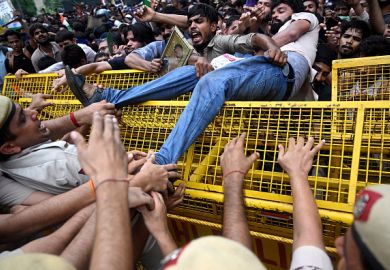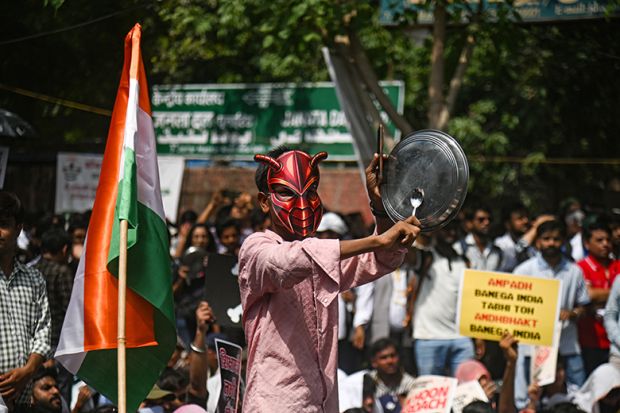
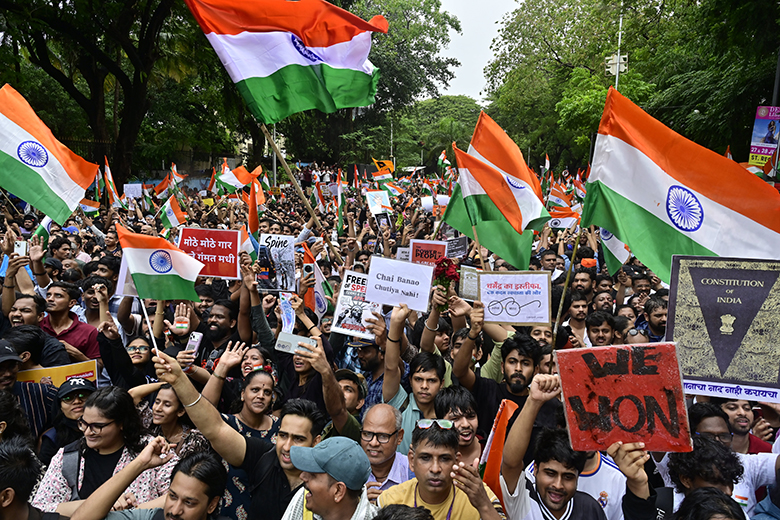
It is Saturday evening in New Delhi. India’s education minister, Dharmendra Pradhan, has just resigned and the tens of thousands of young people who had been demanding it erupt into cheers, chants, singing and dancing. Some bang tambourines; others wave hand-painted posters and the national flag of India.
Some of these young people were mere infants when Narendra Modi was first elected Indian prime minister in 2014. Yet they are now part of one of the largest anti-government movements in India, known as the Cockroach Janta Party (CJP).
Although the CJP is not an official political party (its name is a satirical play on Modi’s BJP), it has managed to do what India’s opposition leaders could not and forced the first senior political resignation of Modi’s leadership, a major setback for a party whose defence minister Rajnath Singh, while serving as home minister, said in 2015 that, unlike previous governing coalitions, “we don’t do resignations”.
To onlookers outside the country, India’s biggest protests in years seemingly came out of nowhere and focused on an unlikely cause: examination integrity. But, in reality, they were the culmination of years of bubbling frustration among Indian youth, amid a sense that however hard they try, getting ahead is much more difficult than it should be.
At the start of May, questions contained in India’s national medical college entrance exam, the National Eligibility cum Entrance Test (Undergraduate), known as NEET-UG, were apparently leaked. The NEET is taken by more than two million students, who compete for over 100,000 places at medical schools: a one in 20 chance of success.
When the leaked questions became public knowledge, the test was called off and students were told they would have to sit it again with a new set of questions amid tightened scrutiny – complete with biometric identification checks, metal detectors and armoured patrols at exam centres. For some, the pressure of retaking a notoriously difficult test was too much and more than 20 died by suicide.
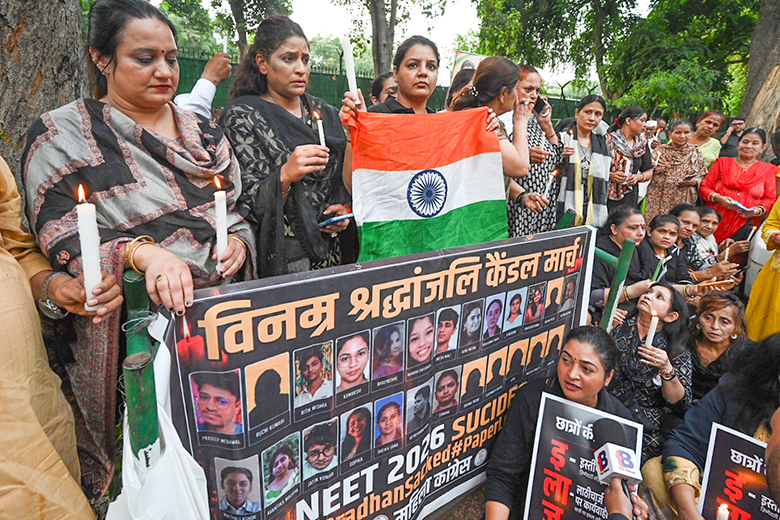
Some days later, India’s chief justice, Surya Kant, added further fuel to the fire by apparently comparing unemployed young people in India to “parasites” and “cockroaches” during a Supreme Court session. “What if all cockroaches came together?” Abhijeet Dipke, an Indian graduate of Boston University, asked on X. The post went viral and Dipke rode the wave, producing an AI-generated image of a cockroach wearing a pair of sunglasses. And so the CJP was born.
Social media enabled the youth movement to quickly mobilise. It currently boasts more than 26 million followers on Instagram, almost three times as many as the BJP and six times more than the government of India.
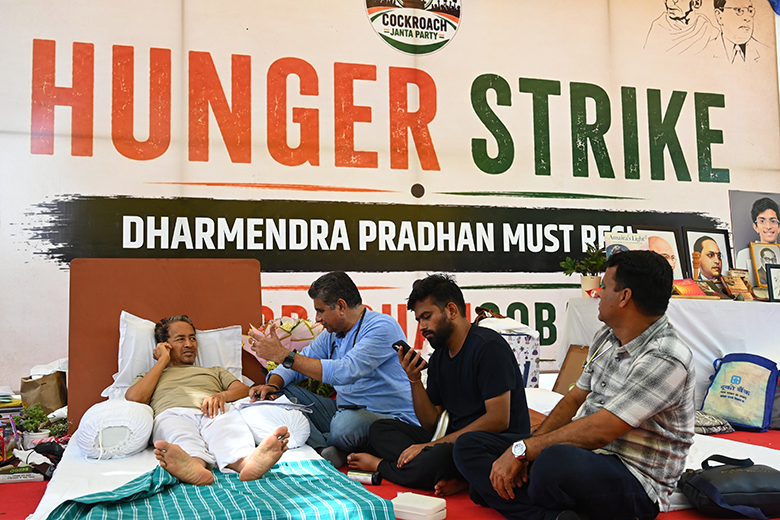
In early June, the CJP started protesting peacefully at the Jantar Mantar site in New Delhi, a historical observatory. It had three key demands: for the education minister to accept accountability for the paper leaks and resign, for the bereaved families of students who had taken their own lives to be compensated, and for any police cases prosecuting young people involved in the protests to be dropped.
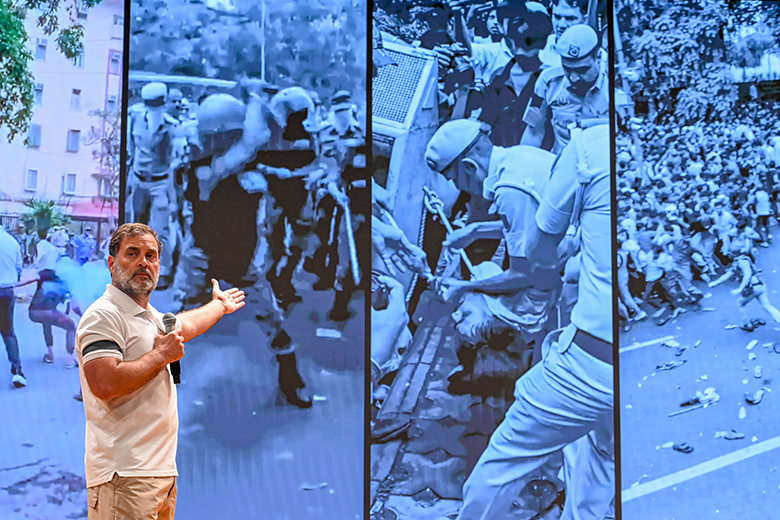
One month later, in mid-July, pressure really started to build. Activist Sonam Wangchuk had joined the movement, going on hunger strike for 26 days – a political tactic that resonates deeply with Indian people. On 20 July, demonstrators attempted to march peacefully to parliament but were repulsed with tear gas and pellet gunshots by the police. Angered by their treatment, protestors only dug their heels in further. And after a week of mass demonstrations across the nation, Pradhan resigned.
Walking around the now-deserted protest site, Booker prize-winning author Arundhati Roy told independent news website Scroll that the CJP had achieved “so much more than it set out to achieve”. But much pertaining to education “remains unaddressed. The games are just beginning,” she predicted.
Higher education has always been seen as the path to social mobility in India. And tech worker Raj Dayal, who attended the protests in Delhi, said the fact that “everybody relates very closely to education” explains why the CJP gained so much momentum so quickly.
“In India, everyone is brought up to work, study hard. That’s the first thing that everyone is taught in school. You study hard, you work hard, and that will guarantee a good life. And then suddenly, when all these students are studying super hard…the system completely throws them under the bus…I think it hits a little close to home for everyone.”
The NEET fiasco is only the latest of a string of exam leaks; opposition leader Rahul Gandhi claimed that at least 152 have occurred in the past 10 years. But it struck a particular chord because of the selectivity and prestige of medical education. Some young people undertake several years of preparation for the NEET, often at dedicated coaching centres. There are reports of families selling their property and remortgaging their land to afford such coaching. It was to some of these coaching centres that the exam papers were allegedly leaked.
But outrage over having to resit a high-stakes exam because of exam officials’ alleged corruption was just the focal point for general dissatisfaction with the lack of opportunity for young people in the world’s fourth largest economy. Indeed, rising youth unemployment, especially outside the megacities of Mumbai, New Delhi and Bengaluru, is widely believed to have contributed to the BJP faring worse than expected in the 2024 general election.
“Only one in four of college-educated youth aged 15 to 29 has a salaried job in India”, said Rahul Choudaha, principal of DrEducation Research, a consultancy that analyses global higher education trends and insights. Although youth unemployment is on the rise in several advanced economies, “the numbers are staggering” in India, Choudaha said, noting that 45 million students are currently enrolled in higher education in the country.
The fact that an estimated 70 per cent of them are at private institutions is another frustration raised by the CJP. Years of underinvestment in the sector has resulted in the proliferation of such institutions but they are typically of lower quality than their public counterparts, while also being more expensive.
This is why Rituparna Patgiri, assistant professor of sociology at IIT Guwahati, detects “a growing sense” among the Indian public that “public universities cannot be replaced. You may have private universities, but they are not for everyone…does it mean that only if you have money should you get a quality education?”
Dipke received criticism in some quarters for professing to speak for Indian students when he had studied in the US. But it then emerged that minister Pradhan had also sent his daughter to Boston – to Tufts University. Many cited this as evidence that India’s universities were inadequate, and Tufts’ Instagram page was flooded with hundreds of thousands of comments using the hashtag #resigndharmendrapradhan.
“Your student is the daughter of a minister whom many people believe failed to uphold his moral responsibility,” one commenter wrote.
“You are doing a great job giving education to a student whose tuition fee is being paid with blood of 20 students,” another said.
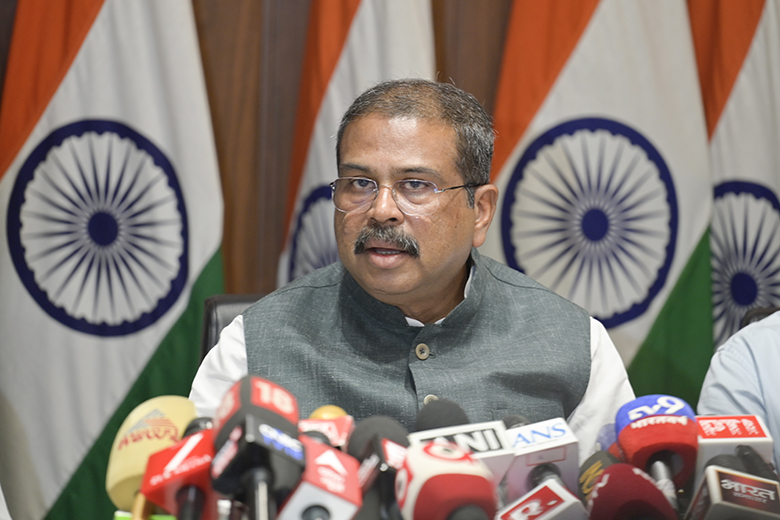
Pradhan’s resignation made headlines around the world. But even though it was the protesters’ central demand, some observers question whether it is really such a triumph.
Saikat Majumdar, professor of English at Ashoka University, described it as a mostly “symbolic victory...I definitely see it as a step forward but it’s a long way from solving the country’s higher education problems.”
Lakshay Sharma, associate director of an IT consultancy, took a similar view. He was very alive to the “disheartening” chaos caused by the NEET leak because his cousin was one of those forced to resit the test. But he cautioned against celebrating Pradhan’s resignation just yet. The graduate of IIT Roorkee, one of India’s most prestigious engineering schools, added that the “real test of the protests is…how we follow up on some of the demands…it’s important that we actually push for discussion [of education reforms] in the parliament and get something concrete out of it. Otherwise, it will all just be a waste.”
In a bid to the quell the protests, Modi promised to set up “fast-track courts” to try the people arrested in connection with the NEET leak, including officials from the National Testing Agency. He also pledged harsher punishments for those who leak exam papers. But many observers are sceptical about such promises given the enormous backlogs in Indian courts.
“These false promises are something that people have been hearing for the past 10, 15 years…the execution from the government leaves so much to be desired,” Sharma said. And, sure enough, the first hearing to deal with the NEET paper leak had to be adjourned on 27 July because no one appeared on behalf of the Central Bureau of Investigation.
In Sharma’s view, the most important thing is to focus on ensuring leaks do not happen in the first place. To that end, Modi has established a “high-powered task force” to reform the National Testing Agency. Only one of the committee’s six members, IIT Madras director Veezhinathan Kamakoti, has experience working in an academic institution, but DrEducation Research’s Choudaha said the committee’s chair, Nandan Nilekani, co-founder of technology company Infosys, is a “very credible name…and that’s what they were trying to communicate: ‘Here is a credible person who’s going to fix everything’.”
But whether Pradhan’s successor fulfils the protestors’ expectations is another question. Modi’s interim appointment, Pralhad Joshi, comes with baggage, having publicly defended the Gujarat government’s 2022 decision to grant remission to 11 men convicted in a high-profile gang rape and murder case. However, Joshi, who already serves as minister of consumer affairs, food and public distribution and minister of new and renewable energy, is expected to be replaced in August with an as yet unknown full-time appointment.
Meanwhile, the new secretary in the Ministry of Education’s higher education department, Naresh Pal Gangwar, faced questions in June over allegations that his family were beneficiaries of significant agricultural subsidies while he was associated with the National Horticulture Board.
Asked whether the cockroach protests will ultimately result in meaningful educational reform, IIT Guwahati’s Patgiri said she was “not very hopeful” because whatever transpired would inevitably fall far short of the “structural systematic overhaul” that is required – including the introduction of “more transparency”, the involvement of individuals with “knowledge of how to run educational institutions and systems” and “more diverse representation and voices in policymaking”.
But other observers have suggested that whatever its effect on education policy, by forcing the removal of a powerful government minister, the cockroach movement might have opened a political door that was previously closed under Modi’s authoritarian rule.
“The students who protested against the government policies were not only concerned about paper leakage,” said Eldho Mathews, who works for the Kerala State Higher Education Council, having previously been at the Ministry of Education in Delhi. “They were concerned about many other issues…and central government is just implementing the key policies without adequate discussion with the states. There’s no dialogue mechanism and whoever opposes government policies will be labelled as anti-nationalists.”
He noted that the cockroach movement lacks “a clear political ideology – and that is going to affect the long term”. But CJP figures have insisted that although they are not aligned with any political party, future interventions will take place, decided on an issue-by-issue basis. Dayal, the protestor, mentioned climate policy, lack of infrastructure and high taxes – as well as Hindu nationalism, the defining ideology of the BJP.
“There’s been so many issues,” said Dayal. “It’s not just that this medical exam got leaked. I think this was just the last straw.”
And Dayal is clear that transport minister Nitin Gadkari is “everyone’s next target. There is a major conflict of interest in what he’s doing. His son owns a company that is a major ethanol producer and saw its revenue skyrocket in a year.” This is because since April, E20 fuel – petrol blended with 20 per cent ethanol – has become the standard (and sometimes only) choice at Indian garages, even though motorists claim it is not efficient and damages their engines.
Anger is revving up, and Delhi transport unions have planned a protest march to parliament at the start of August – something Dayal said would not have happened if the cockroach movement had not blazed a trail for protest.
Farming groups have also scheduled protests in mid-August against the government’s labour policies.
“The young people found a voice. They have momentum,” Choudaha reflected.
“This is really a moment of crisis if you are looking at it from the government perspective. This is a storm which is not quietening for a while.”
Register to continue
Why register?
- Registration is free and only takes a moment
- Once registered, you can read 3 articles a month
- Sign up for our newsletter
Subscribe
Or subscribe for unlimited access to:
- Unlimited access to news, views, insights & reviews
- Digital editions
- Digital access to THE’s university and college rankings analysis
Already registered or a current subscriber?