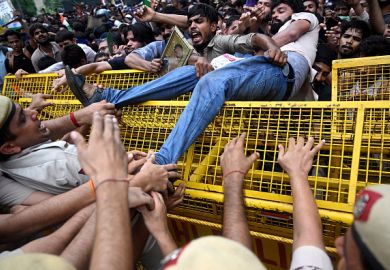
The Indian government has formed a new task force to enact education reforms after mass protests by the youth-led Cockroach Janta Party (CJP) forced the resignation of a government minister.
Dharmendra Pradhan stepped down from his post as education minister on 25 July after weeks of CJP demonstrations, which were among the largest citizen-led protests to have shaken India in recent times.
Pradhan’s resignation was one of the central demands of the CJP movement, which emerged following the leak of a medical college entrance exam in May that led to millions of prospective students having to resit the test.
Pradhan announced his resignation on X, saying that he “deeply respected the aspirations, dreams, and expectations” of India’s young people. He added that he was troubled by the demonstrations throughout the country in recent weeks.
Pralhad Joshi has been appointed the new minister for education. Joshi also serves as minister of consumer affairs, food and public distribution and minister of new and renewable energy.
The CJP called off the protests after a round of talks with government officials in which they said that their demands had been met.
The organisers said that the government would not bring charges against the young people who participated in the demonstrations. They also confirmed that the families of prospective medical students who died by suicide would receive compensation.
When the news broke of Pradhan’s resignation, what had been a site of protest and resistance at Jantar Mantar in New Delhi turned into a site of celebration. Young people were recorded chanting, cheering, singing and dancing.
On 26 July, prime minister Narendra Modi announced the formation of a six-member task force focused on reforming India’s National Testing Agency in a video on X. It has been noted that only one of the six members, Veezhinathan Kamakoti, director of IIT Madras, has experience of working in an academic institution.
Modi posed the video one day after Pradhan’s resignation but he did not mention the youth protests nor the former education minister. This was the first government resignation during Modi’s 12 years in office that was triggered by pressure from the public.
The “high-powered task force” will be spearheaded by Nandan Nilekani, co-founder of technology company Infosys, and it will recommend structural reforms to India’s education system. The two main goals are to make exams in India leak-proof and to harness the power of technology.
The constitution of a task force comes after Modi’s promise to use fast-track courts to punish those involved in paper leaks. This announcement, made last week, met with criticism because there was already a backlog of 250,000 dating from late 2025. Fast-track courts are meant to complete trials in one year.
Register to continue
Why register?
- Registration is free and only takes a moment
- Once registered, you can read 3 articles a month
- Sign up for our newsletter
Subscribe
Or subscribe for unlimited access to:
- Unlimited access to news, views, insights & reviews
- Digital editions
- Digital access to THE’s university and college rankings analysis
Already registered or a current subscriber?