ADVERTISEMENT
Better support for entrepreneurship boosts gender equality
Our data suggests that start-up support is especially beneficial for women, say Henrik Lekkas, Philipp Sieger, Isabella Hatak and Thomas Zellweger

Source: Hispanolistic/Getty Images
Entrepreneurship remains a male-dominated game: men start businesses at higher rates than women, and the businesses they start are far more often in technology.
Often, broad efforts to stimulate entrepreneurial activity only worsen this gap. For example, research shows that early access to investors increased men’s but not women’s later chances of receiving venture capital. Accelerator programmes often increase equity funding only for ventures with exclusively male founders. And business training frequently improves men’s but not women’s businesses.
Universities have spent the past decade building exactly this kind of broad support for entrepreneurship: incubators, accelerators, venture funds, pitch nights and innovation districts. Hence, when we set out to study how students perceive such measures, as part of the Global University Entrepreneurial Spirit Students’ Survey that we have run since 2003, we expected to find the same male-female imbalance. Surprisingly, the results were the complete opposite.
The responses, from 734,412 university students aged 18 to 30 in 83 countries, surveyed in 2018, 2021, 2023, and 2025, revealed that more men (35.3 per cent) than women (28.8 per cent) want to found a company within five years of graduating. However, we also found that women’s positive answers rise, proportionately, twice as much as men’s do when satisfaction with their university’s entrepreneurial environment is higher.
Specifically, where students rate their university’s ecosystem one standard deviation above average, women’s intention to found a company is 10.0 per cent higher, compared with 4.5 per cent for men. For actually running or starting a business, the pattern is the same, with a 12.3 per cent rise for women and 7.3 per cent for men (all comparisons control for age, degree level, field of study, country, and survey year).
ADVERTISEMENT
Moreover, the effect concentrates where male and female participation is most uneven. In all 12 fields that we observed, spanning natural science and social science, women benefited at least as much as men from a better entrepreneurial climate. For example, in computer science, women account for just 28 per cent of students, but they are 11.2 per cent more likely to want to found a company in a better climate, compared with 5.0 per cent for men. In engineering (37 per cent women), the numbers are 7.9 per cent and 3.2 per cent respectively.
Women also gained more than men regardless of level of study. In percentage points, the distance is widest among undergraduates, which is also the group with the widest gender gap.
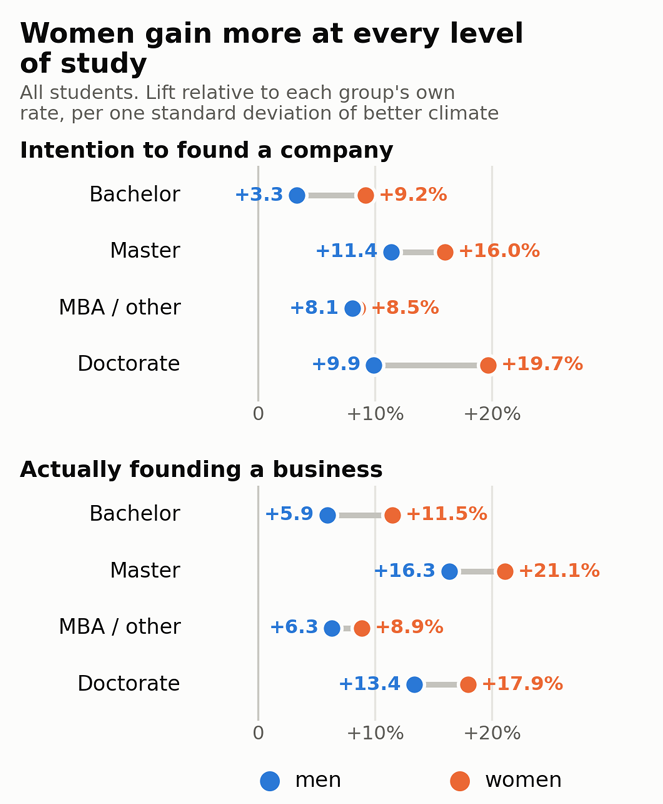
Wanting to found a company is one thing; taking the first step is another. But among students who already want to found a company, a better entrepreneurial climate raised the share of women who have taken that step by 4.9 per cent, from a base of 39.3 per cent. For men, a better climate raised the base of 50.0 per cent by just 0.2 per cent: indistinguishable from zero.
Innovation and equality schemes usually have separate budgets, separate committees and separate staff within universities. However, our data suggests that the two agendas feed each other more than expected. The data is correlational so we cannot draw causal conclusions. But it is not unreasonable to speculate that investing in the entrepreneurial environment would have a disproportionately beneficial effect for women. So we have several pieces of advice for university administrators contemplating how to approach entrepreneurship support.
First, start it in the first year. The clearest gender effect sits among bachelor students, who also face the widest gender gap. Often, university spin-off support primarily targets postgraduates with a technology to commercialise. But this is several years after the point at which our data say the gender return is largest.
Second, while most university entrepreneurship provision still sits in the business school, our evidence suggests that projects in other areas, such as a makerspace in engineering, are also effective.
ADVERTISEMENT
Third, do not stop at intention. A better climate moves women from intention to action but it still leaves them about 10 percentage points behind men on taking the first step. Mentoring, early funding and practical help are still vital, and an appropriate follow-on programme ensures that participants aren’t left stranded afterwards.
Finally, treat the ecosystem as an equality instrument, and measure it accordingly. Few universities report their incubator, accelerator or venture fund by gender or other minority classifications – but they should. Break down every programme by gender and follow students from first interest through intention and first step to incorporation. The resulting numbers might help build broader support for your entrepreneurial efforts.
A good entrepreneurial ecosystem will not close the gender gap in entrepreneurship on its own. But it reliably advances equality while simultaneously advancing the innovation agenda – and the funding assigned to it by universities should reflect that.
Henrik Lekkas is professor of entrepreneurship at the University of St Gallen. Philipp Sieger is professor of entrepreneurship at the University of Bern. Isabella Hatak is professor of SME management at St Gallen, and Thomas Zellweger is professor of family business at St Gallen.
Read more about




Related articles

Featured jobs
ADVERTISEMENT