Renewed uncertainty over federal funding for science will cause more damage to US universities, experts predict, even if drastic cuts can be avoided for the second time.
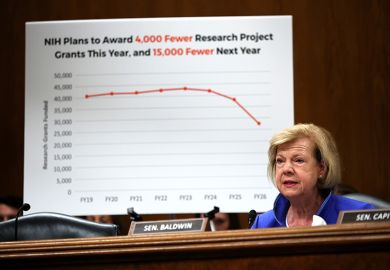
Donald Trump’s administration has proposed to cut billions from the budgets of the major funding agencies in its latest proposals for 2026-27, mirroring a move last year which was eventually struck down by Congress.
The National Institutes of Health (NIH) faces a $5 billion (£3.7 billion) cut, although this is significantly less than the $19 billion proposed for 2025-26.
The National Science Foundation (NSF)’s funding would be halved to $4.8 billion under the proposals, and $1.1 billion would be cut from the Energy Department’s Office of Science.
Benjamin Jones, professor of entrepreneurship at Northwestern University, said the scale of the proposed cuts was expected but that there was some “good news” for federal agencies.
“When they tried this last time, Congress came back with a much better budget for science…so I think there’s still room here for science to come out OK.
“But there has been a consistent attempt from the Trump administration to cut back funding and so they’re kind of playing to form here.”
Cuts to science agencies make up just one part of the massive federal budget, which proposes reductions elsewhere to afford a $500 billion increase in military spending.
“All of these things will be negotiated,” said Jones. “I think the real question is, is this the hill the Trump administration wants to die on? Or is it an area where they will make concessions because it’s important to people in Congress and they have other parts of the budget they’re actually more focused on.”
Marc Edwards, professor of civil and environmental engineering at Virginia Polytechnic Institute and State University, likened the situation to Trump’s infamous “Art of the Deal” business philosophy.
“It’s like a hostage negotiation situation where one side makes a bid that’s kind of ridiculous and then uses it as a bone they can throw and to get what they want.
“Science has really, partly due to its own failings, become a political football and once that happens, it’s really hard to get out of it.”
While sparing high-performance computing, AI, quantum information science, fusion, and critical mineral research, the cuts to the Office of Science will target funding for climate change and “Green New Scam research”.
“That’s very clear that science is being politically directed towards the priorities of whatever administration has been in power and, with each generation, it’s getting worse and worse,” said Edwards.
Despite the reversal of last year’s proposals, experts have warned they still damaged universities and research due to the uncertainty caused. Jones said top researchers have been considering more stable sources of funding outside the US for their long-term work.
“There’s a cost to uncertainty, and I think that’s true across a lot of the Trump administration policies. By raising uncertainty, they make the investment environment less stable and less attractive.
“Those who feel like they can find better opportunities or more certain opportunities elsewhere are more likely on the margins to divert their efforts into other economies, other nations.”
Jonathan Cole, John Mitchell Mason professor of the university at Columbia University, said the “draconian proposals” by Trump had shocked the research universities.
“It has had several effects even in the short run. There is no trust that these efforts will not happen again shortly, a chilling effect on the hiring of new faculty in these science-supported fields, and a potential longer-term self-selection effect of those who intended to enter scientific research will turn away from it.”
But despite a number of top US researchers leaving for roles around the world, Cole said there is no “brain drain yet”.
“English is the language of science, but someday it might be Chinese. And Europe does not have the resources at the time to fund major laboratories at scale.”
Register to continue
Why register?
- Registration is free and only takes a moment
- Once registered, you can read 3 articles a month
- Sign up for our newsletter
Subscribe
Or subscribe for unlimited access to:
- Unlimited access to news, views, insights & reviews
- Digital editions
- Digital access to THE’s university and college rankings analysis
Already registered or a current subscriber?