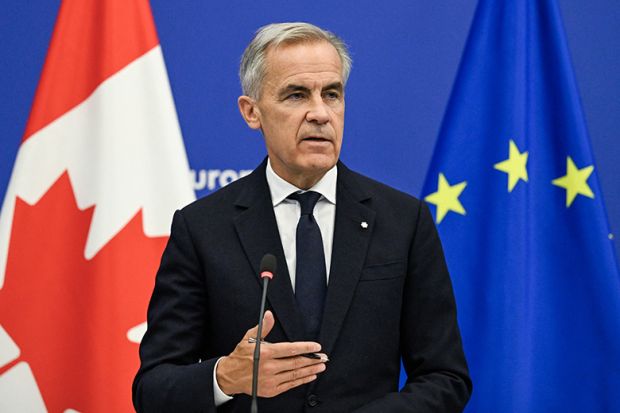
Canada is open to joining the European Union’s Erasmus+ mobility scheme and deepening its involvement in the bloc’s flagship research programme, prime minister Mark Carney said as he called for closer ties across the Atlantic.
His comments came a day after the European Commission president, Ursula von der Leyen, invited Canada to become the EU’s first “associate member” in her state of the union address. It is unclear what that status would entail because it does not currently exist within the EU and few details have been revealed.
In a wide-ranging speech at the European Parliament in Strasbourg on Thursday, Carney called for closer ties between Canada and Europe in research and education. “Canadian membership of Erasmus+ can give your students, and ours, more opportunity to learn at some of the world’s top universities, to broaden their horizons and to build lasting ties that will sustain our alliance for the future,” he said.
Canada is currently a “third country” when it comes to Erasmus+, which means that Canadian institutions can take part in some activities but do not have the full access available to EU countries and those formally associated to the programme.
The EU is in the process of designing the next Erasmus+ programme for 2028 to 2034. The European Commission has proposed increasing its budget from €26.2 billion (£22.5 billion) in the current seven-year period to €40.8 billion.
The Canadian prime minister also signalled interest in getting involved in the next Horizon Europe framework, the EU’s research funding programme, which starts in 2028. Canada is already associated with Pillar II of the current Horizon framework, which funds collaborative research addressing global challenges and industrial competitiveness.
“Canadian membership of the next generation of Horizon would allow us to pool resources, cooperate on frontier technologies and leverage our world-class research institutes and universities,” Carney said.
His comments have raised questions about how Canada will seek to expand its participation in the next Horizon framework, which is likely to have a nearly doubled budget of €175 billion.
Jan Palmowski, secretary general of the Guild of European Research-Intensive Universities, said greater access to the programme’s other pillars could be “on the Canadian wish list”.
“The key issue, then, is under what conditions access to Pillars I and III could be opened up – and if it is access to all or only some of the instruments,” he said.
Pillar I, Excellent Science, includes the European Research Council, Marie Skłodowska-Curie Actions (MSCA) and research infrastructures, while Pillar III covers innovation instruments including the European Innovation Council and the European Institute of Innovation and Technology.
Palmowski said the instruments in Pillars I and III were among Horizon’s most “oversubscribed”, adding that an “absolute precondition” for closer association should be ensuring that money contributed by non-EU countries is channelled proportionately into the schemes they are able to access.
“We have seen, for instance, that in the past couple of years the Commission cut its allocation to MSCA even though the UK and other associated countries have been successful in it”, which should have resulted in the MSCA budget being “boosted by association”.
Register to continue
Why register?
- Registration is free and only takes a moment
- Once registered, you can read 3 articles a month
- Sign up for our newsletter
Subscribe
Or subscribe for unlimited access to:
- Unlimited access to news, views, insights & reviews
- Digital editions
- Digital access to THE’s university and college rankings analysis
Already registered or a current subscriber?