AI enables society to innovate at scale and tackle the world’s biggest problems. But with its high levels of energy consumption, can it be used to support a revolution in sustainability?
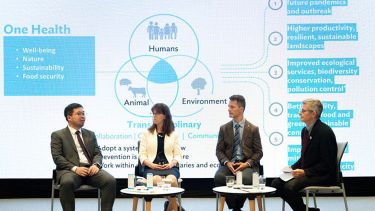
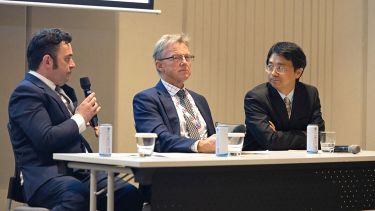
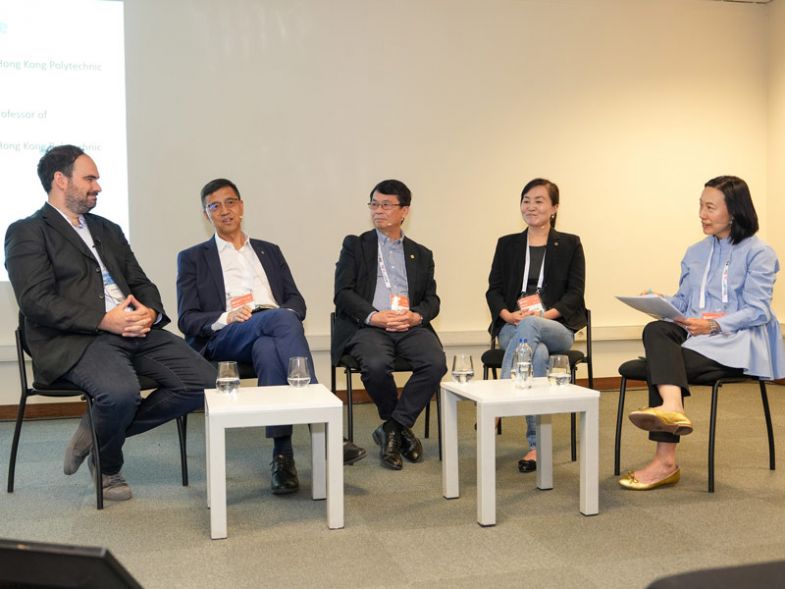
The challenges faced in achieving carbon neutrality and designing a more sustainable society remain considerable. At a panel discussion, held in partnership with The Hong Kong Polytechnic University (PolyU), during the 2025 THE Global Sustainable Development Congress, experts discussed how AI could accelerate the development of green technologies, support sustainable construction and modernise the energy grid for the 21st century.
AI technologies have the capability to make large-scale construction projects more efficient and address complexities in the regulatory frameworks. Geoffrey Shen, associate vice-president of global partnerships and chair professor of construction management at PolyU, said the Greater Bay Area offers a fascinating case study on how applied AI could achieve alignment across regulatory differences.
The panellists said that despite the challenges of AI, it can make construction and energy management more efficient, reducing waste and supporting decarbonisation. “To have construction, you need industry practitioners working together,” said Shen. “It’s a huge challenge. With AI, this could be something relatively easy to do. AI can make this integration possible.”
Modular integrated construction is a widely discussed topic in Hong Kong. It involves shipping in prefabricated modules from mainland China and assembling them onsite. Due to the limitations of space in Hong Kong, construction companies find it challenging to store the modules on the island. Shen believes AI modelling can support a just-in-time approach. “At a project level, the use of AI can enable different stakeholders – the designers, clients and contractors – to share information and make timely decisions,” said Shen.
Jerry Yan, editor-in-chief and chair professor of energy and buildings at PolyU, spoke about how AI can transform grid management to integrate renewable energy resources. Stability and flexibility are some of the biggest challenges in grid management, Yan said. “AI has a very powerful function in dealing with data and real-time decision control.”
Hongxia Yang, associate dean of global engagement and professor at PolyU, recognised AI’s potential for improving policy decisions with real-time data analysis. It can radically increase our capacity to innovate. However, a challenge is that the data centres that sustain AI systems require a lot of power, putting further pressure on the grid.
Could AI be the solution to the very problem it is creating? Erdal Aydin, associate professor at Koç University in Türkiye, said that leveraging big data insights could create revolutionary real-time detection and optimisation systems that could underpin global efforts to decarbonise energy supply and build a resilient grid that successfully integrates renewable energy sources. “We can design systems that can work robustly for 20 or 25 years,” Aydin said. “The interplay between demand and supply is the biggest problem, especially if you are using renewable energy. Through AI, we can solve huge optimisation problems.”
This issue is not just technological. The panel argued that human expertise is crucial for fully utilising AI. “The best solution to that is to still keep the human as a regulatory system for AI,” said Aydin. Now more than ever, society needs human talent.
The panel:
- Erdal Aydin, associate professor, Koç University
- Geoffrey Shen, associate vice-president of global partnerships and chair professor of construction management, The Hong Kong Polytechnic University
- Christina Wong, director, Research and Innovation Office, The Hong Kong Polytechnic University (chair)
- Jerry Yan, editor-in-chief and chair professor of energy and buildings, The Hong Kong Polytechnic University
- Hongxia Yang, associate dean of global engagement and professor, The Hong Kong Polytechnic University
Find out more about The Hong Kong Polytechnic University.