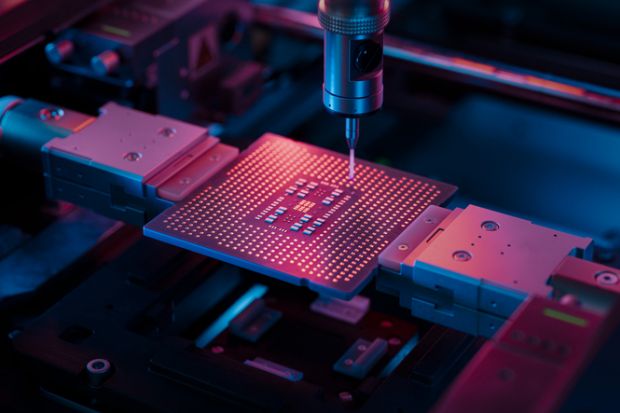
The number of semiconductor programmes offered by European universities has grown rapidly over the past seven years, new data shows, with higher education experts saying the trend suggests universities are increasingly aligning with government industrial priorities in a changing geopolitical environment.
Germany recorded the largest growth, expanding from 18 programmes to 38, followed by Italy (six to 21), Ireland (15 to 28) and Sweden (five to 18), according to figures shared with Times Higher Education by course comparison website Studyportals, which tracked the growth of bachelor's, master's, PhD and short courses between 2019 and 2026. France, Finland and Spain also expanded provision but growth was more modest.
Studyportals found that global student demand for chip-related programmes nearly doubled between 2019 and 2025, although universities around the world were struggling to scale fast enough to meet it. The US has the most programmes but China is seeing the fastest growth in student demand.
The latest European institution to join the push is Ireland's Maynooth University, which this week launched a master of engineering science in circuit design, developed in partnership with domestic industry. “It will fast-track the skills needed for Ireland’s growing semiconductor sector,” said the country’s minister of enterprise Peter Burke, pointing to the government’s Silicon Island strategy as the driving force behind it.
The growth in such programmes across the continent has its roots in the Covid-19 pandemic, when a global chip shortage exposed how heavily the world relied on a handful of suppliers, primarily in Taiwan and China, for semiconductors that power everything from smartphones to medical devices.
The European Commission responded with the European Chips Act, which came into force in 2023 and set a target of doubling Europe’s global market share of the semiconductor industry from 9 per cent to 20 per cent.
Higher education experts said the wave of such programmes is part of a wider pattern of universities adapting programmes to meet the needs of strategic industries.
“The phenomenon is more prevalent now compared with a couple of years ago but it is not unprecedented,” said Mats Benner, professor of science policy studies at Lund University. During the Cold War, he noted, universities oriented much of their research and teaching around defence needs.
“They managed to do so while expanding their core missions, education and research. I suspect they will manage this time as well,” he said. “It will not be easy, as the interests of governments and industry are not always aligned with those of academia. But this is the game in the foreseeable future, and universities will have to play along or find their financial base dwindle.”
Peter Maassen, professor of higher education studies at the University of Oslo, agreed there was a broader trend but warned that it was uneven across sectors because many programmes designed to meet the needs of strategic industries often required large investments in costly equipment.
Another factor is uncertainty in the labour market as a result of rapid changes in certain competitive industries. “In many European countries higher education institutions have limited autonomy for developing non-traditional study programmes,” he said. Such programmes can also face enrolment issues as competition is fierce and low birthrates across Europe means fewer students.
“Obviously recruiting international, that is non-European, students would be an answer but anti-migration attitudes among politicians and part of the electorate have made that more difficult, especially in institutions located outside the main urban areas,” Maassen said.
Register to continue
Why register?
- Registration is free and only takes a moment
- Once registered, you can read 3 articles a month
- Sign up for our newsletter
Subscribe
Or subscribe for unlimited access to:
- Unlimited access to news, views, insights & reviews
- Digital editions
- Digital access to THE’s university and college rankings analysis
Already registered or a current subscriber?