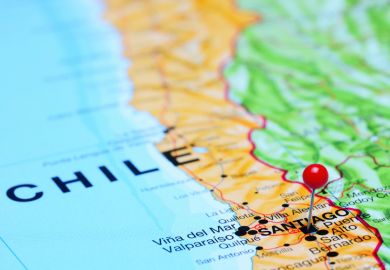
While perhaps unlikely to result in outright Trump-esque attacks on universities, the election of the far-right politician José Antonio Kast as president in Chile likely marks the start of a period of budget cuts that could harm already struggling institutions, academics have warned.
Kast, who claimed victory in the country’s December election, has been an open admirer of US president Donald Trump and ran on the promise of tackling issues like violence and illegal immigration.
However, while Kast is friendly with other far-right leaders around the world, experts are doubtful that he would launch attacks on universities on the scale experienced under Trump and Hungary’s Victor Orbán.
“Direct attacks on universities are not a typical feature of Chilean politics,” said Carolina Guzman Valenzuela, professor of higher education at the University of Tarapacá. “Political influence is more likely to operate quietly through budget decisions, policy priorities and public discourse than through explicit confrontation.”
While Kast has said little about his plans for higher education, there are concerns among some academics that his rise to power could see university funding reduced and scholarships cut for some students.
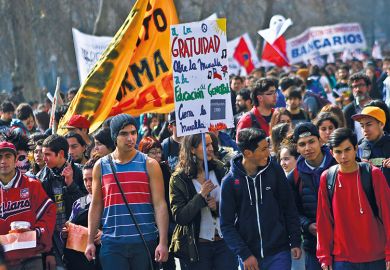
But Kast may also be reluctant to make dramatic changes to the education system, given the “historical strength of student movements in influencing education policy in Chile” in recent years, said Consuelo Thiers, lecturer in international relations at the University of Edinburgh.
“One of Kast’s fears is a renewed wave of social unrest and protests in the streets,” she said. “Given the high expectations he has created around fixing the economy and restoring security, it may be unwise for his government to add another source of instability.
“This could, at least in the short term, restrain more radical changes, although the outcome remains uncertain.”
A more pressing issue for Chilean universities is Kast’s pledge to implement fiscal cuts of $6 million within 18 months across all areas of government – a target “widely regarded as overly ambitious and unrealistic”, according to Thiers.
“Reductions of this scale could directly impact scholarships, grants and the overall functioning of the higher education sector.”
Chile’s public universities are likely to be most affected, although private institutions may also feel the squeeze.
“Tighter budgets, less political attention and a weaker commitment to higher education as a public good or a space for critical thinking could gradually reshape the role of universities and their capabilities,” said Valenzuela. “In my view, the more likely outcome is not a radical change but a quiet continuation and reinforcement of existing market-oriented approaches.”
Veronica Santelices, associate professor at the Pontifical Catholic University of Chile, said many universities are already struggling financially, with few hiring and research grants becoming “increasingly more competitive”.
“A reduction of the funding would be very hard on institutions,” she said. “I would hope that there would be some compensatory scheme where you could…explore new funding sources,” such as private partnerships.
Universities and students will also be closely watching Kast’s approach to the country’s flagship free tuition policy, which covers the costs of attending university for the poorest 60 per cent of the country.
Valenzuela said there is a risk that it “may stagnate or slowly be reshaped in ways that weaken its role as an equity policy” under Kast.
Becas Chile, a programme that provides scholarships for Chileans to study abroad, could also be under threat.
“Many Kast allies have argued that the scheme has served to train left-wing academics abroad and not to support the country’s development,” said Javier Sajuria, professor of comparative politics at Queen Mary University of London.
“On many occasions, congress members from the right have called for the scheme to end; I wouldn’t be surprised if this happens in his government.”
Santelices added: “We’re just hoping that [Kast’s] tone and policies are not as polarised as you may expect.”
Register to continue
Why register?
- Registration is free and only takes a moment
- Once registered, you can read 3 articles a month
- Sign up for our newsletter
Subscribe
Or subscribe for unlimited access to:
- Unlimited access to news, views, insights & reviews
- Digital editions
- Digital access to THE’s university and college rankings analysis
Already registered or a current subscriber?