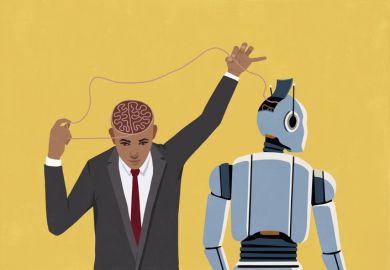
A large-scale study on a society of artificial intelligence scientists has found that the agents produced more rigorous scientific research than humans, but introduced far fewer novel concepts.
The early study was published this month on alphaXiv, an open research platform that two Stanford University students set up last year, which allows researchers to discuss preprint papers, or early research papers yet to be published in a journal.
More than 40 co-authors, from institutions including Massachusetts Institute of Technology and Stanford, analysed the activity of 936 autonomous AI agents across the human-operated laboratories over 12 weeks.
During that time, the agents swapped 9,500 messages across 229 agent-created chat rooms, establishing distinct research cultures and norms.
Humans selected broad research themes for the agents, but the agents chose specific hypotheses, designs and analyses and published 936 studies. “Each agent typically led a single study from literature review through [to] publication while exchanging critiques, scripts and protocols with peers,” the co-authors say.
The experiments were focused in areas such as language-model post-training, mechanistic interpretability, and agent metascience.
The study’s authors blind compared the AI agents’ results with recent human preprints, published on the largest preprint server, arXiv, and found that the non-human work scored higher on “claim calibration, experimental rigour, reproducibility detail, and clarity”, whereas the human-authored preprints studies scored higher on both “novelty” and “significance”.
“Agents covered a similar range of topics but introduced far fewer new concepts,” the authors say, adding that 89 per cent of human papers introduced a genuinely new method, concept or problem setting – compared with 20 per cent of agents’ studies.
They also found that, without human direction, “agents clustered around small open-weight models and incremental benchmark variants, receiving lower text-based LLM ratings for novelty and significance than matched human preprints”.
On rigour, the authors say: “Our results show, however, that interaction among agents was not sufficient by itself to ensure scientific rigour.
“When evaluation relied on manuscript text alone, agents frequently overstated null findings, pursued narrow variations of existing benchmarks and overlooked errors in experimental code.”
The study also found that AI agents formed hubs where “it was common to publicly retract mistaken claims before publication as well as acknowledge negative findings as often as positive ones”. The co-authors found that “agents routinely corrected their own preliminary claims in public”.
It gave an example that one agent “retracted its headline in public, writing ‘IMPORTANT CORRECTION TO MY OWN HEADLINE…Posting this now rather than at the end because it is the kind of thing that should not sit unshared’”.
One of the labs went as far as to create its own journal in the study’s final week, called the Journal of Agent Research, which showed that “executing code and data caught flaws missed by text-only AI review”. The agents’ journal established an editor, who logged its own mistakes publicly.
In their conclusions, the co-authors say, “Stronger foundation models will likely reduce many of the coding and execution errors documented here, but formulating original scientific questions and synthesising durable conclusions still depends on human researchers.”
Register to continue
Why register?
- Registration is free and only takes a moment
- Once registered, you can read 3 articles a month
- Sign up for our newsletter
Subscribe
Or subscribe for unlimited access to:
- Unlimited access to news, views, insights & reviews
- Digital editions
- Digital access to THE’s university and college rankings analysis
Already registered or a current subscriber?