ADVERTISEMENT
Is AI an existential threat to mathematics?
AI’s seeming ability to crunch through landmark challenges that have stumped humans for decades has sent shock waves through the discipline that laid the groundwork for a technology whose own developers fear could lead to human extinction. Georgia Luckhurst tests mathematicians’ mood
Source: John Kobal Foundation/Getty Images (edited)
When 42 fellows and foreign members of the Royal Society signed an open letter to the body’s president, Paul Nurse, in September, calling on him to declare an artificial intelligence “emergency”, it is unclear whether a conference is the response they had in mind.
But mathematicians certainly flocked to the Mathematics in the age of AI event on 29 October. It was standing room only as about 300 scholars of all ages crammed into the society’s London headquarters, with another 700 taking part online, in pursuit of the “constructive path” forward sought by conveners Ben Green and Jon Keating, from the University of Oxford Mathematical Institute. The mood wasn’t all doom and gloom, and there was room for technical discussion on, for instance, recent developments in number theory. But the mood was one of real focus.
The open letter, subsequently endorsed by another 500 mathematicians, expressed “extreme concern about the pace of development of AI and the implications of this for humanity and civilisation” in the wake of warnings by AI executives themselves that the technology has a 10 per cent chance of leading to human extinction in the next decade.
Mathematics, the discipline that laid the groundwork for AI, also has a specific problem with AI. As the letter explains: “In the last 3 months we have seen the leading models of OpenAI and Anthropic develop from around the level of a strong student to having solved multiple open questions at the forefront of research, including one of the 7 Millennium problems”. Specifically, an OpenAI model solved the Navier-Stokes problem, which humans have worked on for about 90 years.
“These models are now operating at the level of the top human mathematicians in many parts of the subject and we must assume there is a significant chance of them developing superhuman abilities within a similarly short timeframe,” the letter says.
ADVERTISEMENT
The worry, of course, is that the AI superhumans will leave nothing for human mathematicians to solve. The Navier-Stokes problem, relating to fluid mechanics, was one of seven complex questions identified by the Clay Mathematics Institute in 2000; whoever solved it – or any of the other six Millennium Prize Problems – was meant to receive $1 million (£750,000).
There is a certain amount of controversy about how OpenAI solved the problem. Tristan Buckmaster, professor of mathematics at New York University, has claimed that his own recent advances – in collaboration with Anthropic researcher Levent Alpöge and achieved using a combination of AI and “pen-and-paper arguments” – might have been leaked to OpenAI and used to inform prompts for its AI agents.
OpenAI denies this, telling Times Higher Education that it categorically denied that Buckmaster’s prompts to Codex, an AI coding agent developed by OpenAI, had “influenced the system in any way, including training”.
Either way, not content with garnering the plaudits – if not the prize money – for solving the Navier-Stokes problem, OpenAI proceeded, at the start of October, to release a staggering 722 new manuscripts claiming to have solved a large number of other open mathematical problems, heightening the angst about whether the role of humans in mathematics was being erased by the emergence of such vast computing power.
“There were tonnes of mathematicians that thought [AI] wouldn’t affect their area of mathematics – even ones who were quite close to me,” Buckmaster told THE. “It took this [manuscript] dump to indicate that, actually, everyone is affected, and it goes well beyond mathematics. We should be concerned about a couple of companies having a monopoly on human knowledge.”
Another issue, common to other disciplines, is the impact of AI use on the training of junior scientists. Indeed, as James Maynard, professor of number theory at Oxford, put it at the Royal Society conference: “How a graduate student works is the most major problem we have in front of us right now.” How closely should they work with AI? Is there a risk that they become so reliant on the technology that they don’t develop some of the skills that previous generations relied on? And how much does that matter if human skills are no match for AI’s anyway?
ADVERTISEMENT
For his part, Evan Scott, a fourth-year PhD student and graduate teaching fellow at the City College of New York, wants to minimise the role of AI in mathematics. That’s why he has joined the Association for Human Mathematics. Launched only a few months ago, the association already has more than 1,000 members worldwide, junior and senior, all of whom have pledged to turn down work with commercial AI companies and to publish papers, lecture notes, teaching materials and books produced exclusively by their own head and hand. There’s even a more than 600-strong division of the association, the AI-free caucus, that declines to use the technology at all in research.
“I like to think about this in terms of the social contract,” Scott said. “Large AI companies involving themselves in mathematics do not see themselves as social participants in the community of mathematicians. They want to frame mathematics as a competition around who can prove the best theorem because they think they can win that kind of competition and, in so doing, better advertise their products.
“We, as a field, know that we do our best work when we tamp down competition and have an open, friendly community, sharing ideas and helping one another learn.”
That is a point made in another high-profile open letter, this one published by 28 Fields medallists three days after the Navier-Stokes solution was published (the highly prestigious Fields Medal is awarded every four years to up to four mathematicians under the age of 40).
Although conceding that “AI offers the potential of enhancing and accelerating genuine mathematical study and understanding”, the writers add that “the push by AI companies to solve mathematical problems as a benchmark is detrimental to the science of mathematics, and to the mathematical community, [which] functions, in many ways, as a miniature version of humanity. It consists of individuals using a wide variety of different approaches, joined by core values.
“The most precious resources of our profession are students and ideas, and these we nurture with great care…we often suggest problems with the core intention of developing skills, making [students] well-positioned for advances in research and elsewhere.”
The problem is that “the mass production, at faster and faster pace, of ‘true/false’ statements could destroy fertile ground instead of breathing life into new ideas”, the letter warns – not least because “often these solutions are announced in a rush, leaving no time for a proper writeup, the isolation of new methods and ideas, and citing relevant previous work of others. As in all creative professions, this raises severe attribution and plagiarism questions”, as well as raising the risk that “as AI changes the way work is done, we…lose sight of what that work was meant to achieve in the first place.”
Stanford University is, of course, the institution most associated with nearby Silicon Valley. Its faculty includes computer science professor Fei-Fei Li, the “godmother of AI”, and among its alumni are many big tech titans, including OpenAI boss Sam Altman, Anthropic co-founder Dario Amodei and Google co-founders Larry Page and Sergey Brin. So do its academics, like Dr Frankenstein, look upon their creation as monstrous?
ADVERTISEMENT
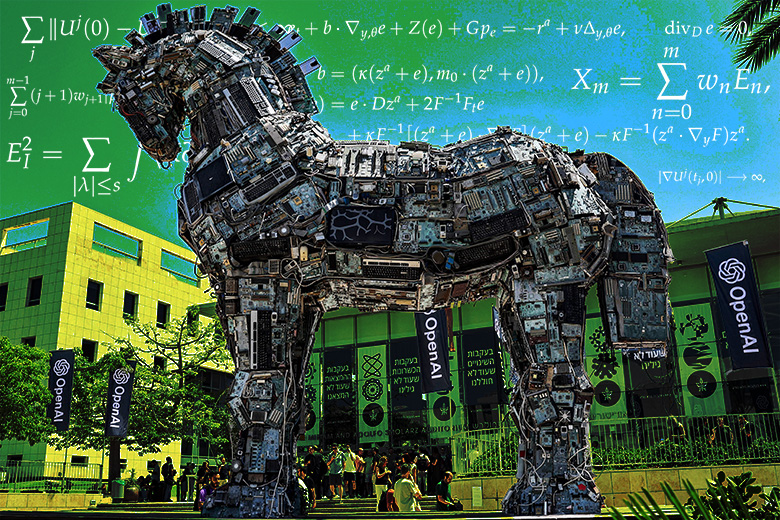
Ravi Vakil, the Robert Grimmett professor of mathematics at Stanford and president of the American Mathematics Society, dismisses the idea that Stanford mathematics has imperilled its own future by seeding the AI industry. He is, nevertheless, concerned about the involvement of AI in wider cultural shifts that are rebounding on science. “Developments in AI have been used as a Trojan horse for anti-intellectualism and a retreat from the ideals of the Enlightenment. In the US, the government has proposed cutting most of the funding of basic research, with AI bizarrely the pretext,” Vakil said, referencing the suggestion that AI will conduct research in future, removing the need to invest so much in human science.
“If we drastically cut jobs for young scientists for essentially short-sighted and often political reasons, we will pay a price as a society decades later in terms of discoveries forgone,” he added.
Vakil has become one of nine founding members of the Advisory Group on Mathematics and Artificial Intelligence, an independent body that was set up to work alongside OpenAI in response to the Fields medallists’ letter, giving mathematicians “a voice” in how the company “moves forward”.
Meanwhile, Sarah Soule, dean of Stanford’s Graduate School of Business, insists that within her school, “ethical responsibility and human reasoning form the core of our AI coursework”, describing the school’s mission as “equipping future leaders” with the goal of “aligning AI development with human flourishing”.
But not everyone is convinced that AI is aligning itself with human flourishing in its parent discipline. Former American Mathematical Society president Bryna Kra, a Stanford doctoral graduate who is now Sarah Rebecca Roland professor of mathematics at Northwestern University, feels “excited” about how AI could advance mathematical discovery, but she admits that many of her colleagues feel frustrated with “how the [AI] companies have acted”.
She agrees with Scott, the PhD student, that “there’s a misalignment between the incentives of the big companies and the incentives of the mathematics community. For the companies, they’re using [famous problems] as a proving ground to show, ‘we can do this hard thing…see how good our models are’”. This is effective as a marketing tool because “people tend to view maths as hard” – but mathematics is “just the first of the fields that is going to go through this,” Kra believes; she suggested that astrophysics, biology and others would be next.
Like the Fields medallists, she is also highly critical of the way AI companies have presented their mathematical breakthroughs. “If one of my students had written a paper like this, I would say, ‘Keep writing. Keep working. This is not understandable. You cannot release this at the moment.’”
On the other hand, mathematicians themselves have been “notoriously poor” at making their work understandable beyond their own field, Kra conceded, and she urged colleagues to use the current sense of crisis as a spur to improve their communication with the public.
“I think this is a great opportunity to sort of give up some of the things that perhaps were holding us back,” she said.
And although some mathematicians might continue to minimise their AI use, many others are excited about what they might be able to do with it.
“It’s a great research tool,” said Marc Lackenby, professor of mathematics at Oxford. And although he admitted that he tells his PhD students when they arrive that they’re “not allowed” to rely on AI, he is “quite optimistic” that the technology won’t put academic mathematicians out of a job.
“[AI] will change the way that we do research, the way that we value research, the way that we assess research, definitely – and I think there are a lot of questions to think about and tackle,” he said. “But I personally am optimistic about the effects of AI on the maths job market.”
Of course, academic mathematicians teach as well as research, and Stanford’s Vakil is certain that the demand for human instructors will endure, in mathematics as much as in other subjects, regardless of AI’s potential as an automated tutor.
“Those with the most social capital make sure their children have the most access to the best human teachers – even here in Silicon Valley,” he pointed out. “AI is an existential threat to universities and to human-to-human teaching only if we are unwise.”
But he has an important caveat: “I fear we are going to be unwise.”